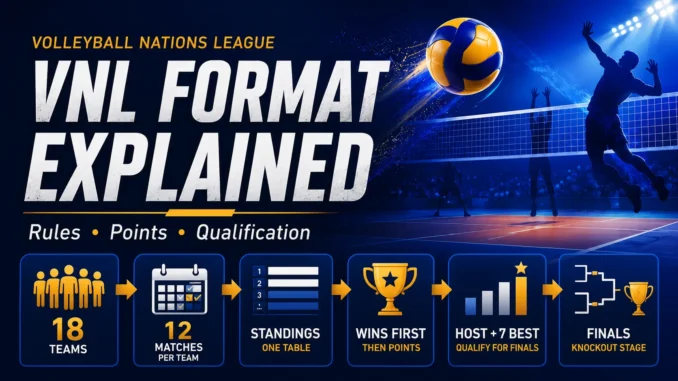

How the VNL works — from 12 Preliminary Phase matches to the gold medal — and how the competition format has evolved since 2018.
| UPDATED | July 2026 • Current 18-team format |
The Volleyball Nations League has used several different competition systems since its launch in 2018. The current format features 18 men’s and 18 women’s national teams, a three-week Preliminary Phase, a single standings table and an eight-team knockout Finals tournament.
Each team plays 12 preliminary matches, but not against every other participant. Results determine qualification for the Finals, tournament seeding and relegation, while the Finals host is guaranteed a place in the quarterfinals.
This guide explains the current VNL format, points system, tiebreakers, Finals bracket, promotion and relegation rules, prize money and the major format changes introduced between 2018 and 2026.
VNL Format at a Glance
| Category | Current format |
|---|---|
| Organiser | FIVB / Volleyball World |
| First edition | 2018 |
| Frequency | Annual |
| Competitions | Separate men’s and women’s tournaments |
| Teams per gender | 18 |
| Preliminary Phase | Three competition weeks |
| Matches per team | 12 |
| Preliminary Phase matches | 108 per gender |
| Total tournament matches | 116 per gender |
| Finals participants | Eight teams |
| Finals format | Single-elimination knockout tournament |
| Host qualification | Finals host receives a guaranteed berth |
| Relegation | Team finishing 18th in the Final Standings |
| Promotion | Highest-ranked eligible non-VNL team |
| 2026 women’s Finals | Macao, China — July 22–26 |
| 2026 men’s Finals | Ningbo, China — July 29–August 2 |
The official 2026 regulations confirm that each tournament contains 108 Preliminary Phase matches and eight Finals matches, producing 116 matches per gender.
What Is the Volleyball Nations League?
The Volleyball Nations League, commonly known as the VNL, is the leading annual FIVB competition for senior men’s and women’s national teams.
It was announced in 2017 as a joint project involving the FIVB, IMG and 21 national federations. The first edition was held in 2018, replacing the men’s FIVB World League and the women’s FIVB World Grand Prix with two tournaments operating under a unified commercial and competition structure.
The men’s and women’s competitions are organised separately but use the same general format. Their schedules typically cover the opening months of the international national-team season.
The VNL has taken place every year except 2020, when both tournaments were cancelled because of the COVID-19 pandemic. The competition returned in 2021 with all matches played inside a controlled bubble in Rimini, Italy.
How Does the Current VNL Format Work?
The VNL is divided into a three-week Preliminary Phase and an eight-team single-elimination Finals tournament. Each of the 18 national teams plays 12 preliminary matches, with results determining qualification, Finals seeding and relegation.
The current 18-team format was introduced in 2025 and retained for the 2026 season.
There are 18 participating teams in each gender. The competition is divided into two main stages:
1. The Preliminary Phase
2. The VNL Finals
The Preliminary Phase determines qualification, seeding and relegation. The Finals decide the medal positions and the VNL champion.
Preliminary Phase
Three Competition Weeks
Each national team plays 12 matches across three competition weeks, with four matches scheduled for each team during every week.
In each competition week, the 18 teams are distributed across three pools of six. Every pool is played at a different host venue.
A six-team pool does not operate as a complete round robin. Each team plays four matches during the week, meaning it does not necessarily face all five other teams at the same venue.
The current scheduling system divides the teams into three groups of six based on sporting strength and the FIVB World Ranking. Across its 12 preliminary matches, each team is scheduled to face four opponents from each ranking group. This is intended to create a more balanced level of opposition across the field.
One Unified Standings Table
Although the matches are played in separate pools and host cities, there are no independent pool standings used for qualification.
All results contribute to one combined 18-team standings table.
This means that teams playing in different countries during a competition week are still competing directly for:
- positions in the top eight;
- more favourable Finals seeding;
- protection from relegation;
- their final tournament ranking.
Because each team plays only 12 of the 17 possible opponents, the VNL uses a detailed ranking system to separate teams with similar records.
How Do Teams Qualify for the VNL Finals?
Eight teams participate in the VNL Finals.
The Finals host receives an automatic place. The remaining positions are filled by the highest-ranked eligible teams from the Preliminary Phase standings.
| Qualification rule: In practical terms, the Finals field normally consists of the host nation plus the seven highest-ranked remaining teams. |
If the host finishes inside the top eight on merit, the top eight teams in the table qualify and the host keeps its natural seeding.
If the host finishes outside the top eight, it replaces the team that would otherwise occupy the eighth qualifying position. The host enters the Finals as the eighth seed and faces the first-ranked team in the quarterfinals.
For the 2026 edition, China is the Finals host in both competitions:
- the Chinese women’s team is guaranteed a place in the Macao Finals;
- the Chinese men’s team is guaranteed a place in the Ningbo Finals.
VNL Finals Format
The VNL Finals use a direct single-elimination format.
There are eight matches in total:
- four quarterfinals;
- two semifinals;
- one bronze medal match;
- one gold medal match.
A team must win three consecutive matches to become champion.
Quarterfinal Pairings
| Quarterfinal | Matchup |
|---|---|
| Quarterfinal 1 | 1st-ranked team vs 8th-ranked team |
| Quarterfinal 2 | 2nd-ranked team vs 7th-ranked team |
| Quarterfinal 3 | 3rd-ranked team vs 6th-ranked team |
| Quarterfinal 4 | 4th-ranked team vs 5th-ranked team |
If the host qualifies automatically from outside the top eight, it takes the eighth-seed position and faces the Preliminary Phase winner.
The listed order of the quarterfinal matches can be changed to meet broadcasting requirements, but the bracket itself remains unchanged.
Semifinal Pairings
| Semifinal | Matchup |
|---|---|
| Semifinal 1 | Winner of Quarterfinal 1 vs Winner of Quarterfinal 4 |
| Semifinal 2 | Winner of Quarterfinal 2 vs Winner of Quarterfinal 3 |
The semifinal winners advance to the gold medal match. The losing semifinalists meet in the bronze medal match.
Teams eliminated in the quarterfinals are ranked from fifth to eighth under the official Teams Ranking System, which considers their results across the matches played up to that point.
VNL Points System
Match points are awarded during the Preliminary Phase as follows:
| Match result | Winner | Loser |
|---|---|---|
| 3–0 or 3–1 | 3 points | 0 points |
| 3–2 | 2 points | 1 point |
A straight-set or four-set victory is therefore worth more than a five-set victory.
The losing team receives no match points after a 3–0 or 3–1 defeat, but earns one point if it takes the match to a fifth set.
| Important: Match points are not the first ranking criterion. The total number of victories is considered before match points. |
VNL Tiebreakers and Ranking Criteria
The first criterion used to rank teams is the number of victories, not the number of match points.
The official order is:
1. Total number of victories
2. Match points
3. Set ratio
4. Point ratio
5. Results between the tied teams
6. FIVB World Ranking, when the tied teams did not play each other
1. Total Victories
The team with more matches won is ranked higher. This means that a team with more match points can still be placed below another team if it has fewer victories.
2. Match Points
If two or more teams have the same number of victories, the team with more match points is ranked higher.
3. Set Ratio
If the tie remains, the set ratio is calculated: Sets won ÷ sets lost. The team with the higher ratio is ranked above the others.
4. Point Ratio
If the teams are still tied, the point ratio is used: Total points scored ÷ total points conceded. Again, the higher ratio produces the better ranking.
5. Results Between Tied Teams
For a two-team tie that remains unresolved, the result of their direct Preliminary Phase match is considered. When three or more teams remain tied, results from matches involving only those tied teams are used to separate them.
6. FIVB World Ranking
Because the VNL schedule does not require every team to play every other participant, tied teams may not have met during the Preliminary Phase. If the previous criteria cannot settle the tie because the relevant teams did not play each other, their positions are determined by the FIVB World Ranking.
How Promotion and Relegation Work
The current promotion and relegation system was introduced with the expanded 18-team format.
At the end of the tournament, the team placed 18th in the official Final Standings is relegated from the VNL.
Its position in the following season is awarded to the highest-ranked national team in the FIVB World Ranking that:
- did not participate in that VNL edition;
- is eligible to enter the following edition;
- accepts and confirms its participation.
The relegated team cannot immediately reclaim its place by also being treated as the highest-ranked non-participating team.
First Promotion Cycle Under the New System
The 2025 season produced the first relegated and promoted teams under the revised system.
In the men’s competition:
- the Netherlands finished last and were relegated;
- Belgium qualified for the 2026 VNL as the highest-ranked eligible non-participant.
In the women’s competition:
- Korea finished last and were relegated;
- Ukraine earned promotion and made their women’s VNL debut in 2026.
Belgium’s men and Ukraine’s women both entered the competition for the first time in 2026.
VNL 2026 Prize Money
The official 2026 competition regulations establish identical prize structures for the men’s and women’s tournaments.
| Season-specific amounts: The amounts below apply to the 2026 edition and may be changed in future competition regulations. |
Preliminary Phase Match Payments
National federations receive prize money after every Preliminary Phase match.
| Result | Prize per team |
|---|---|
| Winning team | $9,500 |
| Losing team | $4,250 |
| Total paid per match | $13,750 |
These payments are awarded regardless of whether a team eventually qualifies for the Finals.
Finals Placement Prize Money
| Final position | Prize |
|---|---|
| Champion | $1,000,000 |
| Runner-up | $500,000 |
| Third place | $300,000 |
| Fourth place | $180,000 |
| Fifth place | $130,000 |
| Sixth place | $85,000 |
| Seventh place | $65,000 |
| Eighth place | $40,000 |
The total Finals placement prize fund is $2.3 million per gender.
VNL Individual Awards
The 2026 regulations divide individual awards into Preliminary Phase statistical awards and the Finals MVP award.
Preliminary Phase Statistical Awards
Seven statistical leaders receive $10,000 each:
| Award | Prize |
|---|---|
| Best Scorer | $10,000 |
| Best Attacker | $10,000 |
| Best Blocker | $10,000 |
| Best Server | $10,000 |
| Best Setter | $10,000 |
| Best Digger | $10,000 |
| Best Receiver | $10,000 |
These awards are determined from the official competition statistics at the end of the Preliminary Phase.
Most Valuable Player
The VNL MVP receives $30,000.
Under the 2026 regulations, the MVP is selected from the players participating in the gold medal match. The decision is made through a combined voting process involving fans and designated volleyball experts.
For a season-by-season overview of the award, see our complete list of VNL MVP winners.
How the VNL Format Has Changed
The VNL has gone through three main structural eras:
| Period | Main format |
|---|---|
| 2018–2021 | 16 teams with core and challenger status |
| 2022–2024 | 16 teams, 12 preliminary matches and Final 8 |
| 2025–present | 18 teams with open promotion and relegation |
2018 — The First VNL Edition
The inaugural VNL featured 16 teams in each gender.
The participants were divided into 12 core teams and four challenger teams.
Core teams were protected from relegation, while challenger teams could lose their place in the competition.
The Preliminary Phase lasted five competition weeks. The top five teams and the Finals host advanced to a six-team final tournament.
The finalists were divided into two groups of three. The best two teams from each group progressed to the semifinals, followed by the bronze and gold medal matches.
Russia won the first men’s title, while the United States became the first women’s VNL champions.
2019 — The Original Format Continues
The second edition retained the same 16-team, five-week structure and Final Six tournament.
Russia successfully defended the men’s title. The United States also retained the women’s championship.
The Challenger Cup continued to serve as the main pathway into the VNL for national teams outside the competition.
2020 — Tournament Cancelled
The entire 2020 VNL season was cancelled because the COVID-19 pandemic made it impossible to organise a multi-country international tournament safely.
Teams that had earned qualification through the 2019 Challenger Cup retained their places for the next edition.
2021 — The Rimini Bubble
The VNL returned in 2021 under a unique single-venue format.
All 16 men’s and 16 women’s teams played inside a secure bubble at the Rimini Fiera complex in Italy. Instead of travelling between host cities, every team remained at the same location throughout the tournament.
Each team played the other 15 participants in a complete round robin.
The Final Six was temporarily replaced by a Final Four: the top four teams advanced; the first-ranked team played the fourth; the second-ranked team played the third; and the winners progressed to the final.
Brazil won their first men’s VNL title, while the United States completed a run of three consecutive women’s championships.
2022 — The Final 8 Era Begins
The VNL was significantly redesigned in 2022.
The competition still featured 16 teams, but each participant now played only 12 Preliminary Phase matches across three competition weeks.
The separate Final Six group stage was removed. The top eight teams advanced directly to a single-elimination tournament containing quarterfinals, semifinals and medal matches.
France won the men’s title, while Italy became women’s champion.
2023 — Format Remains Stable
The 2023 edition retained the 16-team system introduced the previous year: 12 matches per team, three competition weeks, one combined standings table and eight-team knockout Finals.
Poland won their first men’s VNL title. Türkiye won their first women’s championship.
2024 — Final Season With 16 Teams
The 2024 VNL was the last edition with 16 participating teams.
No team was relegated at the end of the season because the tournament was preparing to expand to 18 teams in 2025.
France won the men’s title for the second time. Italy collected their second women’s championship.
2025 — Expansion to 18 Teams
The 2025 season introduced the largest permanent reform in VNL history.
The number of teams increased from 16 to 18 in both tournaments. The distinction between core and challenger teams was removed, meaning every participant became subject to the same sporting rules.
The new format introduced 18 teams per gender, three pools of six in every competition week, three host venues per week, 12 matches per team, 108 Preliminary Phase matches, eight Finals matches, direct relegation for the last-placed team and promotion through the FIVB World Ranking.
Poland won the 2025 men’s championship, while Italy successfully defended the women’s title.
2026 — The Expanded Format Continues
The 2026 VNL retains the 18-team system used in 2025.
It is the first edition to include teams promoted through the new World Ranking pathway following an actual season of relegation: Belgium replaced the Netherlands in the men’s tournament, while Ukraine replaced Korea in the women’s tournament.
The 2026 Preliminary Phase takes the competition to 17 host cities across 12 countries and five continents.
The women’s Finals will be played in Macao from July 22 to 26. The men’s Finals will follow in Ningbo from July 29 to August 2. The 2026 champions had not yet been decided when this article was last updated.
What Happened to the Volleyball Challenger Cup?
The Volleyball Challenger Cup was introduced alongside the VNL as a qualification route for national teams outside the main competition.
Under the former system, the Challenger Cup winner could earn promotion to the following VNL edition and replace a relegated challenger team.
The pathway helped teams such as Slovenia, Cuba, Türkiye, China and Czechia reach the VNL.
The 2024 Challenger Cup was the final edition used to determine new VNL participants. After the competition expanded in 2025, qualification shifted to the FIVB World Ranking and the core-versus-challenger distinction was abolished.
Where Can Fans Watch the VNL?
VNL matches are available live and on demand through VBTV, Volleyball World’s official streaming platform.
Broadcast availability may also include national television channels and local media partners, depending on the participating country and host market.
Frequently Asked Questions
How many teams compete in the VNL?
Since 2025, the men’s and women’s VNL tournaments have each featured 18 national teams. Between 2018 and 2024, each competition contained 16 teams.
How many matches does each team play?
Every team plays 12 Preliminary Phase matches across three competition weeks. Teams that qualify for the Finals can play up to three additional matches: a quarterfinal, semifinal and medal match.
Does every VNL team play every other team?
No. With 18 participants and only 12 matches per team, a complete round robin is not possible. The schedule is designed to give teams a balanced selection of opponents based partly on sporting strength and the FIVB World Ranking.
How many matches are played in the entire VNL?
Each gender’s tournament contains 116 matches: 108 Preliminary Phase matches and eight Finals matches.
Is the VNL standings table based on match points?
Match points are important, but victories are the first ranking criterion. A team with more wins is ranked higher before match points are compared.
How do teams qualify for the Finals?
The Finals host qualifies automatically. The seven highest-ranked remaining teams from the Preliminary Phase complete the eight-team field.
What happens if the host finishes outside the top eight?
The host still qualifies and is placed in the eighth-seed position. The team that would otherwise have taken the final qualifying place is eliminated.
How does VNL relegation work?
The team finishing last in the official Final Standings is relegated. Its place is awarded to the highest-ranked eligible national team that did not participate in that VNL edition.
How much does the VNL champion receive?
Under the 2026 competition regulations, the champion receives $1 million. The same amount is available in both the men’s and women’s tournaments.
Where are the VNL 2026 Finals?
The women’s Finals are scheduled for Macao, China, from July 22 to 26. The men’s Finals will be held in Ningbo, China, from July 29 to August 2.
Quick Summary
- The VNL currently features 18 men’s and 18 women’s national teams.
- Each team plays 12 Preliminary Phase matches over three competition weeks.
- All results contribute to one combined standings table.
- Teams are ranked first by victories and then by match points.
- The Finals host is guaranteed a quarterfinal place.
- The Finals contain eight teams and use a single-elimination bracket.
- The last-ranked team is relegated.
- The highest-ranked eligible non-VNL team is promoted.
- Each tournament contains 116 matches.
- The 2026 champion receives $1 million.
- The current 18-team format was introduced in 2025.


1 Trackback / Pingback