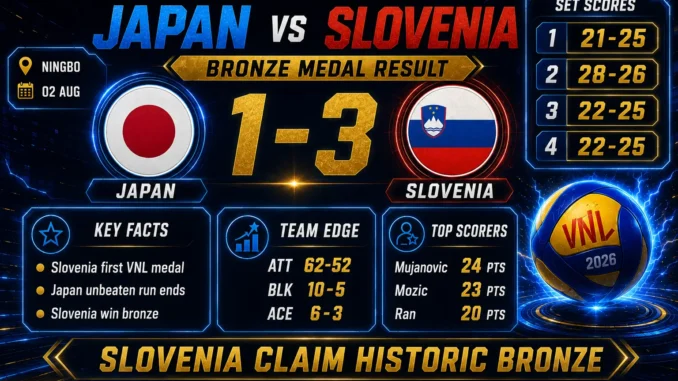

Mujanovic and Mozic combined for 47 points as Slovenia won the bronze medal match 3-1, while Japan’s previously unbeaten campaign ended with consecutive defeats and fourth place.
Slovenia made history in Ningbo by defeating nominal hosts Japan 3-1 in the Men’s VNL 2026 bronze medal match. Fabio Soli’s team won 25-21, 26-28, 25-22 and 25-22 to secure the first Volleyball Nations League medal in the country’s history.
The result created two sharply different endings. Slovenia finally converted repeated Final Four appearances into a place on the podium. Japan, meanwhile, arrived in the semifinals without a defeat but lost twice in the medal rounds and finished fourth.
Match Details
| Match | Japan vs Slovenia |
| Result | Japan 1-3 Slovenia |
| Set scores | 21-25, 28-26, 22-25, 22-25 |
| Stage | Men’s VNL 2026 bronze medal match (places 3-4) |
| Date | 2 August 2026 |
| Venue | Ningbo Beilun Sports and Arts Centre, Ningbo Beilun, China |
| Match time | 15:40-17:57 local time |
| Duration | 2 hours 17 minutes total; 2 hours of playing time |
| Spectators | 5,389 |
Slovenia Turn Years of Near-Misses into History
Slovenia entered the final day carrying the weight of several previous near-misses at the VNL Finals. They had reached the medal stage before, but the podium had always remained one match away. This time, they responded to a heavy semifinal defeat against Poland with their most important victory of the tournament.
The bronze was not secured through one isolated run or a Japanese collapse. Slovenia led the match in attack, block and serve, and their two main wing scorers delivered under pressure. The performance was strong enough to end the country’s wait for a VNL medal on merit rather than emotion alone.
First Set: Mujanovic Creates the First Real Separation
The opening set remained almost perfectly balanced through 18-18. The teams repeatedly exchanged the lead, and neither side built an advantage of more than one point.
The first decisive separation came in the closing phase. Kai served out to give Slovenia a 19-18 lead, before Nik Mujanovic helped produce the next point on Slovenia’s serve for 20-18. From there, Slovenia protected the advantage and won the final seven points of the set by a 7-3 margin to close it 25-21.
Slovenia’s serving pressure had been visible throughout the set. They finished the opener with four aces to Japan’s zero, while Mujanovic scored seven points and Rok Mozic added five.
Second Set: Ran Wins a Marathon to Keep Japan Alive
Japan responded immediately, leading 5-2 and 9-5. Slovenia recovered to 11-11, but Japan moved away again from 13-13 to 16-13 and later led 18-15.
The set changed again at 20-18. Jan Kozamernik scored in attack, Ran Takahashi made an error, and Slovenia then blocked Ran to move ahead 21-20. What followed was a tense exchange of side-outs and missed opportunities.
Slovenia led 23-22 but could not create separation. A Mujanovic attacking error handed Japan a set point at 24-23, before service errors by Nishida, Mozic and Otsuka kept the set alive. At 26-25, Slovenia again had an opportunity to turn defence into a break point, but Mujanovic could not finish.
Japan finally moved ahead 27-26 on their second attacking attempt. In the last rally, Tine Urnaut twice kept Slovenia alive with block touches, but Japan retained the initiative and Ran powered the final ball to the floor for a 28-26 win.
Third Set: Stalekar’s Blocks Restore Slovenian Control
The third set was level until Japan led 9-8. Mujanovic restored parity with a side-out, before Alen Stalekar produced two consecutive blocks. A Planinsic ace and a Mujanovic kill at the end of a long rally completed a 5-0 Slovenian run and made the score 13-9.
Japan gradually erased the deficit and reached 16-16, but Slovenia remained the more productive attacking team. With the score 19-18, they won the next two points on serve to create another three-point advantage at 21-18. This time Japan could not complete a second comeback, and Slovenia closed the set 25-22.
The numbers reflected the difference: Slovenia led 16-11 in attack points and 4-3 in blocks in the third set. Mujanovic scored seven points in the period, while Stalekar’s three block points changed the rhythm around the net.
Fourth Set: Japan Change the Lineup, Slovenia Change the Ending
Laurent Tillie reshaped Japan’s starting lineup for the fourth set. Kento Miyaura replaced Nishida at opposite, Tatsunori Otsuka started instead of Yuki Ishikawa, and Japan initially received the reaction they needed.
Japan moved ahead 3-1 and 7-3. Slovenia began their recovery at 8-4, closed to 8-7 and levelled at 11-11. When Slovenia took a 13-12 lead, the direction of the set changed for good.
Soli’s team gradually took control, reached 19-15 and did not offer Japan another serious route back. Mujanovic scored eight points in the set, all in attack, and Slovenia won 25-22 to complete the historic result.
The fourth set was decided by attack rather than serve. Slovenia recorded no aces and made five service errors, but still led 17-12 in attack points.
Why Slovenia Won
Japan collected ten more points from Slovenian errors, but Slovenia created a much larger volume of points through their own skills. That difference separated the teams over four sets.
| Category | Japan | Slovenia |
| Attack points | 52 | 62 |
| Block points | 5 | 10 |
| Aces | 3 | 6 |
| Points from opponent errors | 33 | 23 |
| Total points | 93 | 101 |
| Points through attack, block and serve | 60 | 78 |
Slovenia scored 78 points through attack, block and serve, compared with Japan’s 60. Japan stayed in the match through defence, extended rallies and Slovenian mistakes, but the direct scoring gap was too large.
Mujanovic and Mozic Carry the Attack
Mujanovic led the match with 24 points: 21 in attack, two on the block and one ace. He was especially important in the first-set finish and then scored eight attack points in the fourth set.
Mozic finished one point behind with 23, including 21 attacks and two aces. Together, Slovenia’s opposite and outside hitter produced 47 points and gave the team a reliable answer whenever rallies became physical or the set moved into its decisive phase.
The support through the middle was equally important. Kozamernik scored 10 points, while Stalekar contributed seven, including four blocks. Slovenia’s 10-5 advantage in block points prevented Japan from relying only on speed and defensive recycling.
Ran Leads Japan, but the Main Rotation Loses Stability
Ran was Japan’s leading scorer with 20 points, including 19 attacks and one ace. He carried a large attacking load, won the dramatic second set and remained Japan’s most consistent source of points.
Nishida scored 10 and Otsuka added nine, but Ishikawa finished with only two points and was removed from the starting lineup for the fourth set. Japan’s changes produced a strong opening to the final period, yet the team could not maintain the required attacking level once Slovenia recovered.
Japan’s Unbeaten Run Ends in Fourth Place
For Japan, the final weekend produced one of the most painful outcomes possible. They reached the semifinals without losing a match and had looked capable of completing an extraordinary campaign.
A five-set semifinal defeat to USA ended the unbeaten run. Less than a day later, the loss to Slovenia left Japan outside the medals altogether. A team that had controlled the tournament for weeks finished fourth after two defeats in the only matches that directly decided the podium.
What the Result Means
Slovenia leave Ningbo with the first Men’s VNL medal in their history. The bronze validates the team’s sustained presence among the competition’s leading sides and changes the meaning of their previous Final Four near-misses.
Japan finish fourth despite entering the medal stage unbeaten. Their run still demonstrated exceptional depth, speed and resilience, but the tournament will be remembered for how quickly an unbeaten campaign turned into two defeats and no medal.
Top Scorers
| Player | Team | Points | Breakdown |
| Nik Mujanovic | Slovenia | 24 | 21 attack, 2 block, 1 ace |
| Rok Mozic | Slovenia | 23 | 21 attack, 2 aces |
| Ran Takahashi | Japan | 20 | 19 attack, 1 ace |
| Yuji Nishida | Japan | 10 | 9 attack, 1 block |
| Jan Kozamernik | Slovenia | 10 | 8 attack, 2 blocks |
| Tatsunori Otsuka | Japan | 9 | 8 attack, 1 ace |
| Tine Urnaut | Slovenia | 9 | 9 attack |
Quick Summary
- Slovenia defeated nominal hosts Japan 3-1 to win the Men’s VNL 2026 bronze medal.
- Set scores: 25-21, 26-28, 25-22 and 25-22 from Slovenia’s perspective.
- The medal is the first in Slovenia’s VNL history.
- Mujanovic scored 24 points and Mozic added 23.
- Slovenia led 62-52 in attack, 10-5 in blocks and 6-3 in aces.
- Ran led Japan with 20 points and finished the dramatic second set.
- Japan entered the semifinals unbeaten but finished fourth after consecutive losses to USA and Slovenia.
Slovenia’s first VNL medal also became one of the stories that stayed with me after the tournament. I share more thoughts on Slovenia’s changing generation, Japan’s campaign and other teams in my fan perspective on Men’s VNL 2026
FAQ
Who won the Japan vs Slovenia VNL 2026 bronze medal match?
Slovenia defeated Japan 3-1 and won the bronze medal.
What were the set scores?
Slovenia won 25-21, 26-28, 25-22 and 25-22.
Was this Slovenia’s first VNL medal?
Yes. The bronze in Ningbo was the first Volleyball Nations League medal in Slovenia’s history.
Who was the top scorer?
Nik Mujanovic led all scorers with 24 points. Rok Mozic added 23 for Slovenia, while Ran Takahashi led Japan with 20.
What was the key statistical difference?
Slovenia led Japan 62-52 in attack points, 10-5 in block points and 6-3 in aces.
Why did Japan finish fourth after an unbeaten start?
Japan reached the semifinals without a defeat, but lost the semifinal to USA in five sets and then lost the bronze medal match to Slovenia.



Be the first to comment