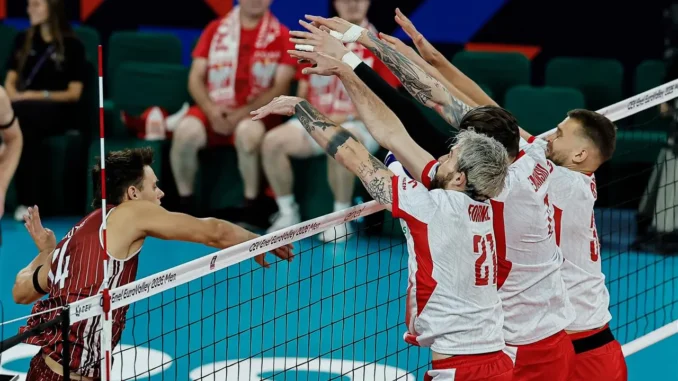

The middle blocker is volleyball’s central net specialist – responsible for reading the setter, closing blocks across the net and running fast first-tempo attacks. This guide explains the role in detail, including skills, tactics, physical demands and original VNL 2026 height data.
EVERGREEN GUIDE | Updated September 2026
The middle blocker is one of the most physically demanding and tactically complex roles in volleyball. Positioned primarily around the center of the net, the middle must read the opposing setter, move quickly between attacking lanes, form blocks against hitters on both sides of the court and immediately transition into a fast attacking option.
Height certainly helps. But being tall alone does not make an effective middle blocker.
At higher levels, the best middles combine reach, explosive jumping, lateral speed, timing and an ability to read the game in fractions of a second. Their influence also goes beyond recorded blocks and kills: a dangerous middle can change where the opposing setter sends the ball and can create better attacking situations for teammates simply by remaining a credible first-tempo threat.
This guide explains what a middle blocker does, where the role operates, how tall elite middles actually are, which physical characteristics and skills matter most, and what developing players can work on to improve.
Quick Answer: What Is a Middle Blocker in Volleyball?
A middle blocker (MB) is a volleyball player who specializes in blocking attacks near the center of the net and attacking fast sets close to the setter.
- reads the opposing setter and attackers;
- blocks in the middle and moves toward both antennas;
- helps form double or triple blocks;
- attacks quick first-tempo sets;
- creates space for wing attackers by holding the opposing middle blocker;
- serves when rotating into the back row;
- is commonly replaced by the libero for back-row play.
Middle blockers are typically among the tallest players at elite level, but there is no minimum height required by the volleyball rules.
Is Middle Blocker a Position or a Role?
Technically, middle blocker is a tactical role rather than one of volleyball’s six numbered rotational positions. The FIVB rules define positions 1 through 6 and distinguish between front-row and back-row players; terms such as middle blocker, outside hitter and opposite describe how teams specialize players within that rotational structure.
In a standard system, a middle blocker commonly operates around Position 3 while in the front row. Once the rally begins, however, the middle does not remain in the center. The player may move toward Position 4 to help block an outside hitter, remain in the middle against a quick attack, or move toward Position 2 against an opposite.
Under the FIVB rules, a back-row player who completes or participates in a completed block commits a blocking fault. That is why the middle blocker’s main blocking work is associated with the front row.
For a complete explanation of numbered court positions, rotations and specialized roles, see our Volleyball Positions Explained guide.
What Does a Middle Blocker Do?
The role has two primary responsibilities:
- Control the net defensively through blocking.
- Provide a fast attacking threat through the middle.
Those responsibilities are closely connected. A good middle blocker can reduce the attacking options available to the opposing setter. At the same time, a dangerous middle attacker forces the opposing blocker to respect the center of the net, which can create one-on-one situations for outside and opposite hitters.
This is why evaluating a middle blocker only by kills and block points misses much of the role. A middle can influence a rally without touching the ball.
Blocking: The Core Responsibility
Blocking is the skill most closely associated with the middle blocker. Because the middle starts near the center of the net, the player is often responsible for helping close blocks against attacks from several locations.
An opposing setter may send the ball to the outside hitter, the opposite, a middle running a quick attack, behind the setter, or into a combination designed specifically to move the blockers. The middle therefore cannot simply follow the ball. The player has to read the developing attack.
How Does a Middle Blocker Read the Setter?
Experienced middles collect information before the set is released. Useful clues include:
- the quality and location of the reception;
- where the setter reaches the ball;
- which attackers are available;
- the opposing middle’s approach;
- setter tendencies and previous patterns;
- attacker approach timing.
A perfect pass can leave the setter with several realistic options. A poor pass may remove the quick attack or make certain sets much less likely. The middle’s job is not to guess blindly, but to reduce uncertainty quickly enough to arrive at the most likely attacking point.
At elite speed, a fraction of a second can determine whether the middle forms a strong double block or arrives too late.
Moving Along the Net
Middle blockers need excellent lateral movement. After recognizing where the attack is going, the middle may have only a short time to travel from the center toward an antenna.
Simply reaching the attacker is not enough. The middle has to arrive in the correct relationship with the outside blocker. Too much space between the two blockers creates a seam that an attacker can exploit.
Good middle-blocker footwork combines speed, balance, an efficient first movement, correct distance from the net, controlled stopping and a vertical take-off. Depending on the situation, players may use shuffle, crossover or swing-block footwork.
The goal is not to move as fast as possible at any cost. The goal is to arrive on time and under control.
Middle Blocker Attacking
Blocking is only half of the role. Middle blockers are also important offensive players and primarily attack quick or first-tempo sets close to the setter.
Unlike a high outside set, where an attacker can see the ball travel before completing the approach, the middle often begins the attacking action before the setter releases the ball. This requires precise coordination.
What Is a Quick Attack?
A quick attack is a fast set designed to allow the middle attacker to contact the ball shortly after it leaves the setter’s hands. The middle may already be jumping, or very close to take-off, when the set is made.
The speed creates two advantages. First, the attack itself can be difficult to block. Second, the opposing middle blocker has to respect the possibility of the quick set. Even when the middle does not receive the ball, that threat can delay the opposing blocker and create more space for an outside or opposite hitter.
Common Middle Attacks
Terminology varies between teams and countries, but common middle attacking patterns include:
- quick attacks directly in front of the setter;
- quick sets slightly away from the setter;
- attacks behind the setter;
- slides;
- crossing routes and combination plays;
- different first-tempo variations designed to manipulate the opposing block.
The slide attack is particularly visible in women’s volleyball, where the middle approaches behind the setter and often takes off from one foot. Whatever terminology a team uses, setter-middle timing is critical.
For definitions of common volleyball terminology, see our Volleyball Terms A-Z: 60 Essential Definitions guide.
Why the Setter-Middle Connection Matters
Few attacking combinations depend more heavily on timing. The ball travels only a short distance on a quick set, leaving very little time for correction.
The setter needs to know where the middle will be, while the middle needs to trust the height, tempo and location of the set. This connection develops through repetition. As the partnership improves, setters and middles learn how to maintain an attacking threat even when the first contact is not perfect.
Physical Profile of an Elite Middle Blocker
Height is a major advantage for a middle blocker, but it is only one part of the physical profile. Important characteristics include:
- height;
- standing reach;
- arm length;
- block reach;
- spike reach;
- vertical explosiveness;
- lateral speed;
- acceleration;
- coordination;
- repeated-jump ability;
- core stability.
A player’s listed height does not tell us exactly how high that player can block or attack. Two athletes who are both 200 cm tall may have different arm lengths, standing reaches and vertical jumps. That is why playing height matters more than body height alone.
How Tall Are Elite Middle Blockers? VNL 2026 Data
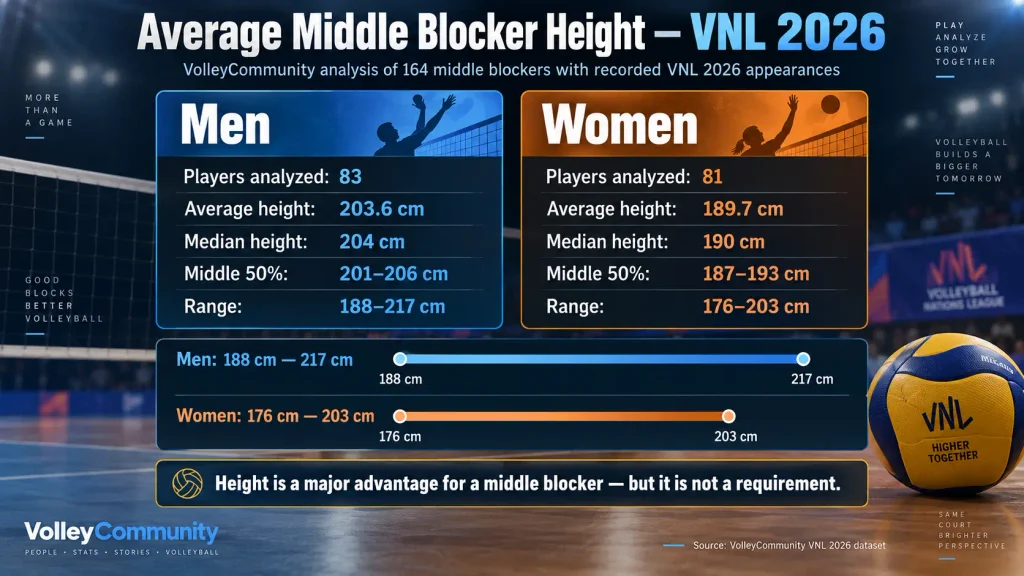
To get a clearer picture of the position, VolleyCommunity analyzed the listed heights of middle blockers with recorded appearances in the 2026 Volleyball Nations League. Our cleaned dataset contains 164 middle blockers – 83 men and 81 women.
| Measurement | Men’s Middle Blockers | Women’s Middle Blockers |
|---|---|---|
| Players analyzed | 83 | 81 |
| Average height | 203.6 cm | 189.7 cm |
| Median height | 204 cm | 190 cm |
| 25th percentile | 201 cm | 187 cm |
| 75th percentile | 206 cm | 193 cm |
| Middle 50% | 201-206 cm | 187-193 cm |
| Shortest in dataset | 188 cm | 176 cm |
| Tallest in dataset | 217 cm | 203 cm |
Source: VolleyCommunity analysis of Volleyball World VNL 2026 player listings, individual profiles and tournament participation data.
The median is especially useful. Rather than focusing on unusually short or tall players, it shows where the center of the elite population sits.
For the men’s competition, the median middle blocker in our dataset was 204 cm. For the women’s competition, it was 190 cm. The middle 50% of players were between 201 and 206 cm for men and between 187 and 193 cm for women.
These figures describe elite international volleyball. They are not minimum or recommended heights for playing middle blocker.
How Wide Is the Height Range?
Much wider than the averages suggest.
Japan’s Keigo Nishimoto was listed by Volleyball World as a 188 cm middle blocker and recorded appearances in VNL 2026. At the other end of the men’s dataset, Poland’s Bartlomiej Lemanski was listed at 217 cm. That is a 29 cm difference between two international middle blockers in the same VNL season.
The women’s range was similarly striking. Japan’s Maki Yamaguchi was listed at 176 cm, while USA middle Dana Rettke was 203 cm – a 27 cm difference.
The lesson is not that height is irrelevant. The lesson is that a typical physical profile and a requirement are two different things.
Height vs Standing Reach vs Block Reach
Height: The player’s standing body height.
Standing reach: The highest point the athlete can touch while standing with one arm extended. Players of identical height can have different standing reaches because of arm length and body proportions.
Block reach: The maximum height the player’s hands reach during a blocking jump.
Spike reach: The maximum contact height achieved during an attacking approach.
Vertical jump: The difference between standing reach and jumping reach.
These measurements explain why a shorter player can sometimes play higher above the net than a taller player. A 198 cm middle with long arms and excellent jumping ability may have a more effective playing reach than a 202 cm player with a lower vertical jump.
Does a Taller Middle Blocker Get More Blocks?
Not automatically. The VNL 2026 statistics provide useful examples.
Canada’s Jackson Howe, listed at 198 cm, recorded 45 block points. Poland’s 217 cm Bartlomiej Lemanski recorded 38. Both totals are strong, but the contrast shows why listed height alone cannot explain blocking production.
The women’s competition offers the same lesson. Brazil’s Julia Kudiess, listed at 192 cm, recorded 42 block points, while Czechia’s Ela Koulisiani, listed at 188 cm, recorded 37.
This does not prove that height is unimportant. Blocking totals are influenced by playing time, number of sets, blocking opportunities, opponents, team tactics, reading ability, footwork, hand positioning and timing.
Height is a major physical advantage for a middle blocker, but it is neither a requirement nor a standalone predictor of blocking performance.
Men’s vs Women’s Middle Blocker Profiles
The tactical responsibilities are fundamentally similar. Both men’s and women’s middles must control the center of the net, read the setter, move toward both antennas, provide quick attacks and transition rapidly between blocking and attacking.
The physical distributions differ. In our VNL 2026 dataset, the average men’s middle was approximately 14 cm taller than the average women’s middle. But within each competition there was still substantial variation.
That is another reason to avoid statements such as “a middle blocker must be at least 200 cm.” For elite men’s volleyball, 200 cm is common. It is not a rule.
Key Skills for a Middle Blocker
Blocking technique. Effective blocking requires correct starting position, efficient footwork, timing, hand position, penetration over the net, body control and coordination with the wing blocker. A high jump with poor hand positioning can still produce an ineffective block.
Reading ability. The middle processes information continuously: where the reception went, whether the setter can run the middle, which hitters are available and what patterns the setter has shown. Reading improves through experience, video analysis and repetition.
Lateral speed. Middles repeatedly travel from the center toward either antenna. The ability to cover this distance quickly while remaining balanced is essential.
Explosive jumping. Middle blockers may have to block, land, transition, attack and prepare to block again within seconds. Repeated explosiveness is more useful than one isolated maximum jump.
Quick-attack timing. The middle cannot wait until the set is clearly visible before beginning the approach. Good first-tempo attacking depends on timing with the setter.
Transition footwork. After blocking, the middle needs to create enough distance from the net to attack again. Standing and watching after landing wastes valuable time.
Serving. Middle blockers still need to serve. Their service turn can create pressure and shape the next blocking situation.
Communication. Blocking is a team action. The middle communicates assignments, tendencies and adjustments with wing blockers and back-row defenders.
Why Does the Libero Replace the Middle Blocker?
One of the most common patterns in modern volleyball occurs when the middle blocker rotates into the back row and a libero replaces them. This is a tactical choice rather than a rule requiring the middle to leave.
The reasoning is straightforward: the middle blocker is selected primarily for blocking and quick attacking, while the libero specializes in reception and back-row defense. Using both specialists where their skills provide the greatest value improves the team’s overall structure.
Under the current FIVB rules, the libero may replace any player in a back-row position. The libero may not complete a block or attempt to block.
Does a Middle Blocker Serve?
Yes. Being a middle blocker does not remove the player’s right to serve. A middle commonly rotates from the front row into Position 1 and serves before later being replaced by the libero. The exact timing depends on team tactics and competition regulations.
For developing players, serving should therefore remain an important skill.
Does a Middle Blocker Play Back-Row Defense?
They can. Nothing about the middle-blocker role automatically prevents back-row defense. At elite level, however, teams normally have a better defensive specialist available in the libero.
At youth or amateur levels, middles may spend much more time playing all six rotations. That can be valuable for development because players continue improving defense, ball control and serving instead of becoming narrowly specialized too early.
What Makes a Great Middle Blocker?
Reach + speed + timing + reading + technique + decision-making.
Consider two players. The taller player may have a greater theoretical blocking reach. But if that player reacts late, takes inefficient steps and arrives with poor hand position, the advantage can disappear.
A slightly shorter player who identifies the set earlier and closes the block correctly may be much more effective. Physical qualities create possibilities; technical and tactical qualities determine how effectively those possibilities are used.
Tips for Young Middle Blockers
Do not train only your vertical jump. Jumping ability matters, but a higher jump cannot fix bad positioning. Footwork and timing should develop alongside explosiveness.
Learn to watch more than the ball. Beginners naturally follow the ball. A middle needs to see the broader picture: pass -> setter -> attackers -> set. The earlier useful information is recognized, the more time the blocker has to react.
Improve lateral footwork. Practice getting from the center toward both antennas efficiently. The goal is not just to arrive, but to arrive balanced and ready to jump vertically.
Develop your setter connection. Repeat quick attacks at different tempos and from slightly different starting positions. A middle who remains available after imperfect passes makes the entire offense harder to defend.
Make block-to-attack transition automatic. After landing from a block, immediately prepare for the next offensive action. Do not stand under the net watching the ball.
Practice serving. Do not ignore serving because a libero usually replaces you later in the rotation. A strong serve can create the exact predictable attacking situation your blocking unit wants.
Study elite middles before they jump. Watch starting position, eye movement, first step, distance from the net, movement toward the wing blocker, timing, hands, landing and transition. Much of elite middle-blocker play happens before the visible highlight.
Common Middle Blocker Mistakes
Watching only the ball. This usually makes the player react too late. The setter and attackers provide information before the ball changes direction.
Committing too early. Opposing middles can use their approach to hold the blocker. Jumping automatically on every quick-attack movement can leave the outside or opposite with a weak block.
Moving sideways in the air. A middle should ideally complete the lateral movement before take-off. Drifting can create seams and increase the risk of net contact.
Arriving near the outside blocker but not closing. Being present is not the same as forming a block. Even a small gap between hands can become a target for an elite attacker.
Forgetting the transition. The rally continues after the block attempt. Landing is immediately followed by the next decision.
Depending on height. Height can forgive some errors at lower levels. It cannot replace reading, positioning and technique against elite attackers.
Middle Blocker vs Other Volleyball Positions
Middle Blocker vs Outside Hitter
A middle blocker focuses on blocking across the net and running quick attacks. An outside hitter normally carries a larger serve-reception responsibility and attacks primarily from the left side.
Outside hitters are also regularly asked to attack high out-of-system balls. Middle attacks are generally more dependent on the quality of the first contact because first-tempo offense requires the setter to reach the ball in a usable position.
Middle Blocker vs Opposite
The opposite attacks primarily from the right side and is often one of the team’s highest-volume scorers. The middle operates primarily around the center and has a larger responsibility for connecting the blocking system across the width of the net.
Both positions benefit from height and reach, but their movement patterns and offensive responsibilities differ substantially.
Middle Blocker vs Libero
These two roles illustrate volleyball specialization particularly well. The middle is primarily a front-row specialist in blocking, quick attacking and net movement. The libero is a back-row specialist in reception, digging and defensive organization.
That complementary specialization explains why the two players so often replace one another within the rotation.
Is Middle Blocker a Difficult Position?
Yes, but its difficulty is different from roles that handle the ball more frequently. A middle may receive fewer total contacts than a setter or outside hitter, but many of the middle’s decisions happen under extreme time pressure.
During one sequence, the player may need to evaluate the reception, identify available attackers, read the setter, choose whether to commit or move, travel along the net, coordinate with another blocker, time the jump and then land and immediately transition.
The role therefore combines substantial physical demands with rapid tactical decision-making.
Is Middle Blocker the Right Position for You?
You may enjoy middle blocker if you like:
- playing close to the net;
- blocking;
- explosive movements;
- quick attacks;
- reading opponents;
- tactical decision-making;
- communicating with teammates;
- influencing plays without necessarily touching every ball.
Height becomes increasingly valuable as the competitive level rises. But young players should be careful about choosing or abandoning a role based solely on professional-player measurements.
The VNL represents the extreme end of volleyball selection. A developing player’s age, growth, jumping ability, technique and competitive level matter much more than whether they currently resemble a 204 cm international middle blocker.
FAQ
What position is the middle blocker in volleyball?
Middle blocker is a tactical role rather than a numbered rotational position. In the front row, the middle commonly operates around Position 3 but moves across the net according to the developing attack.
Is middle blocker Position 3?
Not exactly. Position 3 is a location in the rotation; middle blocker describes a player’s tactical job. A middle frequently plays around Position 3 in the front row, but the two terms are not interchangeable.
How tall is the average men’s middle blocker?
In VolleyCommunity’s dataset of 83 middle blockers with VNL 2026 appearances, the average height was 203.6 cm and the median was 204 cm. Half of the players were between 201 and 206 cm.
How tall is the average women’s middle blocker?
Across 81 women’s middle blockers in our VNL 2026 dataset, the average was 189.7 cm and the median was 190 cm. Half were between 187 and 193 cm.
Is there a minimum height for a middle blocker?
No. The FIVB rules do not establish minimum heights for tactical roles. Height and reach are competitive advantages, not eligibility requirements.
Can a short player be a middle blocker?
Yes. The effect of height becomes increasingly important at higher levels, but shorter players can compensate partly through jumping ability, reach, timing, speed, reading and technique. VNL 2026 itself included middle blockers well below the tournament average.
Are middle blockers usually the tallest players?
They are often among the tallest players on elite teams because blocking and quick attacking reward height and reach. Other roles, especially opposite, can also include exceptionally tall players.
Why does the libero replace the middle blocker?
The middle is primarily selected for front-row abilities, while the libero specializes in reception and defense. Replacing the middle after the player moves into the back row allows teams to maximize specialization.
Does a middle blocker serve?
Yes. A middle can serve normally. Depending on the team’s system, the libero may enter later in that back-row rotation.
Does a middle blocker receive serve?
Usually not in elite systems. Teams typically organize reception around the libero and outside hitters so the middle can prepare for a quick attacking approach. That is a tactical convention rather than a rule.
Do middle blockers attack?
Yes. First-tempo attacking is one of their primary offensive responsibilities. A middle who is a credible attacking threat can also create better conditions for the team’s wing attackers.
What is the most important middle-blocker skill?
Blocking is central to the role, but successful blocking depends on several skills rather than one. Reading, footwork, timing, hand position and communication are all crucial.
Quick Summary
- The middle blocker specializes in blocking and quick attacks.
- Middle blocker is a tactical role, not one of the six numbered rotation positions.
- Elite middles are generally tall, but the FIVB rules impose no height requirement.
- Our VNL 2026 dataset produced a median height of 204 cm for men and 190 cm for women.
- The middle 50% of players measured 201-206 cm for men and 187-193 cm for women.
- Height helps, but reach, jumping ability, lateral speed, timing and reading are also critical.
- A middle has to defend attacks across almost the entire width of the net.
- Quick attacks also help create opportunities for outside and opposite hitters.
- At elite level, the libero commonly replaces the middle in the back row.
- Young players should not use professional height averages as minimum requirements for choosing a position.
Editorial & Data Note
The VNL 2026 height analysis uses Volleyball World player profiles and competition participation records. Players were included in the height dataset when they were classified as Middle Blocker and had a recorded VNL 2026 match appearance.
Current roster pages were not used alone because tournament rosters changed during the season. Player profiles and competition statistics were used to identify players who appeared earlier in the competition but were no longer displayed on later roster pages.
The analysis is descriptive. It shows the physical profile of middle blockers who appeared at elite international level in one VNL season and should not be interpreted as a minimum-height standard or as proof that height alone causes better blocking performance.
Descriptions of technique, role and tactics are VolleyCommunity editorial explanations based on standard volleyball terminology and the current FIVB rules. Specific training decisions should be adapted to a player’s age, level and coaching environment.

Be the first to comment