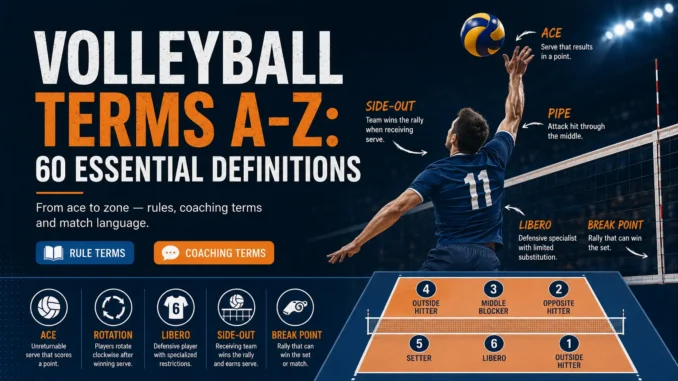

Sixty essential indoor volleyball terms, from ace and break point to pipe, side-out and zone – what each one means and how it is used.
Quick Answer
This A-Z glossary explains 60 essential indoor volleyball terms, from official FIVB rulebook language to coaching, statistical and match terms. Every entry is labelled, includes a rule reference where one exists, and separates the permanent 2025-2028 rules from tests used in selected 2026 competitions.
Most volleyball glossaries define words without showing where they come from. That makes it difficult to tell a formal rule from a tactical label, a statistical category or court slang.
This glossary makes that distinction explicit. Every entry is tagged, and rule references are included only when the FIVB Official Volleyball Rules 2025-2028 define the term or directly support the action.
Labels used: [Rule] official rulebook term or concept; [Common term] common in match coverage; [Coaching term] tactical role, system, technique or slang; [Statistical term] used in statistics and commentary.
2026 competition note. This guide follows the base FIVB Official Volleyball Rules 2025-2028. The 2026 Volleyball Nations League, FIVB U17 World Championships and 2026 Continental Championships use selected tests, including double-contact interpretation, receiving-team positioning and eight substitutions per set. Relevant entries identify those tests separately; they are not permanent changes to the rulebook.
A
Ace · [Statistical term]
A serve that produces an immediate point because the receiving team does not touch it or cannot keep the first contact in play.
Example: She closed the set with an ace down the line.
Antenna · [Rule, 2.4]
A flexible vertical rod fixed at the outer edge of each side band. The antennae are part of the net and mark the lateral limits of the crossing space.
Example: The attack drifted wide and clipped the antenna.
Attack hit · [Rule, 13.1.1]
Any action that directs the ball towards the opponent, except a serve or a block. A hard spike and a soft tip can both be attack hits.
Example: Her third-contact attack hit landed inside the sideline.
Attack line · [Rule, 1.3.4]
The line drawn three metres behind the centre line on each side. Its rear edge marks the boundary of the front zone and is used to judge some back-row attacks.
Example: He took off from behind the attack line for the back-row hit.
Attack coverage · [Coaching term]
The positioning of team-mates around an attacker to recover a ball that rebounds from the opponent’s block. Good coverage keeps the rally alive and gives the team another chance to attack.
Example: The outside hitter was blocked, but attack coverage kept the ball off the floor.
B
Back-row player · [Rule, 7.4.1.2]
A player in rotation position 5, 6 or 1. A back-row player may not complete a block and commits an attack fault if they take off from the front zone and contact the ball entirely above the top of the net.
Example: As a back-row player, she defended at the net but did not join the block.
Best of five · [Common term, 6.2-6.3]
The standard FIVB indoor match format in which the first team to win three sets wins the match. A fifth set is played only if the score reaches 2-2.
Example: The final went the full best of five.
Block · [Rule, 14.1.1]
An action close to the net that intercepts a ball coming from the opponent while part of the blocker’s body is above the top of the net. Only front-row players may complete a block.
Example: The middle blocker’s block ended the rally.
Block touch · [Common term, 14.4.1]
A contact between a blocker and the ball. A blocking contact does not count as one of the team’s three hits, so the team may use three more contacts if the ball stays in play.
Example: The block touch slowed the attack and gave the defence time to react.
Break point · [Statistical term]
A point won by the serving team. It may come from an ace, a block, a counterattack or an opponent error and is the scoring phase opposite to side-out.
Example: Two consecutive break points turned a one-point deficit into the lead.
C
Carry · [Common term, 9.3.3]
The usual name for the FIVB fault called a catch, when the ball is caught or thrown instead of rebounding cleanly from the contact. Players may also call it a held ball.
Example: The referee whistled a carry on the second contact.
Centre line · [Rule, 1.3.3]
The line beneath the net that divides the playing court into two equal 9 x 9 metre courts. The full width of the line belongs equally to both sides.
Example: The blocker landed close to the centre line but stayed on her own side.
D
Defensive specialist (DS) · [Coaching term]
A back-row defensive player who enters through a normal substitution. The term is common in North American volleyball. A DS is not a libero and, as an ordinary player, may serve and is not subject to Rule 19.
Detailed guide: Volleyball Positions Explained
Example: Their defensive specialist entered to serve for the middle blocker.
Dig · [Statistical term]
A defensive contact that keeps an opponent’s attack in play. Digs are usually made low to the floor with the forearms, but any legal defensive contact can count.
Example: The libero’s dig turned a hard-driven attack into a counterattack.
Double contact · [Rule, 9.3.4]
A fault in which a player contacts the ball twice in succession or the ball touches different parts of the body successively outside one permitted action. In selected 2026 FIVB competitions, a double contact during the setting action on the second team contact continues to be allowed if the ball remains on the same side of the court.
Example: Under the base rules, the referee called a double contact on the set.
E
Extended attack line · [Rule-supported term, 1.3.4]
The broken-line extension of the attack line beyond each sideline in FIVB, World and Official Competitions. It helps officials judge a back-row take-off near the edge of the court.
Example: The line judge watched the extended attack line on the pipe attack.
F
Fault · [Rule, 6.1.2]
A playing action or other violation that breaks a rule. The referees judge the fault and apply the consequence specified in the rules.
Example: The first fault in the rally gave the point to the opponent.
Five-one (5-1) · [Coaching term]
A team system that uses one setter through all six rotations, together with two outside hitters, two middle blockers and one opposite.
Example: They use a 5-1, so the same setter organises every rotation.
Float serve · [Coaching term]
A serve struck with little or no spin, causing the ball to drift or change direction late in flight. It may be delivered from the floor or after a jump.
Example: The float serve moved late and forced an awkward reception.
Free ball · [Coaching term]
An easy ball returned without a full attack, usually through a controlled pass or standing contact. It gives the receiving team time to organise several attacking options.
Example: The free ball allowed the setter to use all three front-row attackers.
Free zone · [Rule, 1-1.1]
The area surrounding the playing court within the playing area. The ball may still be played there, provided it has not become out of play for another reason.
Example: She chased the pass deep into the free zone and kept it alive.
Front-row player · [Rule, 7.4.1.1]
A player in rotation position 4, 3 or 2. Front-row players may complete blocks and attack from the front zone at any height, subject to the other attack rules.
Example: He rotated to the front row and joined the block.
J
Joust · [Coaching term, 9.1.2.2-9.1.2.3]
A simultaneous contact by opponents above the net. If the ball remains in play, the team that receives it is entitled to another three hits.
Example: The two players met the ball in a joust above the tape.
Jump float serve · [Coaching term]
A float serve contacted in the air after a short approach and jump. It combines the unstable no-spin flight of a float serve with a higher contact point.
Example: Her jump float serve dropped sharply between two passers.
K
Kill · [Statistical term]
An attack that directly wins the point. It is a statistical and commentary term rather than a named rulebook action.
Example: Her cross-court kill made it set point.
L
Libero · [Rule, 19]
A specialist player who is always treated as a back-row player, wears a contrasting uniform and replaces players in back-row positions. Under FIVB rules, the libero may not serve, block, attempt to block or complete an attack hit when the ball is entirely above net height.
Detailed guide: Volleyball Positions Explained
Example: The libero controlled the serve and kept the setter in system.
M
Match point / set point · [Common term]
A point that would end the match or the current set if the leading team wins the next rally. These are standard commentary terms, not definitions in the FIVB rulebook.
Example: They saved two match points before losing the third.
Middle blocker · [Coaching term]
The role that attacks quick sets near the centre of the net and moves laterally to form blocks against opposing attackers. The role is not named in the rulebook.
Detailed guide: Volleyball Positions Explained
Example: The middle blocker read the setter and closed the block.
N
Net fault · [Common term, 11.3.1]
A fault caused when a player touches the net between the antennae during the action of playing the ball. Contact with the net outside the antennae is not automatically a fault unless it interferes with play.
Example: The hitter touched the net during landing and was called for a net fault.
O
Opposite hitter · [Coaching term]
The role that attacks mainly from the right side and lines up diagonally opposite the setter. In many elite systems, the opposite is one of the main scorers and is excluded from most serve reception.
Detailed guide: Volleyball Positions Explained
Example: The opposite attacked from zone 1 after rotating to the back row.
Outside hitter · [Coaching term]
The role that attacks mainly from the left side and usually carries a major share of serve reception and back-row defence. Left-side hitter is a common synonym.
Detailed guide: Volleyball Positions Explained
Example: Both outside hitters remained in the reception pattern.
Out of system · [Coaching term]
A situation in which the first contact pulls the setter away from the planned setting area or prevents the team from running its full attack. Teams often respond with a higher, safer set to an outside attacker.
Example: The poor reception left the team out of system and forced a high ball to zone 4.
Overpass · [Coaching term]
A reception, dig or other team contact that crosses the net unintentionally, often giving the opponent an immediate attacking opportunity.
Example: The powerful serve produced an overpass that the middle put away.
Overhand pass · [Coaching term]
A contact played with the fingers above the forehead, most often to set an attacker. The pass must still comply with the general ball-contact rules in Rule 9.
Example: The setter used an overhand pass to release the middle.
P
Pancake · [Coaching term]
A defensive save in which a player slides a hand flat on the floor and lets the ball rebound from the back of the hand before touching the court.
Example: She pancaked the ball centimetres above the floor.
Point · [Rule, 6.1.1]
A score awarded when the ball lands successfully on the opponent’s court, the opponent commits a fault or the opponent receives a penalty.
Example: The penalty gave the receiving team a point.
Positional fault · [Rule, 7.5]
Under the base rules, a fault committed when a player is not in the correct rotational position at the moment of the service hit. Selected 2026 FIVB competitions check the receiving team at the referee’s whistle and allow movement once the serving action begins.
Example: The receiving team was called for a positional fault before the rally developed.
Pipe · [Coaching term]
A back-row attack through the middle of the court, usually by an outside hitter taking off from behind the attack line near position 6.
Example: The outside hitter scored on a fast pipe from the back row.
Q
Quick attack · [Coaching term]
A fast attack from a low, short set near the middle of the net, designed to reduce the time available for the block to form.
Example: The middle jumped for a quick and scored before the block closed.
R
Rally · [Rule, 6.1.3]
The sequence of playing actions from the service hit until the ball is out of play. A completed rally ends with the award of a point.
Example: The rally lasted more than twenty contacts.
Rally point system · [Common term, 6.1]
A scoring system in which every completed rally awards a point, regardless of which team served. If the receiving team wins, it also serves next.
Example: Under rally point scoring, every service error immediately costs a point.
Reception · [Statistical term]
The first team contact used to handle an opponent’s serve. Reception quality affects how many attacking options the setter has on the next contact.
Example: Their reception held up under a run of jump serves.
Rotation · [Rule, 7.6.2]
The clockwise movement of all six players by one position when the receiving team wins the right to serve. The player moving from position 2 to position 1 becomes the next server.
Example: After the side-out, the team rotated and a new server stepped up.
Rotational fault · [Rule, 7.7]
A fault committed when the service is not made according to the recorded rotational order. The opponent receives a point and the right to serve.
Example: Serving out of turn produced a rotational fault.
S
Serve (service) · [Rule, 12.1]
The action that puts the ball in play. It is performed by the back-right player from the service zone after the first referee authorises the serve.
Example: Her jump serve forced an overpass.
Set (action) · [Coaching term]
A contact that places the ball for an attacker, usually the team’s second contact and most often an overhand pass by the setter. It is not the same as a set in the match score.
Example: He set the opposite for the final swing.
Set (period of play) · [Rule, 6.2-6.3.2]
A division of the match. The first four sets are played to 25 points and a deciding fifth set to 15, always with a minimum lead of two points.
Example: They won the third set 27-25.
Setter · [Coaching term]
The role that organises the attack, usually takes the second contact and decides which attacker receives the ball. Setter is a tactical role, not a specialist role defined in the rulebook.
Detailed guide: Volleyball Positions Explained
Example: The setter used a faster tempo to isolate the middle.
Setter dump · [Coaching term, 13.3.3]
An attack on the second team contact in which the setter sends the ball over instead of setting a hitter. A back-row setter remains subject to the normal back-row attack restrictions.
Example: The front-row setter surprised the defence with a setter dump.
Side-out · [Common term]
Winning a rally while receiving serve, which gives the team a point and the right to serve next under rally point scoring. The side-out phase usually covers serve reception, the set and the first attack.
Example: They needed a clean side-out to stop the opponent’s run.
Slide attack · [Coaching term]
A one-footed attack by a middle blocker moving behind the setter towards the right side, usually on a back set near position 2.
Example: The middle scored on a slide attack behind the setter.
Stuff block · [Statistical term]
A successful block that sends the ball immediately to the opponent’s floor for a point. Volleyball World statistics commonly record direct blocking points as stuff blocks.
Example: The middle finished the set with a stuff block.
Substitution · [Rule, 15.1, 15.5]
The act of a recorded player entering the game to replace another player, who leaves the court. Under the base rules, a team may request six substitutions per set; selected 2026 FIVB competitions are testing eight.
Example: They used a substitution to bring on a serving specialist.
Switching · [Coaching term, 7.4.4]
Players moving from their rotational positions into their tactical base positions. Under the base rules, this movement may begin after the service hit; selected 2026 competitions allow the receiving team to move once the serving action begins.
Example: After the serve, the setter switched quickly to the net.
T
Tie-break (deciding set) · [Common term, 6.3.2, 18.2.2]
The fifth set of a best-of-five match. It is played to 15 points with a two-point margin, and the teams change courts when the leading team reaches eight points.
Example: The match went to a tie-break.
Tip / dink · [Coaching term, 13.1.2]
A soft attack used to place the ball over or around the block. Rule 13.1.2 permits tipping only when the ball is cleanly hit and not caught or thrown. Selected 2026 competitions apply this standard strictly to push, carry and throw-like attacks.
Example: She tipped the ball into the open space behind the block.
Tool / wipe · [Coaching term]
An attack deliberately played off the outside hands of the block so the ball deflects out of bounds. To tool the block is to use it; a wipe often describes brushing the ball off the hands.
Example: The hitter tooled the outside hand for the point.
Topspin jump serve · [Coaching term]
A powerful serve contacted in the air with forward spin, causing the ball to travel fast and dip sharply after crossing the net.
Example: His topspin jump serve dropped inside the end line for an ace.
Transition · [Coaching term]
The phase in which a team changes from defence to attack after controlling an opponent’s attack or free ball. It includes the dig, setter movement and preparation for the counterattack.
Example: Strong transition play turned the dig into a quick counterattack.
Z
Zone 1-6 (rotation positions) · [Common term, 7.4.1]
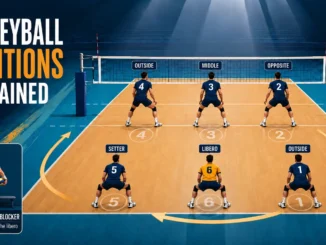
The common names for the six numbered rotational positions: 4, 3 and 2 across the front row, and 5, 6 and 1 across the back row. The FIVB rulebook calls them positions; a number describes rotational status, not a player role.
Detailed guide: Volleyball Positions Explained
Example: He started in position 1 and switched to the left after the serve.
Quick Summary
- Rulebook terms such as libero, rotation and attack line are defined in the FIVB Official Volleyball Rules 2025-2028.
- Setter, outside hitter, opposite and middle blocker are coaching roles, not specialist roles created by the rulebook.
- Break point is a point won by the serving team; side-out is a rally won by the receiving team.
- Pipe, slide attack and setter dump describe specific attacking options used in elite volleyball.
- Float, jump float and topspin jump serves differ mainly in contact, spin and flight.
- Block touch, stuff block, tool and attack coverage describe different outcomes around the block.
- Selected 2026 competitions use tests for setting double contacts, receiving-team movement and eight substitutions per set.
Based on the FIVB Official Volleyball Rules 2025-2028 and the approved FIVB rule tests for selected 2026 competitions. Last updated: July 2026.
Sources
FIVB Official Volleyball Rules 2025-2028
FIVB rule tests for 2026 competitions
Volleyball World: Essential attack names and set calls
Volleyball World: Perfecting the jump serve
Volleyball World: Break point, pipe and stuff-block usage


Be the first to comment