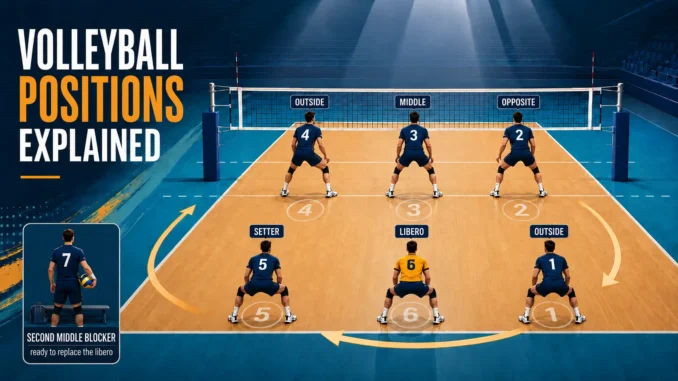

Six players and six numbered positions — but player roles are a separate system.
Quick Answer
| Volleyball positions and player roles are not the same. Positions 1 to 6 are rotation slots defined by the FIVB rules, while setter, outside hitter, opposite and middle blocker are coaching roles. The libero is the only specialist role defined by the rulebook, with its own replacements and restrictions. |
Most guides to volleyball positions list the player roles and stop there. That approach misses the distinction that causes most of the confusion.
The FIVB rulebook defines numbered rotation positions, front-row and back-row status, service order and the libero. Coaches then organise setters, outside hitters, opposites and middle blockers within that framework. Once you separate the two systems, rotations and tactical movement become much easier to follow.
| 2026 competition note. This guide explains the base FIVB Official Volleyball Rules 2025–2028. The 2026 Volleyball Nations League, FIVB U17 World Championships and 2026 Continental Championships are testing two relevant variations: the receiving team may leave its rotational positions once the serving action begins, and teams may use eight substitutions per set instead of six. These are competition tests, not permanent changes to the rulebook. |
Volleyball positions and roles at a glance
The table below describes the standard five-role structure used in elite indoor volleyball. Base areas are tactical conventions after the serve, not fixed starting positions.
| Role | Players per team (5–1) | Main function | Common base area after the serve | Serve reception | Rulebook status |
|---|---|---|---|---|---|
| Setter | 1 | Organises the second contact and chooses the attacker | Near the net, often between zones 2 and 3 | Sometimes | Coaching role |
| Outside hitter | 2 | Left-side attack, serve reception and defence | Zone 4 in the front row | Usually | Coaching role |
| Opposite hitter | 1 | Right-side and back-row attack | Zone 2 in the front row | Often excluded in elite systems | Coaching role |
| Middle blocker | 2 | Quick attacks and blocking across the net | Zone 3 in the front row | Usually replaced by the libero in the back row | Coaching role |
| Libero | 1 on court | Serve reception and back-row defence | Back court | Yes | Defined by Rule 19 |
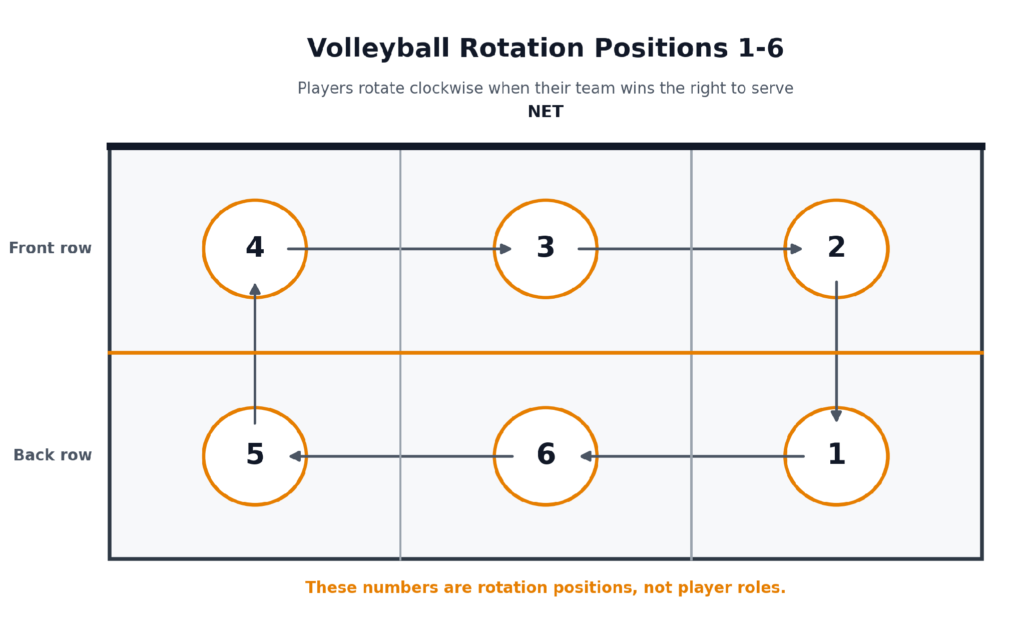
Figure 1. Rotation positions 1–6 and the clockwise rotation order.
What the FIVB rules actually define
A team has six players on court. Its starting line-up fixes the rotational order for the set (Rule 7.3.1).
The front-row positions are 4 on the left, 3 in the centre and 2 on the right. The back-row positions are 5 on the left, 6 in the centre and 1 on the right (Rules 7.4.1.1 and 7.4.1.2).
Under the base 2025–2028 rules, the receiving team must be in the correct rotational order when the server hits the ball. The serving team may occupy any position inside its own court at that moment (Rule 7.4).
When the receiving team wins the right to serve, its players rotate one position clockwise. The player moving from position 2 to position 1 becomes the server (Rule 7.6.2).
After the service hit, players of both teams may move anywhere on their own court and in the free zone (Rule 7.4.4). The numbered positions govern rotation and front-row or back-row status. They do not prescribe where a setter or attacker must stand throughout the rally.
The five core volleyball roles
Setter
Definition. The setter organises the attack and normally takes the second contact when the first contact allows it.
Function. A team has up to three hits to return the ball, and a block contact does not count as one of them (Rules 9.1 and 14.4.1). The setter uses the second contact to select the attacker, control tempo and distribute the ball across the net.
Common misunderstanding. The setter has no special status in the rulebook. When a setter is a back-row player, the normal back-row restrictions apply. The setter may not complete a block and may not complete an attack above net height after taking off from the front zone (Rules 14.6.2 and 13.3.3).
Outside hitter
Definition. The outside hitter attacks primarily from the left side and usually takes a major role in serve reception.
Function. In a standard 5–1 line-up, teams use two outside hitters. They contribute in all six rotations because they combine attacking, reception, defence and serving.
Common misunderstanding. Outside hitter and left-side hitter are common names for the same role. Receiver-hitter is also used in some international material. None of these terms is a synonym for opposite hitter.
Opposite hitter
Definition. The opposite hitter attacks primarily from the right side and lines up diagonally opposite the setter in the rotation.
Function. In many elite systems, the opposite is one of the main scorers and is kept out of serve reception. This allows the player to prepare for both front-row and back-row attacks. That deployment is a tactical choice, not a rule.
Common misunderstanding. Back-row attacking is not a special privilege of the opposite. Any back-row player may complete an attack from behind the attack line, provided the take-off does not touch or cross that line. The player may land in the front zone afterwards (Rules 13.2.2.1 and 13.2.2.2).
Middle blocker
Definition. The middle blocker attacks quick sets near the centre of the net and moves laterally to form blocks against opposing hitters.
Function. Only front-row players may complete a block, and part of the body must be above the top of the net at contact (Rule 14.1.1). Middle blockers are selected and trained around that responsibility.
In elite volleyball, a libero commonly replaces the middle blocker when the middle rotates into the back row. That is a tactical convention rather than a requirement of the rules.
Common misunderstanding. Height is not a legal requirement. The rulebook sets no physical standard for any role. Teams prefer height, reach and lateral speed because those qualities help with blocking and quick attacks.
Libero
Definition. The libero is a specialist defensive player who is always treated as a back-row player and may replace only a player in a back-row position.
Function. Rule 19 gives the libero a status that no other tactical role receives. A team may designate up to two liberos, although competition handbooks may set additional roster requirements. Only one libero may be on court at a time.
The libero wears a uniform with a clearly contrasting dominant colour (Rule 19.2). Libero replacements are unlimited and do not count as substitutions, but a completed rally must normally separate two replacements (Rule 19.3.2.1).
The restrictions are specific:
- The libero may not serve, block or attempt to block under FIVB rules (Rule 19.3.1.3).
- The libero may not complete an attack hit when the ball is entirely above the top of the net at contact (Rule 19.3.1.2).
- If the libero makes an overhand finger pass from inside the front zone, a team-mate may not complete an attack on that ball above net height (Rule 19.3.1.4).
- The same overhand pass made from outside the front zone may be attacked without that restriction.
Common misunderstanding. Being treated as a back-row player does not mean the libero is forbidden from entering the front zone. The restrictions depend on the action performed and, for an overhand finger pass, where the libero contacts the ball.
Regional role: defensive specialist
Definition. A defensive specialist, usually shortened to DS, is a regular player used mainly for back-row defence and reception. The term is common in North American volleyball and does not appear in the FIVB rulebook.
Function. A DS enters through a normal substitution and does not receive the unlimited replacement privileges of a libero. Under the base FIVB rules, teams have six substitutions per set. Selected 2026 competitions are testing eight.
Common misunderstanding. A DS is not another name for a libero. A defensive specialist is an ordinary player and may serve. If the player rotates to the front row, normal front-row rights apply. A libero remains subject to the restrictions in Rule 19.
At Elite Level
The VNL MVP record shows why tactical roles matter even though most of them are absent from the rulebook. Poland and France alone have supplied three of the four winners below.
| Season | Player | Role | Verified evidence |
|---|---|---|---|
| VNL 2023 | Paweł Zatorski, Poland | Libero | First men’s libero to win VNL MVP; 77 digs and 32 passes in ten matches |
| VNL 2024 | Antoine Brizard, France | Setter | MVP and Best Setter; 250 successful sets and 26 points in 15 matches |
| VNL 2025 | Jakub Kochanowski, Poland | Middle blocker | Men’s MVP and Best Middle Blocker; 55 points, including 14 kill blocks and five aces |
| VNL 2025 | Monica De Gennaro, Italy | Libero | First women’s libero to win VNL MVP; 160 digs and 39 passes in 12 matches |
The VNL Dream Team is also selected by role: setter, opposite, two outside hitters, two middle blockers and libero. That structure reflects how elite teams organise their line-ups in practice.
There is no contradiction between the rulebook and the awards. The rules define legal positions and actions. Competition practice defines the tactical jobs performed inside those limits.
Common misconceptions
“Both teams must be in rotational order when the ball is served.”
Under the base FIVB 2025–2028 rulebook, only the receiving team must be in rotational order at the service hit. The serving team may occupy any position inside its court.
The 2026 VNL, U17 World Championships and Continental Championships use a test procedure. The receiving team must be correctly positioned at the referee’s whistle but may move once the serving action begins.
“Players must stay in their numbered zone during the rally.”
No. Under the base rulebook, both teams may move anywhere on their own court and in the free zone after the service hit (Rule 7.4.4). The 2026 test gives the receiving team permission to begin moving even earlier, once the server’s action starts.
“A libero cannot be captain.”
A libero may be either the team captain or the game captain under Rule 5. The contrasting uniform and replacement rules do not remove captaincy rights.
“A libero cannot attack the ball.”
The restriction is narrower. A libero commits a fault only by completing an attack hit when the ball is entirely above the top of the net at contact. An attack below that height is legal.
“A defensive specialist and a libero are the same role.”
They are different. A DS is a regular player entering through a substitution. A libero uses special replacements and remains subject to Rule 19.
FAQ
What are the six positions in volleyball?
The six positions are rotation zones 1 to 6. Positions 4, 3 and 2 form the front row, while positions 5, 6 and 1 form the back row. They are not player job titles.
How many player roles are there in volleyball?
Elite indoor teams normally use five core roles: setter, outside hitter, opposite hitter, middle blocker and libero. A standard 5–1 line-up contains one setter, two outside hitters, one opposite and two middle blockers, with the libero replacing a back-row player.
What is the difference between a volleyball position and a role?
A position is a numbered place in the rotation and determines front-row or back-row status. A role describes a player’s tactical job. Setter and outside hitter are roles; zones 1 and 4 are positions.
Which volleyball role is the most important?
The rules do not rank the roles. A team needs first-contact control, accurate setting, attacking and blocking to function. VNL MVP awards have gone to a setter, a middle blocker, two liberos and multiple opposites.
Can a libero serve?
Under FIVB indoor rules, no. Rule 19.3.1.3 prevents the libero from serving, blocking or attempting to block. This is one of the clearest differences between a libero and a defensive specialist, who is an ordinary substitute and may serve.
What is the difference between an outside hitter and an opposite hitter?
The outside hitter attacks mainly from the left and usually participates in serve reception. The opposite attacks mainly from the right, lines up opposite the setter and is often excluded from reception in elite systems.
Do volleyball positions change during a rally?
The players keep their front-row or back-row status until the next rotation, but their physical location changes constantly. Under the base rules, they may move freely after the service hit.
Quick Summary
- Positions 1 to 6 are rotation zones; setter, outside hitter and other names describe tactical roles.
- Positions 4, 3 and 2 form the front row; positions 5, 6 and 1 form the back row.
- Players rotate clockwise when their team wins the right to serve.
- Under the base rules, players may move freely after the service hit.
- The libero is the only specialist role defined by the FIVB rulebook.
- A defensive specialist is a regional tactical role and uses normal substitutions.
- Selected 2026 competitions are testing earlier receiving-team movement and eight substitutions per set.
Based on the FIVB Official Volleyball Rules 2025–2028 and the approved FIVB rule tests for the 2026 international season. Last updated: July 2026.


Be the first to comment