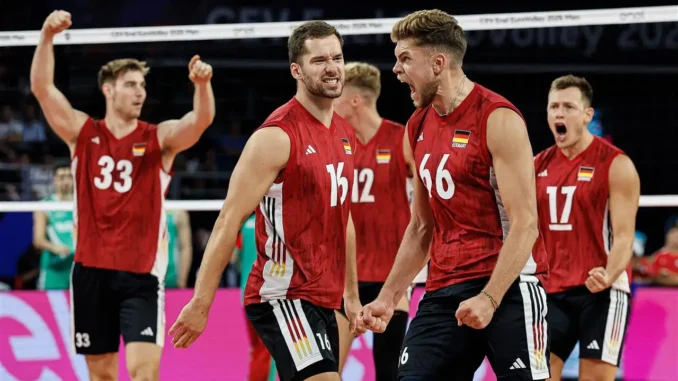

Germany survived the brink of elimination, erased a two-set deficit and beat hosts Bulgaria 3-2 in front of 12,198 spectators in Sofia. The comeback was built on survival first, then a steadier reception as Bulgaria’s once-devastating serve gradually lost its impact.
ROUND OF 16 | 19 September 2026 | Arena 8888, Sofia
For two sets, Bulgaria looked ready to turn a packed Arena 8888 into the scene of one of the biggest nights of Men’s EuroVolley 2026.
Their serve was flying, Germany’s reception was under constant pressure, and the hosts led 2-0 after taking the opening sets 25-21 and 25-21. Bulgaria were one set from the quarterfinals.
Germany did not respond with one sudden tactical trick. First, they simply stayed alive. Late in the third set, the message from the German bench was about survival rather than control. They survived – and once the match continued, the balance gradually shifted.
Germany won the next three sets 25-19, 25-23 and 15-12, completing a 3-2 comeback after 137 minutes and silencing a crowd of 12,198 that had spent most of the evening pushing Bulgaria toward the finish line.
Match at a Glance
| Match | Result | Set scores |
| Germany vs Bulgaria | Germany 3-2 Bulgaria | 21-25, 21-25, 25-19, 25-23, 15-12 |
Attendance: 12,198 | Match duration: 137 minutes
Bulgaria Had Germany on the Brink
Bulgaria’s first two sets were built around exactly the weapon that had made them dangerous throughout the tournament: the serve.
The hosts produced five aces in the opening set and another four in the second. Germany’s positive reception was 35% in the first set and collapsed to just 17% in the second. That prevented the Germans from consistently playing in-system and allowed Bulgaria to dictate the emotional rhythm of the match.
Bulgaria did not need Aleksandar Nikolov to win every rally. The pressure from the service line repeatedly created uncomfortable first contacts, narrowed Germany’s attacking options and gave the Bulgarian block-defense a clearer picture.
At 2-0, the hosts were not simply ahead on the scoreboard. They had imposed the style of match they wanted. Germany needed the contest to change before it was too late.
“We Need to Survive” – The Third Set Changes the Match
The third set became the psychological hinge of the match.
Bulgaria still led 8-7 at the first scoring checkpoint, but Germany finally created separation in the middle of the set. They moved ahead 16-14, then 21-17 and closed the set 25-19.
Late in that set, the German bench message heard on the broadcast was simple: they needed to survive. That description fit the moment perfectly. Germany were not yet dominating the match; they were fighting to extend it long enough for the conditions to change.
And they did. Germany’s positive reception rose to 38%, while Bulgaria managed only one ace. Germany also attacked at 56% in the set, their best attacking figure of the match apart from the opening set, and suddenly the hosts were no longer winning so many rallies before Germany could organize their offense.
The score was still 2-1 Bulgaria, but the match no longer looked the same.
Bulgaria’s Serve Built the 2-0 Lead – Then Lost Its Grip
The clearest statistical explanation for the comeback is the change in Bulgaria’s serving performance and Germany’s reception.
Across the opening two sets, Bulgaria fired nine aces. Over the final three sets, they managed only four. At the same time, service errors increased sharply, especially in the fourth set and the tie-break.
| Set | Bulgaria aces | Bulgaria serve errors | Germany positive reception |
| 1 | 5 | 1 | 35% |
| 2 | 4 | 7 | 17% |
| 3 | 1 | 3 | 38% |
| 4 | 2 | 10 | 43% |
| 5 | 1 | 6 | 50% |
The trend is striking. Germany’s positive reception climbed from 17% in the second set to 38%, then 43%, and finally 50% in the tie-break. Bulgaria’s service pressure, meanwhile, stopped producing the same volume of direct damage.
In simple terms, Bulgaria’s serve had built the lead. Once it stopped controlling the first contact, Germany finally had room to run a more stable offense.
The Fourth Set: Bulgaria Still Attack Well, but Serve Away Too Much
The fourth set is important because Bulgaria did not suddenly stop playing well.
They led 8-6 and 16-14, and their attack remained excellent: 15 winning attacks from 27 attempts, a 56% success rate. In many matches, that would be enough to close the door.
But Bulgaria committed 10 service errors in the set.
That number is enormous in a set that ended 25-23. The aggressive serve had been Bulgaria’s main source of pressure earlier in the match, but by the fourth set the risk was increasingly producing free points for Germany rather than break opportunities for the hosts.
Germany turned 14-16 into 21-18 and held on through the closing rallies. At 2-2, the momentum had fully changed. Bulgaria were still dangerous in attack, but they were no longer forcing Germany into the same unstable volleyball that had decided the first two sets.
The Tie-Break: Bulgaria Need Break Points but Cannot Keep the Serve On
Germany took early control of the deciding set and never gave Bulgaria the lead: 5-3, 10-8 and 12-10 before closing it 15-12.
This was the point where Bulgaria’s service problem became most costly. The hosts committed six service errors on only 12 serves in the fifth set. Half of their trips to the service line ended without giving the block-defense a chance to work.
That matters most late in a tie-break. When a team is two or three points behind, side-out alone is not enough; it needs break points. Bulgaria needed stretches of sustained pressure from the service line, but could not put together enough consecutive quality serves to create them.
Germany, by contrast, no longer had to survive the kind of serving storm they had faced at the beginning of the match. Their positive reception reached 50% in the fifth set and their attack remained at 50%.
Bulgaria Lean Heavily on Aleksandar Nikolov
There was another late-match trend that became increasingly important: Bulgaria’s offense became heavily dependent on Aleksandar Nikolov.
Simeon Nikolov repeatedly went to his brother in the biggest moments. Aleksandar finished with 42 attack attempts – exactly twice as many as Asparuh Asparuhov, who had 21, and far more than any other Bulgarian attacker.
Aleksandar still finished as Bulgaria’s leading scorer with 23 points: 17 attacks, five aces and one block. But the volume was enormous, and Germany gradually had more opportunities to anticipate where the high-pressure ball was going.
By the fifth set, that workload appeared to show in the character of some rallies. Several balls were tipped rather than attacked at full power, while Germany were able to read and block some of the more predictable high-ball situations. It is safer to describe that as accumulated workload and tactical predictability than as a psychological collapse – but visually, Bulgaria’s main attacking outlet looked less explosive in the closing phase than he had earlier.
The overall numbers reinforce the point: Aleksandar converted 17 of 42 attacks, or 40%, with six attack errors and three attempts blocked. He carried a huge share of Bulgaria’s offense, but Germany eventually made that burden harder to sustain.
Germany Find Contributions Across the Lineup
Germany’s comeback was not built around one scorer alone.
Erik Roehrs led the team with 20 points, including 14 winning attacks, three aces and three blocks. Tobias Brand added 13 points, while Anton Brehme delivered one of the most efficient attacking performances of the match.
Brehme scored 14 points and converted 11 of 12 attacks – an extraordinary 92% attack success rate – while also adding three aces.
That efficiency mattered because once Germany’s reception stabilized, their setter could involve the middle more confidently rather than simply sending predictable high balls to the pins. Bulgaria’s block then had to defend a wider court, which made the German offense increasingly difficult to contain.
Key Match Statistics
| Statistic | Germany | Bulgaria |
| Final score | 3-2 | 2-3 |
| Attack points | 48 | 51 |
| Attack success | 53% | 48% |
| Blocks | 7 | 8 |
| Aces | 11 | 13 |
| Service errors | 26 | 27 |
| Positive reception | 34% | 44% |
| Break points | 30 | 29 |
The full-match totals show just how close the contest was. Bulgaria had more attack points, more blocks, more aces and a better overall positive reception percentage. Germany still won.
That is why the set-by-set progression matters more than the final totals alone. Bulgaria accumulated much of its service advantage early; Germany were the more stable team when the match reached the moments that decided qualification.
Why Germany Won
The comeback can be reduced to four connected changes rather than one dramatic turning point:
- Germany survived the third set and extended the match before Bulgaria could close it.
- Bulgaria’s serve stopped producing the same pressure: nine aces in the first two sets became four across the final three, while errors rose sharply.
- Germany’s reception stabilized from 17% positive in set two to 50% in the tie-break, allowing a more balanced offense.
- Bulgaria became increasingly dependent on Aleksandar Nikolov in the biggest rallies, making the offense easier to anticipate late in the match.
None of those factors alone explains a 0-2 comeback. Together, they explain how a match Bulgaria appeared to control gradually became a match Germany could play on their own terms.
What This Result Means
Germany advance to the Men’s EuroVolley 2026 quarterfinals after surviving one of the most dramatic matches of the knockout stage.
Their next opponent will come from the Poland vs Latvia Round of 16 match. The fixed bracket means there is no reseeding before the quarterfinals.
For Bulgaria, the defeat is especially painful because the path was open. They were two sets up, playing at home, supported by more than 12,000 spectators and still attacking efficiently deep into the fourth set.
But knockout volleyball is often decided by what a team can still execute after two hours of pressure. Bulgaria’s greatest weapon from the opening sets – the serve – became unreliable when they needed break points most. Germany stayed alive long enough to take advantage.
Final Takeaway
This was more than a comeback from 0-2. It was a match that changed element by element.
Bulgaria’s serve dominated the beginning. Germany’s reception slowly recovered. The hosts kept scoring in attack, but gave away too much from the service line. In the tie-break, Bulgaria needed pressure and continuity on serve but instead committed six errors in 12 attempts. At the same time, their attack became increasingly centered on Aleksandar Nikolov, who had already carried 42 swings.
Germany’s first task was simply to survive. Once they did, they became the steadier team.
From 0-2 down in front of a roaring home crowd, Germany found a way back – and turned one of Bulgaria’s biggest nights of the tournament into one of the most painful exits of EuroVolley 2026.
Editorial Note
This article is based on the official CEV match page and Data Volley statistics for Germany vs Bulgaria in the Men’s EuroVolley 2026 Round of 16 on 19 September 2026.
Set-by-set observations about changes in service pressure, reception stability and attacking distribution are VolleyCommunity editorial analysis based on the official statistical report and match viewing.
The late-third-set message about needing to survive is described from the match broadcast rather than the official CEV statistical sheet. The wording is paraphrased rather than presented as a verified transcript.
The description of Bulgaria’s late reliance on Aleksandar Nikolov is supported by his 42 attack attempts, while comments about the character of several late attacks are editorial observations from the match rather than psychological claims about the player.



Be the first to comment