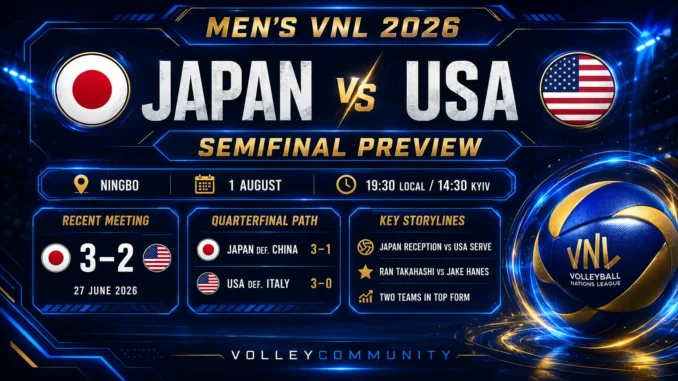

Japan’s elite reception and attacking balance meet the most dangerous serving performance of the quarterfinals, while both teams return to a matchup Japan won in five sets only five weeks earlier.
Match: Saturday, 1 August 2026 – 19:30 in Ningbo, 14:30 Kyiv time. The winner advances to the Men’s VNL 2026 gold medal match.
Japan and the United States meet in the second Men’s Volleyball Nations League 2026 semifinal with a place in the final at stake. Japan arrive as the only unbeaten team in the competition after extending their record to 13-0 with a 3-1 quarterfinal victory over hosts China. USA reached the last four by sweeping Italy and producing the most destructive serving performance of the quarterfinal round.
The contrast is clear. Japan rely on reception quality, speed and several attacking routes. USA use height, physical serving and the control of Micah Christenson to turn short scoring runs into decisive separation. The teams already played a five-set match on 27 June, when Japan recovered twice from a one-set deficit and won 15-13 in the tiebreak. That result gives Japan confidence, but it also showed how close the matchup remains.
This preview is connected to our Men’s VNL 2026 quarterfinal schedule and bracket, the Japan vs China quarterfinal preview and the Italy vs USA quarterfinal report.
Match Details
| Detail | Information |
|---|---|
| Competition | Men’s VNL 2026 Finals |
| Stage | Semifinal |
| Date | Saturday, 1 August 2026 |
| Venue | Ningbo Beilun, China |
| Start time | 19:30 local / 14:30 Kyiv / 11:30 UTC |
| Final path | Winner advances to the gold medal match |
Quarterfinal Paths: Two Different Ways to the Semifinal
Japan defeated China 3-1 after dropping the opening set. Their 61-54 advantage in attack, 9-6 edge on the block and 69% positive reception showed the structure that has carried them through an unbeaten campaign. Ran Takahashi led the scoring with 21 points, while Yuji Nishida and Larry Ik Evbade added 13 each. Japan did not need a dominant serving match: the ace count was level at 4-4.
USA took a shorter route, sweeping Italy 25-22, 25-21, 25-21. The attack totals were nearly identical at 39-38, and Italy even led 4-3 on the block. The decisive category was serve. USA produced 14 aces to Italy’s five, with Jake Hanes contributing six. Hanes finished with 21 points, Matt Anderson added 15 and Ethan Champlin scored 10.
| Category | Japan | USA |
|---|---|---|
| Quarterfinal result | 3-1 vs China | 3-0 vs Italy |
| Set scores | 23-25, 25-23, 25-16, 25-23 | 25-22, 25-21, 25-21 |
| Leading scorer | Ran Takahashi – 21 | Jake Hanes – 21 |
| Aces | 4 | 14 |
| Positive reception | 69% | 37% |
| Match duration | 125 minutes | 94 minutes |
The June Meeting: Japan Won the Deciding Moments
The teams met on 27 June in Orleans, and Japan won 3-2: 18-25, 25-21, 20-25, 25-22, 15-13. USA twice took the lead in sets and finished with more total points, 106-103. They also led 69-66 in attack and 9-4 on the block. Japan still won because they converted the late points of the fourth set and tiebreak more efficiently and received 29 points from American errors, compared with 25 for USA.
The individual duel was already visible. Ran Takahashi scored 26 points for Japan, while Jake Hanes scored 25 for USA. Kento Miyaura added 20 for Japan; T.J. DeFalco and Matt Anderson contributed 17 and 16 for USA. Unlike several early-season meetings involving rotated lineups, this match included many of the players expected to shape the semifinal, including Christenson, Hanes, Anderson, DeFalco, Ran and Ishikawa.
Key interpretation: Japan’s win was significant, but it was not a performance of statistical control. USA won several major categories. Japan won the rallies that decided the match.
Recent Head-to-Head: USA Lead the Series, Japan Lead the Trend
Across the last eight meetings supplied for this preview, USA hold a 5-3 advantage and lead 17-14 in sets. The longer view favours the Americans, but the current trend favours Japan. Japan have won the last two meetings and three of the last four VNL matches. USA won the most important recent knockout encounter, defeating Japan 3-1 at the Paris 2024 Olympics.
| Date | Competition | Result |
|---|---|---|
| 27 Jun 2026 | VNL | USA 2-3 Japan |
| 20 Jul 2025 | VNL | USA 0-3 Japan |
| 2 Aug 2024 | Olympics | Japan 1-3 USA |
| 23 Jun 2024 | VNL | Japan 3-0 USA |
| 8 Oct 2023 | Olympic Qualification | Japan 2-3 USA |
| 11 Jun 2022 | VNL | Japan 2-3 USA |
| 23 Jun 2021 | VNL | USA 3-0 Japan |
| 5 Oct 2019 | World Cup | Japan 0-3 USA |
Japan’s Main Strength: Reception That Keeps Every Option Alive
Japan’s 69% positive reception against China is the most relevant quarterfinal statistic for this matchup. USA eliminated Italy by preventing Simone Giannelli from running a full-width offence. Japan are better equipped to resist that plan because their passing structure, floor defence and transition speed allow the setter to keep several attackers involved even after difficult first contacts.
Ran Takahashi remains the central wing scorer. He produced 21 points in the quarterfinal and 26 in the June win over USA. Nishida and Miyaura give Japan two different opposite profiles, while Ishikawa can influence the match through reception, serve and late-set decision-making even when he is not the leading scorer. Larry’s 13-point quarterfinal, including five blocks, also showed that Japan can create pressure through the middle.
Japan do not need to win the serving contest outright. They need to limit the number of direct American points and keep enough passes near the net to attack before the USA block is fully organised.
USA’s Main Strength: A Serve That Can Change the Match in One Rotation
USA’s 14 aces against Italy were not a decorative statistic. The serve changed the structure of the quarterfinal. Hanes delivered six aces, Anderson three, Christenson two, Champlin two and Averill one. That distribution matters because Japan cannot solve the problem by surviving only one server.
Hanes enters the semifinal after a 21-point performance and a decisive third-set service run against Italy. Christenson can also use the improved defensive situations created by serve pressure to involve the middle, keep Hanes in favourable matchups and prevent the offence from becoming predictable. Anderson and Champlin gave USA a stable outside-hitter pairing in the quarterfinal.
T.J. DeFalco did not play against Italy. He was part of the 15-player Finals group and scored 17 points against Japan in June, but his role in the semifinal should not be assumed until the match roster and warm-up confirm his availability. USA have already shown they can win without him, yet his return would add another high-level server and transition scorer.
Ran Takahashi vs Jake Hanes: Two Different Ways to Score
| Metric | Ran Takahashi | Jake Hanes |
|---|---|---|
| Quarterfinal points | 21 vs China | 21 vs Italy |
| June meeting points | 26 | 25 |
| Quarterfinal profile | Wing attack, reception, transition | Opposite attack, block, six aces |
| Main semifinal challenge | Score while carrying reception load | Stay efficient against Japan’s defence |
The semifinal should not be reduced to a scoring race between Ran and Hanes, but their production may reveal which team is imposing its preferred style. A high Ran total with stable reception would suggest Japan are controlling the first-contact battle. A high Hanes total with several serving points would suggest USA have moved the match toward physical high-ball volleyball.
Five Tactical Questions That Could Decide the Semifinal
Can USA repeat their serving pressure against a much stronger reception line?
Italy passed at 27% positive reception; Japan reached 69% against China. The Americans do not need another 14-ace match, but they must move Japan away from the net often enough to simplify the attack.
Can Japan avoid USA’s block advantage from the June meeting?
USA led 9-4 in blocks in Orleans. Japan need faster distribution, cleaner transition spacing and enough middle involvement to prevent the American wings from forming early double blocks.
Which opposite gives Japan the better matchup?
Nishida offers explosive serving and left-handed attack, while Miyaura scored 20 points in the June victory. The choice can change during the match depending on block matchups and serving rhythm.
What role will DeFalco have?
He scored 17 against Japan in June but did not play in the quarterfinal. Champlin performed well against Italy, so USA have no need to force a change unless DeFalco is fully ready and tactically useful.
Who wins the last five points of close sets?
The June match turned on a 15-13 tiebreak. Japan have repeatedly survived tight endings during their unbeaten run, while USA showed against Italy that they can create separation before the final rallies.
What Japan Need to Do
- Protect the passing seams and keep the setter close enough to the net to use the middle.
- Limit Hanes’ service runs before they become multi-point swings.
- Use Ran, Ishikawa and the opposite as complementary options rather than narrowing the attack to one wing.
- Make USA defend repeated transition rallies instead of allowing short, serve-led exchanges.
- Trust their late-set composure without relying on another comeback from behind.
What USA Need to Do
- Serve with the same aggression shown against Italy, but avoid giving Japan long sequences of easy side-outs through errors.
- Use Christenson to keep the middle attack credible and prevent Japan from loading toward Hanes.
- Attack Japan’s smaller block with height while remaining patient against their floor defence.
- Get stable reception from Anderson, Champlin and the libero so the match does not become a pure serving contest.
- Turn statistical advantages into set wins, something they failed to do in the June meeting.
Outlook: Japan Are Slight Favourites, but the Match Is Close
Japan deserve a narrow advantage. They are 13-0, have won the last two meetings with USA and possess the reception quality most likely to reduce the Americans’ strongest quarterfinal weapon. Their attack also has more than one route, and their record in close endings has been exceptional.
USA have a convincing case of their own. They scored more points than Japan in the June meeting, won the attack and block categories, and just eliminated Italy in straight sets. Their serve can change the match before Japan establish rhythm, and Christenson, Hanes and Anderson bring extensive high-pressure experience.
The likely shape is more balanced than either quarterfinal. Japan will try to extend rallies and preserve attacking width; USA will try to shorten rallies with serve and block. Four or five sets are more likely than a quick result. Japan are the marginal pick because of their reception, unbeaten form and recent head-to-head wins, but the difference is small enough that one dominant American serving rotation could reverse the forecast.
Frequently Asked Questions
When is Japan vs USA in the Men’s VNL 2026 semifinal?
The match is scheduled for Saturday, 1 August 2026 at 19:30 local time in Ningbo, which is 14:30 in Kyiv and 11:30 UTC.
Who won the Japan vs USA match earlier in VNL 2026?
Japan won 3-2 on 27 June in Orleans. USA twice led by one set, but Japan won the fourth set and took the tiebreak 15-13.
Who were the leading scorers in the previous meeting?
Ran Takahashi scored 26 points for Japan and Jake Hanes scored 25 for USA. Kento Miyaura added 20, while T.J. DeFalco and Matt Anderson scored 17 and 16 for the Americans.
How did the teams reach the semifinals?
Japan beat China 3-1. USA swept Italy 3-0 behind 14 team aces and six aces from Hanes.
Will T.J. DeFalco play?
He was part of the USA Finals group but did not play against Italy. His semifinal role should be confirmed only when the match roster and warm-up information are available.
Who will the winner face?
The winner will advance to the Men’s VNL 2026 gold medal match against the winner of Slovenia vs Poland.
Quick Summary
- Japan enter the semifinal unbeaten at 13-0; USA are 9-4 after sweeping Italy.
- Japan beat USA 3-2 on 27 June despite USA leading in total points, attack and blocks.
- USA produced 14 aces against Italy; Japan posted 69% positive reception against China.
- Ran Takahashi and Jake Hanes each scored 21 points in the quarterfinals.
- USA lead the broader recent series 5-3, but Japan have won the last two meetings.
- T.J. DeFalco scored 17 against Japan in June but did not play in the quarterfinal.
- The central tactical battle is USA’s serve against Japan’s reception and attacking width.
- Japan are slight favourites, but four or five sets would be a natural outcome.
Last updated: 31 July 2026.

Be the first to comment