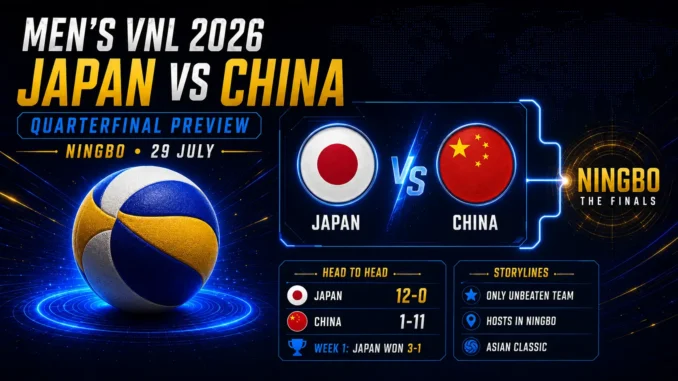

Japan enter the Men’s VNL 2026 Finals as the only undefeated team, while hosts China arrive after finishing last in the Preliminary Phase. The gap is enormous on paper, but this Asian rivalry still gives the top seeds a meaningful knockout test: can Japan turn a perfect 12–0 campaign into a semifinal place, or can China use the home crowd, block and serving pressure to make the favorite uncomfortable?
| Quick SummaryJapan finished first at 12–0 and 30 points; China finished 18th at 1–11 and four points.The quarterfinal starts on July 29 at 19:30 in Ningbo (14:30 Kyiv time).Japan lead the VNL head-to-head 5–1 and won this season’s meeting 3–1.China’s clearest route to resistance is aggressive serving, strong middle-blocker involvement and early scoreboard pressure.Japan are clear favorites, but their six tie-break wins show that the perfect record was built on resilience as well as dominance. |
Match Details
| Detail | Information |
|---|---|
| Match | Japan vs China |
| Competition | Men’s VNL 2026 quarterfinal |
| Date | Wednesday, July 29, 2026 |
| Time | 19:30 local time / 11:30 UTC / 14:30 Kyiv time |
| Venue | Ningbo Beilun, China |
| Bracket | Winner faces the winner of Italy vs USA in the semifinal |
For the complete knockout schedule and bracket, see our Men’s VNL 2026 quarterfinal hub.
The Widest Quarterfinal Gap on Paper
Japan and China arrive in Ningbo from opposite ends of the standings. Japan won all 12 Preliminary Phase matches, collected 30 points and posted a 36–15 set record. China won once in 12 matches, earned four points and finished with a 10–33 set record. The hosts reached the Final Eight through the guaranteed berth awarded to the organizing nation under the VNL competition formula.
That contrast makes Japan the overwhelming favorite. It also changes the psychological terms of the match. China can play with little external expectation, while Japan must manage the pressure attached to a quarterfinal they are widely expected to win. A routine victory will be treated as the minimum; any prolonged struggle will immediately raise questions about Japan’s ability to transfer regular-season form into knockout volleyball.
Japan’s Perfect Record Was Built on Resilience
The 12–0 record should not be mistaken for 12 comfortable performances. Japan recorded only three straight-set victories, won three more matches 3–1 and needed a fifth set six times. At 10–0, they had already collected six tie-break wins, including a dramatic reverse sweep against Canada after falling two sets behind.
This is both a strength and a warning. Laurent Tillie’s team repeatedly found solutions under pressure, used its bench effectively and showed excellent emotional control in deciding sets. At the same time, opponents demonstrated that Japan can be disrupted through serving, blocking and sustained physical pressure.
Japan’s depth has been one of the defining features of the campaign. Yuki Ishikawa, Ran Takahashi and Yuji Nishida remain the headline trio, but players such as Tatsunori Otsuka, Kento Miyaura, Shoma Tomita and Masato Kai have also delivered important scoring stretches. That flexibility should help Japan avoid overloading one attacker if China begin well.
What the First Japan–China Match Revealed
The teams met in Linyi on June 13, with Japan winning 3–1 (25–23, 25–22, 20–25, 25–21). The result followed the wider pattern of the rivalry—Japan controlled the match—but China were competitive for long periods and took the third set.
Ran Takahashi led Japan with 21 points, including 14 attacks at a 64% success rate, three aces and two blocks. Yuki Ishikawa added 12 attack points, while Taishi Onodera produced five of Japan’s 10 kill blocks.
China’s best work came through the middle. Zhang Zhejia scored 18 points, attacked at 70% and registered four blocks. Peng Shikun added 11 points and three aces, while Wang Bin contributed 15 points. China made fewer unforced errors and outperformed Japan in blocking, but Japan had more complete production across attack, serve and transition play.
The most useful conclusion is not that China nearly caused an upset. They did not. It is that their block and middle attack created enough problems to prevent a routine Japanese sweep. The quarterfinal challenge is to reproduce that resistance while improving first contact and late-set execution.
The Rivalry Still Matters
Japan lead the all-time VNL series 5–1. China’s only victory came in the teams’ first VNL meeting in 2018, which was also their last win over Japan at a world-level competition. China’s three most recent successes in the rivalry were achieved in Asian continental events.
That history establishes Japan’s global-level control, but the familiarity between the teams still matters tactically. China understand Japan’s speed, combination patterns and defensive persistence. Japan, in turn, know that China’s size at the net can become uncomfortable when the host team serves well and brings its middles into the game.
China’s Route to a Competitive Match
1. Serve with calculated risk: China cannot allow Japan to run a clean, fast offense from perfect reception. The hosts need pressure without giving away long sequences of service errors.
2. Use the middle before the score gets away: Zhang Zhejia and Peng Shikun were central to China’s best phase in the first meeting. Quick attacks and a credible middle threat can hold Japan’s blockers and create better one-on-one opportunities on the wings.
3. Turn block touches into transition chances: China do not need to stuff every attack. Controlled block touches can slow Japan’s speed and give the hosts opportunities to score in transition.
4. Stay composed after Japan’s defensive rallies: Japan often win points that appear lost. China must avoid allowing one spectacular defensive sequence to become a run of three or four points.
5. Keep the first set close: The home crowd becomes a real factor only if China give it a reason to believe. A competitive opening set would increase pressure on the favorite and make the match emotionally different from a routine top-seed quarterfinal.
What Japan Must Avoid
Japan’s greatest danger is not a lack of quality but a loss of discipline. The first meeting included reception problems, nervous phases and inconsistent stretches. A knockout match against the lowest seed can tempt the favorite to chase quick winners or assume that the opponent will eventually collapse.
Japan should be comfortable if they protect first contact, distribute the attack and force China’s wing hitters to score repeatedly against an organized block-defense system. The longer Japan remain patient, the more the difference in depth, transition quality and late-set experience should become visible.
Key Tactical Battles
| Battle | Why It Matters |
|---|---|
| China’s serve vs Japan’s reception | The hosts need to remove Japan’s quick combinations and force more predictable high balls. |
| Japan’s speed vs China’s block | China’s size matters only if the blockers can read the setter and close before Japan attack the seams. |
| Zhang and Peng through the middle | China’s middles produced their strongest advantage in the first meeting and can reduce pressure on the wings. |
| Japan’s wing depth | Ishikawa, Takahashi and Nishida are elite options, but Japan can also change the rhythm through Otsuka, Miyaura and other reserves. |
| Late-set execution | The first two sets in Linyi were close. Japan’s superior composure in the final points remains a major edge. |
Match Outlook
Japan should advance. They have the stronger serve-receive balance, more proven scoring options, a deeper bench and far more evidence of winning difficult endings. China’s home advantage and blocking strength could make one or two sets competitive, especially if Japan begin nervously, but the hosts would need their best serving and attacking performance of the season to sustain an upset attempt.
A three- or four-set Japanese victory is the most realistic outcome. The more important question for the top seeds is whether they can win with control, protect energy for the semifinal and show that last year’s quarterfinal exit has strengthened rather than haunted them.
FAQ
When is Japan vs China in the Men’s VNL 2026 quarterfinal?
The match is scheduled for Wednesday, July 29, at 19:30 local time in Ningbo, 11:30 UTC and 14:30 in Kyiv.
Why did China qualify after finishing 18th?
China received the guaranteed Final Phase berth reserved for the host nation under the VNL competition formula.
What was the result of their 2026 Preliminary Phase meeting?
Japan defeated China 3–1 in Linyi on June 13, winning 25–23, 25–22, 20–25 and 25–21.
What is the VNL head-to-head record?
Japan lead the VNL series 5–1. China’s only VNL victory over Japan came in 2018.
Who will the winner face in the semifinal?
The winner will play the winner of the Italy vs USA quarterfinal.
Are Japan clear favorites?
Yes. Japan finished 12–0 and China 1–11, but China’s home support and blocking give the hosts a path to making individual sets competitive.


Be the first to comment