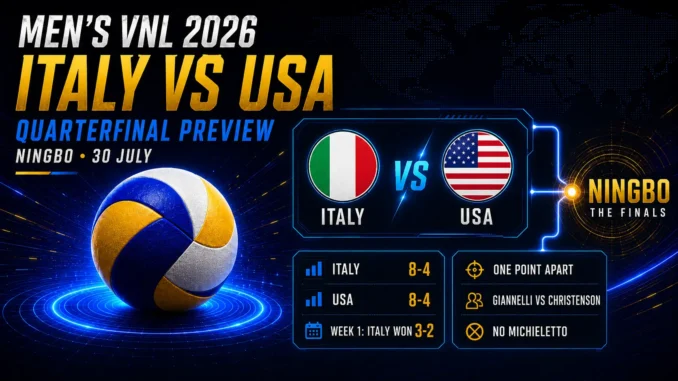

Italy enter Ningbo with stronger late-round momentum but without Alessandro Michieletto, while USA bring Micah Christenson, T.J. DeFalco and a roster much closer to full strength than in the teams’ first meeting.
Match: Thursday, 30 July 2026 – 15:00 in Ningbo, 10:00 Kyiv time. The quarterfinal winner advances to face Japan or China in the semifinals.
Italy and the United States meet in the Men’s Volleyball Nations League 2026 quarterfinal with almost nothing separating them in the table. Both finished the Preliminary Phase at 8-4. Italy took fourth place with 26 points, while USA were fifth with 25. The one-point gap accurately reflects a matchup between two teams with championship-level experience, elite setters and enough serving power to change a set in a few rotations.
The teams have already played once this season, with Italy winning 3-2 in Ottawa. That result matters less than it first appears. Both sides used experimental combinations and played without their primary setters, Simone Giannelli and Micah Christenson. The knockout match in Ningbo will feature different systems, stronger lineups and no space for long-term testing.
This detailed preview is part of our Men’s VNL 2026 quarterfinal hub, which includes the full schedule, bracket and links to every match preview.
Match Details
| Detail | Information |
|---|---|
| Round | Men’s VNL 2026 quarterfinal |
| Date | Thursday, 30 July 2026 |
| Venue | Ningbo Beilun, China |
| Start time | 15:00 local / 10:00 Kyiv / 07:00 UTC |
| Seeds | Italy 4th; USA 5th |
| Semifinal path | Winner faces Japan or China |
Italy vs USA at a Glance
| Category | Italy | USA |
|---|---|---|
| Preliminary record | 8-4 | 8-4 |
| Match points | 26 | 25 |
| Sets won-lost | 30-18 | 29-16 |
| Final seed | 4th | 5th |
| Recent VNL history | Runners-up in 2025 | Last medal: silver in 2023 |
| Week 3 finish | Three consecutive wins | Two consecutive losses |
| Confirmed major absence | Alessandro Michieletto | None announced |
A Familiar Rivalry With a Different Quarterfinal Context
Italy and USA have met 60 times at major world-level tournaments, with Italy holding a 32-28 advantage. Their VNL record is exactly level at 4-4. The American team’s most recent victory in the rivalry came in the Paris 2024 Olympic bronze-medal match, when USA won in straight sets. Italy then took the next two meetings, in VNL 2025 and VNL 2026.
History therefore offers support for both sides. USA have the most recent knockout victory and the deeper VNL medal record, with three silvers and one bronze. Italy are the reigning world champions and reached their first VNL podium last year, finishing second after fourth-place results in 2022 and 2023. Neither team have won the competition, so one established international power will leave Ningbo after a single match.
Why the 3-2 Match in Ottawa Is Not a Quarterfinal Blueprint
Italy won the June 14 meeting 25-18, 15-25, 25-19, 18-25, 15-10. The alternating set scores showed how quickly control changed, but the personnel makes direct conclusions risky. Micah Ma’a set for USA, while Paolo Porro ran Italy’s offence. Christenson and Giannelli did not play.
| Team | Key Week 1 combination | What changes in Ningbo |
|---|---|---|
| Italy | Paolo Porro; Luca Porro; Bottolo; Rychlicki; Mati; Sanguinetti | Giannelli and Sbertoli available; Romanò, Lavia, Galassi, Russo and Balaso in the Finals roster |
| USA | Ma’a; Hanes; Anderson; Ewert; Jendryk; Averill | Christenson and DeFalco available; Anderson, Hanes, Averill and Shoji remain in the core |
The first meeting still revealed useful qualities. Italy’s wider system survived heavy rotation: 22-year-old Luca Porro scored 23 points, Mattia Bottolo added 14 and young middle Pardo Mati reached double figures. USA generated major pressure through Jake Hanes, who finished with 25 points, including five aces. The lesson is not that Italy’s main lineup is already superior. It is that both programmes have enough depth to remain competitive when the expected starters change.
The quarterfinal should be faster and more organised. With Giannelli and Christenson, both teams can involve the middle more consistently, attack on second contact, change tempo after poor reception and manage late-set distribution with greater precision. The Ottawa result belongs in the background, not at the centre of the prediction.
Italy: Better Momentum, Less Margin Without Michieletto
Italy completed Week 3 with a 3-1 record. They lost a five-set match to unbeaten Japan, then swept Belgium and Argentina before defeating Cuba 3-1. After the Japan match, they won nine of their final ten sets and arrived at the Finals with a clearer first-choice structure than they had during the opening weeks.
Giannelli’s return restored the team’s familiar rhythm. His value is not limited to distribution: he reached 100 career VNL kill blocks during the win over Argentina and remains a direct scoring threat at the net. Yuri Romanò also produced a strong finish, scoring 12 points against Belgium, 15 against Argentina and 17 against Cuba. Mattia Bottolo carried a larger role throughout the Preliminary Phase and finished with 155 points, giving Italy a proven wing scorer even when the lineup changed.
The major limitation is confirmed. Alessandro Michieletto is not in Italy’s 14-player Finals roster. The Italian federation announced that he will continue an individual recovery programme at Viola Park from July 29 to August 4. His appearance in an earlier training camp did not lead to a competitive return. He will not play against USA.
| Confirmed lineup factor Italy will play without Alessandro Michieletto. Daniele Lavia and Mattia Bottolo are the established outside-hitter options in the 14-player roster, with Luca Porro and Francesco Sani providing alternatives. |
Michieletto’s absence matters most when reception breaks down. Italy lose one of their best high-ball attackers, a powerful server and a large blocking presence on the left side. The replacement group is still strong, but Lavia and Bottolo now carry more reception and transition responsibility. Giannelli will need the middle attack and Romanò to remain active so the American block cannot load its best resources toward the outside hitters.
USA: Close to Full Strength, but Which Version Will Appear?
USA Volleyball named 15 players for the trip to Ningbo. The group includes three setters – Christenson, Ma’a and Andrew Rowan – along with Anderson, DeFalco, Hanes, Cole Hartke, four middle blockers and two liberos. Unlike Italy, the Americans have not announced a comparable absence from their established core.
Their final week showed two very different versions of the team. USA opened in Chicago by sweeping China and Brazil. The Brazil performance was particularly significant: DeFalco scored 18 points and produced seven aces as the Americans secured qualification. At that level, their serve can break even a high-quality reception line and allow the block-defence system to control the next contact.
The week then turned. USA lost 1-3 to Bulgaria and 0-3 to Poland. DeFalco and Hanes remained dangerous, but the attack became easier to read and the Americans struggled to stop opponents from building scoring runs. The Poland match ended 20-25, 21-25, 19-25, leaving USA with two consecutive defeats before travelling to China.
That finish creates a psychological question rather than a talent question. The American roster contains enough experience to reset: Christenson controls the system, Erik Shoji stabilises the back court, Anderson offers high-pressure experience and DeFalco can take over a match from the service line. The challenge is to reproduce the organised, aggressive version that swept Brazil rather than the flatter version that closed the Preliminary Phase.
The Setter Duel Changes Everything
Giannelli versus Christenson is the clearest reason the Week 1 match should not be treated as a rehearsal. Both setters can turn an ordinary reception into a full-width offence. They attack on second contact, score on the block and understand how to manipulate a middle blocker before releasing the ball to the wing.
For Italy, Giannelli’s priority will be to prevent the absence of Michieletto from making the attack predictable. That means using Galassi, Russo or Sanguinetti early, keeping Romanò involved from both the front and back row, and giving Lavia and Bottolo favourable one-on-one situations rather than repeated high balls against a formed block.
For USA, Christenson must find a stable balance between Hanes, the middle attack and the Anderson-DeFalco pairing. When the American reception moves off the net, the offence can narrow toward the left side and opposite. Italy’s block is experienced enough to recognise that pattern. Christenson’s ability to keep the middle credible after imperfect passes may be one of the match’s decisive details.
Five Tactical Questions That Could Decide the Quarterfinal
1. Can USA remove Italy’s middle attack with the serve?
USA’s best route is to force Giannelli away from the net. DeFalco, Hanes and Anderson can all serve aggressively, but the risk level must be controlled. A high error count would give Italy easy side-outs and allow Giannelli to keep every attacker involved. The American serve needs to create repeatable high-ball situations, not merely occasional highlight aces.
2. How will Italy replace Michieletto in difficult rotations?
Italy can replace a position, but not every function Michieletto performs. Lavia and Bottolo must cover the reception load, score in transition and handle difficult balls. Luca Porro or Sani may be used to change the balance, but the safest solution is structural: stable passing, active middles and enough Romanò production that no outside hitter is forced to carry every broken play.
3. Can Hanes stay efficient against Italy’s formed block?
Hanes scored 25 points in Ottawa and finished the Preliminary Phase with 157. His height and serving power make him a central threat, but Italy will have more experienced blockers and a more familiar defensive system than in Week 1. USA need to create cleaner situations for him rather than repeatedly asking him to beat a settled double block from a high ball.
4. Which outside-hitter pair wins the all-around battle?
Lavia and Bottolo against Anderson and DeFalco is not only a scoring comparison. Each pair must receive under pressure, defend transition swings and remain available after long rallies. DeFalco has the highest single-rotation serving ceiling. Italy may have the more stable collective passing structure. Whichever pair limits errors while still creating points will give its setter a much wider tactical field.
5. Who handles the first major momentum swing?
The Ottawa meeting alternated sharply from set to set, and both teams showed similar volatility in Week 3. A quarterfinal can turn on one bad serving rotation or a sequence of blocked high balls. The more important skill may be recovery: ending a run quickly, changing a matchup before the set is lost and avoiding the emotional carry-over that turns one poor rotation into an entire poor set.
What Italy Need to Do
- Protect reception so Giannelli can use the middle and avoid a predictable high-ball offence.
- Spread the scoring load across Romanò, Bottolo, Lavia and the central attackers.
- Serve at USA’s passing seams without giving Christenson too many free first-tempo situations.
- Build the block around Hanes when the American reception is off the net.
- Use the bench early if the outside-hitter balance becomes too heavy in reception or attack.
What USA Need to Do
- Reproduce the serving pressure shown in the 3-0 win over Brazil.
- Keep Hanes efficient by involving the middle and preventing Italy from setting the block early.
- Use Anderson and DeFalco as complementary attackers rather than allowing the offence to narrow to one wing.
- Target the Italian outside hitters and test how the team reorganises without Michieletto.
- Stay patient after long Italian side-out phases and avoid the error runs seen against Poland.
Outlook: Italy Are Slight Favourites, Not Clear Favourites
Italy deserve a narrow advantage. They finished one point higher, won their final three Preliminary Phase matches and have a settled tactical identity around Giannelli. Their block and middle attack give them several ways to control a match even when the wing scoring is not perfect.
The gap is reduced by Michieletto’s absence and by the quality of the American roster. USA arrive with Christenson, Anderson, DeFalco, Hanes, Averill and Shoji available. Their 3-0 victory over Brazil showed a level high enough to eliminate any team in Ningbo. The two defeats that followed showed why the fifth seed remains difficult to predict.
The most likely shape is a long, tactical match in which serving runs and reception stability create the separation. Italy appear slightly more reliable over several sets, while USA may have the more explosive single-rotation weapon through DeFalco’s serve. Four or five sets would be a natural outcome. Italy are the marginal pick to advance, but this is much closer to a 50-50 quarterfinal than the seedings suggest.
Frequently Asked Questions
When is Italy vs USA in the Men’s VNL 2026 quarterfinal?
The match is scheduled for Thursday, 30 July 2026 at 15:00 local time in Ningbo, which is 10:00 in Kyiv and 07:00 UTC.
Who won the first Italy vs USA match in VNL 2026?
Italy won 3-2 in Ottawa on June 14. The set scores were 25-18, 15-25, 25-19, 18-25 and 15-10.
Did Giannelli and Christenson play in the first meeting?
No. Paolo Porro set for Italy and Micah Ma’a set for USA. Giannelli and Christenson are available for the Finals, making the quarterfinal tactically different from the Week 1 match.
Will Alessandro Michieletto play against USA?
No. Michieletto is not in Italy’s 14-player Finals roster and will continue his individual recovery programme in Italy from July 29 to August 4.
Who are the main attacking players to watch?
Italy will look to Yuri Romanò, Mattia Bottolo and Daniele Lavia. USA have Jake Hanes at opposite and the experienced outside-hitter pairing of Matt Anderson and T.J. DeFalco.
Who will the winner face in the semifinal?
The winner will face the winner of Japan vs China in one of the semifinals on August 1.
Quick Summary
- Italy finished fourth at 8-4 and 26 points; USA were fifth at 8-4 and 25.
- Italy won the Week 1 meeting 3-2, but both teams played without their primary setters.
- Giannelli and Christenson will give the quarterfinal a faster and more complete tactical structure.
- Italy are without Alessandro Michieletto, who remains on an individual recovery programme.
- USA have named a strong 15-player group including Christenson, Anderson, DeFalco, Hanes and Shoji.
- Italy ended the Preliminary Phase with three wins; USA ended with losses to Bulgaria and Poland.
- The winner advances to face Japan or China in the semifinal.
Last updated: 28 July 2026.

Be the first to comment