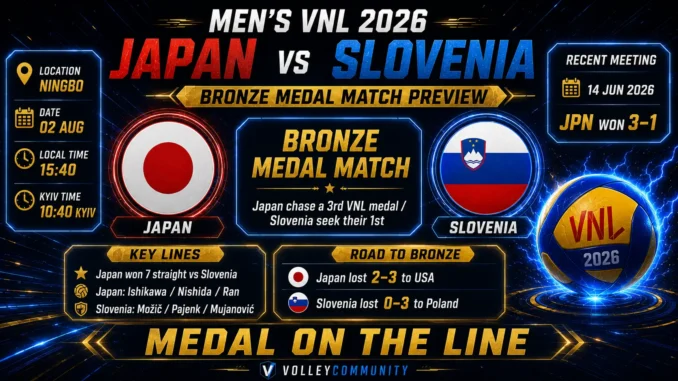

Japan chase a third VNL medal in four seasons, while Slovenia have another opportunity to turn repeated Final Four appearances into their first podium finish.
Japan and Slovenia meet for the bronze medal at the Men’s Volleyball Nations League 2026 Finals in Ningbo on Sunday. The matchup brings together two teams dealing with very different semifinal experiences: Japan pushed USA through five dramatic sets before falling 2–3, while Slovenia were swept 0–3 by Poland and never managed to establish sustained pressure.
The historical stakes are just as contrasting. Japan are trying to collect their third VNL medal after bronze in 2023 and silver in 2024. Slovenia have finished fourth in 2021, 2024 and 2025 and now have another chance to secure the first VNL medal in the country’s history.
Match Details
| Match | Japan vs Slovenia |
| Stage | Men’s VNL 2026 Bronze Medal Match |
| Date | Sunday, 2 August 2026 |
| Time | 15:40 local time / 10:40 Kyiv time |
| Venue | Ningbo Beilun Sports and Arts Centre, Ningbo Beilun, China |
| Nominal host | Japan |
Two Very Different Semifinal Defeats
Japan came within three points of the final. They recovered from losing the opening set against USA, won the second and third, and then fought back from 8–10 down to lead 12–11 in the tie-break. The decisive turn came at 12–12, when Ethan Champlin entered as a serving substitute and USA won two consecutive break points during his service turn. The Americans eventually closed the match 15–13.
The five-set semifinal lasted 2 hours 41 minutes and placed a heavy physical and emotional demand on Japan. Still, the performance showed that their speed, defence and wing attack remained competitive against one of the most physical teams in the tournament. Yuji Nishida scored 19 points, Yuki Ishikawa added 18 and Ran Takahashi contributed 13.
Slovenia’s semifinal was shorter but much more one-sided. Poland controlled the serve-block battle and won 25–16, 25–19 and 25–17. Slovenia were outscored 35–25 in attack, 12–6 on block and 9–3 on serve. Alen Pajenk delivered 11 points, including four blocks and two aces, but Rok Možič, Nik Mujanović and Tine Urnaut were unable to provide enough production from the wings.
That creates the central recovery question: Japan have less physical recovery after a long five-set battle, while Slovenia have more time and energy but must rebuild their confidence and attacking rhythm after a semifinal in which they never threatened Poland.
Historical VNL Stakes
Japan have already established themselves as a regular VNL medal contender. Their first medal came with bronze in 2023, followed by a historic silver in 2024. A victory in Ningbo would give Japan three medals in four seasons and confirm the continuity of their rise among the leading men’s national teams.
For Slovenia, the match carries a different emotional weight. They finished fourth in 2021, 2024 and 2025. Reaching another bronze medal match proves their consistency, but another defeat would extend one of the most frustrating podium droughts in the competition. Sunday is another opportunity to convert years of Final Four experience into a first VNL medal.
Japan are chasing their third VNL medal in four seasons. Slovenia are chasing the first medal in their VNL history.
Recent Head-to-Head: Japan Hold a Clear Advantage
Japan have won seven consecutive meetings with Slovenia, including six straight victories in their VNL series since 2022. Across the nine most recent matches listed below, Japan lead 7–2 in wins and 22–9 in sets.
| Date | Competition | Result |
| 14 Jun 2026 | VNL | Slovenia 1–3 Japan |
| 29 Jun 2025 | VNL | Slovenia 0–3 Japan |
| 29 Jun 2024 | VNL | Slovenia 0–3 Japan |
| 8 Jun 2024 | VNL | Japan 3–1 Slovenia |
| 7 Oct 2023 | Olympic Qualification | Japan 3–0 Slovenia |
| 20 Jul 2023 | VNL | Japan 3–0 Slovenia |
| 26 Jun 2022 | VNL | Japan 3–1 Slovenia |
| 22 Jun 2021 | VNL | Japan 0–3 Slovenia |
| 14 Sep 2018 | World Championship | Japan 1–3 Slovenia |
The trend is especially strong inside the VNL: Japan have won six of the last seven VNL meetings, with an 18–6 set advantage. Slovenia’s only VNL victory in this sequence came in 2021.
What Happened in Their 2026 Meeting?
Japan defeated Slovenia 3–1 in Linyi on 14 June: 25–27, 25–16, 25–22, 25–22. Slovenia took a tight opening set, but Japan responded with three consecutive set wins and finished with a 100–87 advantage in total points.
| Statistic | Slovenia | Japan |
| Attack points | 51 | 60 |
| Block points | 9 | 4 |
| Serve points | 7 | 7 |
| Opponent errors | 20 | 29 |
| Total points | 87 | 100 |
Yuki Ishikawa led Japan with 23 points, Yuji Nishida scored 17 and Ran Takahashi added 16. For Slovenia, Tine Štern scored 21, Nik Mujanović had 18 and Žiga Šen contributed 11.
The June match is useful, but it is not a complete blueprint for the bronze medal contest. Rok Možič and Tine Urnaut did not play in that meeting, while Pajenk did not make a scoring contribution. Slovenia used a different attacking structure, whereas Japan fielded much of the core expected to carry the load again in Ningbo.
Japan: Can the Hosts Recover in Time?
Japan’s biggest challenge is recovery. Their semifinal was longer, more emotional and played later in the day. Ishikawa, Nishida and Ran all carried significant attacking and reception responsibilities, and the team had to defend through many extended rallies.
Tactically, Japan should still feel confident. Their speed can force Slovenia’s block to move laterally, and the recent head-to-head record suggests that Slovenia have repeatedly struggled to control Japan’s tempo. Japan also showed against USA that different leaders can take over at different moments: Ishikawa drove the second set, Nishida dominated the third, and Ran remained a reliable option through the tie-break.
- Keep the reception stable enough to use the full width of the net.
- Avoid long high-ball sequences against Slovenia’s physical block.
- Use serve placement and defence to create transition opportunities rather than chasing only ace volume.
- Manage the workload of Ishikawa, Nishida and Ran after the five-set semifinal.
Slovenia: One More Chance to Break the Podium Barrier
Slovenia need a far stronger performance from the service line than they produced against Poland. Without serve pressure, Japan can play at the speed that has caused Slovenia problems throughout the recent rivalry. Pajenk was the only Slovenian who consistently disrupted Poland, but a middle blocker cannot carry the scoring burden alone.
Možič, Mujanović and Urnaut must provide more efficient wing scoring. Against Poland, they combined for only 19 points and repeatedly struggled with the block. Slovenia’s path to bronze depends on creating a different attacking picture: stronger first contact, more central involvement and enough pressure from the service line to prevent Japan from running a clean side-out system.
- Re-establish serve pressure after producing only three aces in the semifinal.
- Use Pajenk and the other middles early to hold Japan’s blockers in the centre.
- Find a reliable high-ball option when rallies become extended.
- Turn the frustration of three previous fourth-place finishes into controlled urgency rather than forcing the game.
Five Tactical Questions That Could Decide the Bronze
Can Japan recover physically? The hosts have less time after a 2-hour-41-minute semifinal and may need to manage their main attackers carefully.
Can Slovenia serve well enough to slow Japan? This is likely the most important tactical question. Japan become much harder to block when the reception allows a fast, balanced offence.
Will Slovenia’s wing attackers rebound? Možič, Mujanović and Urnaut must offer far more than they did against Poland.
Can Japan avoid Slovenia’s block? Slovenia won the block battle 9–4 in the June meeting even though they lost 1–3. Japan must vary tempo, direction and combinations.
Who handles the emotional reset better? Japan lost a match they nearly won; Slovenia never entered their semifinal. The team that processes disappointment more quickly may control the opening set.
Match Outlook
Japan enter with the stronger head-to-head record, the better recent VNL medal history and a semifinal performance that was much closer to championship level. Those factors make the nominal hosts the more convincing side on paper.
However, this is not a routine rematch of the June encounter. Japan have to recover from five demanding sets, while Slovenia had a shorter semifinal and carry the urgency of another opportunity to win their first VNL medal. If Slovenia can serve aggressively and bring Možič and Mujanović into the match, the contest should be much closer than the recent head-to-head sequence suggests.
Japan’s speed and deeper recent experience in medal matches give them a slight edge, but the opening set will be especially important. A fast Japanese start could revive the pressure created by seven consecutive wins in the rivalry. A strong Slovenian start could turn the match into a physical battle and reopen the question of Japan’s recovery.
Quick Summary
- Japan face Slovenia in the Men’s VNL 2026 bronze medal match on 2 August at 15:40 local time in Ningbo.
- Japan are seeking their third VNL medal after bronze in 2023 and silver in 2024.
- Slovenia are still chasing their first VNL medal after finishing fourth in 2021, 2024 and 2025.
- Japan have won seven consecutive head-to-head meetings and beat Slovenia 3–1 earlier in the 2026 VNL.
- Japan lost a dramatic five-set semifinal to USA; Slovenia were swept by Poland.
- The key battle is Japan’s speed and reception against Slovenia’s serve and block.
Frequently Asked Questions
When is the Japan vs Slovenia bronze medal match?
The match is scheduled for Sunday, 2 August 2026 at 15:40 local time in Ningbo, which is 10:40 in Kyiv.
Where will Japan vs Slovenia be played?
The match will take place at the Ningbo Beilun Sports and Arts Centre in Ningbo Beilun, China.
Who is the nominal home team?
Japan are listed as the nominal home team.
Has Japan won a VNL medal before?
Yes. Japan won bronze in 2023 and silver in 2024.
Has Slovenia ever won a VNL medal?
No. Slovenia finished fourth in 2021, 2024 and 2025 and are still seeking their first medal.
Who won the most recent Japan vs Slovenia match?
Japan won 3–1 on 14 June 2026 after Slovenia took the opening set.
What is the recent head-to-head record?
Japan have won seven consecutive meetings and lead the last nine-match sequence 7–2.
Related Coverage
Japan 2–3 USA: Men’s VNL 2026 Semifinal Report — Japan’s five-set semifinal and the decisive tie-break sequence.
Slovenia 0–3 Poland: Men’s VNL 2026 Semifinal Report — how Poland’s serve and block controlled the first semifinal.
Men’s VNL 2026 Quarterfinals Hub — tournament path, matchups and knockout-stage coverage.

Be the first to comment