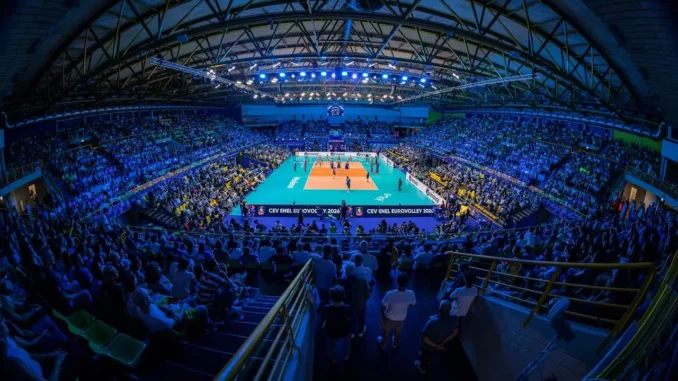

Italy were the only unbeaten team, Ukraine finished second in a three-way Pool B battle, Belgium won the tournament’s most unpredictable group, and injury-hit Türkiye became the biggest casualty of the opening phase.
GROUP STAGE REVIEW | 9-17 September 2026
The 60-match group stage of Men’s EuroVolley 2026 is complete, and the first phase produced a mixture of expected power, genuine surprises and standings that need more context than the final win-loss records alone can provide.
Italy were the only team to finish 5-0. Poland, Belgium and France also won their pools, but all three finished 4-1. Ukraine and Bulgaria joined Poland on four wins in Pool B, while Pool C delivered almost exactly the kind of instability expected from the most balanced group in the tournament.
The biggest story, however, came from Pool D. Türkiye arrived in Cluj-Napoca only weeks after finishing sixth in the 2026 VNL Preliminary Phase and reaching the VNL Finals for the first time in team history. Five EuroVolley matches later, they were out – fifth in the pool with a 1-4 record.
That result cannot be separated from a severe injury situation. Türkiye had already lost Efe Mandıracı and Bedirhan Bülbül before the tournament, and the list grew during the group stage to include Mirza Lagumdžija, Berkay Bayraktar and Adis Lagumdžija, while Cafer Kirkit was also limited by injury. By the decisive match against Latvia, the roster no longer resembled the full-strength version that had impressed during the VNL.
At the same time, not every late defeat by a favorite deserves the same interpretation. Poland had already secured first place before losing 2-3 to Bulgaria and used the match with more freedom in their rotation. France’s final-day 2-3 loss to Romania likewise had no effect on first place in Pool D. Those results belong in the record, but they should not be treated in the same way as results that decided qualification or exposed a structural problem.
For the competition format, tiebreakers and fixed Round of 16 crossover, see our Men’s EuroVolley 2026 Format & Rules guide.
Group Stage at a Glance
| Category | Group-stage result |
| Matches played | 60 |
| Teams | 24 |
| Teams advancing | 16 |
| Teams eliminated | 8 |
| Pool winners | Italy, Poland, Belgium, France |
| Only unbeaten team | Italy – 5-0 |
| Tightest top three | Pool B – Poland, Ukraine and Bulgaria all 4-1 |
| Biggest surprise elimination | Türkiye – 1-4 in Pool D |
| Winless teams | Slovakia and Netherlands – both 0-5 |
Pool A – Italy Stay Perfect, Slovenia Recover and Greece Climb to Third
| Pos. | Team | W-L | Sets | Points |
| 1 | Italy | 5-0 | 15-4 | 14 |
| 2 | Slovenia | 3-2 | 12-7 | 10 |
| 3 | Greece | 3-2 | 10-9 | 9 |
| 4 | Czechia | 3-2 | 11-9 | 8 |
| 5 | Sweden | 1-4 | 6-13 | 4 |
| 6 | Slovakia | 0-5 | 3-15 | 0 |
Pool A came closest to following the pre-tournament script. Italy finished first, Slovenia took second, and the main fight was over how Greece and Czechia would arrange themselves behind the two strongest teams.
Italy’s first place was never seriously in doubt. The world champions won all five matches and finished 15-4 in sets. Czechia pushed them, Slovakia stole a set, and Slovenia forced the final match all the way to a tie-break, but Italy still left the pool as the only unbeaten team in the entire tournament.
The final 3-2 against Slovenia was a useful test rather than a warning sign. Slovenia had already secured knockout volleyball and showed enough quality to push Italy for five sets, but the broader group-stage picture still points in the same direction: Italy remain one of the clearest reference teams in the championship.
Slovenia’s only real deviation from expectation was the 1-3 defeat to Greece. That result cost them the chance to challenge Italy more directly for first place, yet three wins and 10 points were still enough for a comfortable second-place finish.
Greece produced the most interesting trajectory in the group. They began with a 1-3 loss to Czechia and then lost 0-3 to Italy, leaving little margin for error. Instead of fading, they responded with three consecutive wins – including the defining 3-1 upset of Slovenia – and climbed all the way to third place.
That recovery also created one of the table’s unusual details: Greece finished above Czechia despite losing their direct meeting. Both teams ended 3-2, but Greece collected one more standings point. Czechia still qualified in fourth after winning three of their first four matches before losses to Italy and Slovenia.
Sweden’s return to EuroVolley produced one victory, against Slovakia, but not enough consistency to threaten the top four. Slovakia finished 0-5, although taking sets from Slovenia and Italy showed that the final zero in the win column did not mean every match was straightforward.
Pool B – Poland, Ukraine and Bulgaria Separate from the Rest
| Pos. | Team | W-L | Sets | Points |
| 1 | Poland | 4-1 | 14-3 | 13 |
| 2 | Ukraine | 4-1 | 12-5 | 12 |
| 3 | Bulgaria | 4-1 | 13-6 | 11 |
| 4 | Portugal | 1-4 | 5-12 | 4 |
| 5 | North Macedonia | 1-4 | 3-12 | 3 |
| 6 | Israel | 1-4 | 5-14 | 2 |
No pool created a clearer division between the leading teams and the bottom half. Poland, Ukraine and Bulgaria all finished 4-1. Portugal, North Macedonia and Israel managed only one victory each.
Poland secured first place with four straight wins, all in straight sets, including a 3-0 victory over Ukraine in the direct meeting that ultimately decided the top of the table. Their final 2-3 defeat to Bulgaria should be read with context: Poland could no longer fall from first place before the match, and the result came in a situation where tournament urgency was very different for the two teams.
Ukraine can take a great deal from second place. They opened with four consecutive wins and, most importantly, beat hosts Bulgaria 3-1 in front of 11,689 spectators in Sofia. That was not a low-stakes result. Bulgaria were still fighting for the top positions, had strong home support behind them and had every reason to treat the match as one of the key tests of the pool.
Ukraine controlled enough of that match to earn all three points, then swept Portugal before the loss to Poland. A 4-1 record and 12 points leave Raul Lozano’s team with a strong group-stage foundation and a Round of 16 place earned through results against both the lower half and one of the pool’s other major contenders.
Bulgaria also finished on four wins and closed the group with the eye-catching 3-2 victory over Poland. It was still a valuable result, but it does not completely rewrite the hierarchy because Poland had already solved the question of first place. Bulgaria’s more meaningful setback was the 1-3 loss to Ukraine, which left them third despite matching both teams above them on victories.
The fight for fourth was much messier. Israel entered the final stretch with a realistic route to qualification, but a 0-3 defeat to North Macedonia in their last match destroyed that opportunity. North Macedonia finally earned their first win of the tournament, yet it was Portugal who benefited most. Portugal had already beaten North Macedonia 3-0 and, despite finishing with only one victory, held enough standings value to take the fourth and final ticket.
Pool B therefore produced two very different competitions at the same time: a high-level three-team race at the top and a survival contest below it in which one win was ultimately enough to advance.
Pool C – Belgium Win the Most Unpredictable Group, Denmark Earn Their Place
| Pos. | Team | W-L | Sets | Points |
| 1 | Belgium | 4-1 | 14-6 | 13 |
| 2 | Finland | 4-1 | 14-7 | 11 |
| 3 | Serbia | 3-2 | 9-11 | 7 |
| 4 | Denmark | 2-3 | 9-9 | 7 |
| 5 | Estonia | 2-3 | 8-12 | 5 |
| 6 | Netherlands | 0-5 | 6-15 | 2 |
Pool C was expected to be the most balanced group, and it delivered. Almost every round produced a match in which the nominal favorite looked vulnerable, and the final standings contain both one of the strongest pool winners and one of the tournament’s biggest negative surprises.
Belgium finished first because they were the most stable team across five matches. Their only defeat came in a five-set battle with Finland, at a point when nothing had been settled. They then beat Estonia, Denmark and, most decisively, Serbia 3-0 on the final day. Four wins, 13 points and a 14-6 set record were enough to take the group.
Finland were every bit as dangerous as expected at home. They beat Belgium 3-2 and swept Serbia 3-0, two results that showed they could handle the strongest teams in the pool. The only reason they did not finish first was the final-day 2-3 defeat to Estonia – another reminder that in this group there was no comfortable match simply because the table said one team was higher than another.
Serbia probably leave the first phase with more questions than expected. They lost 0-3 to both Finland and Belgium and needed major recoveries elsewhere: the Netherlands led them 2-0 before Serbia escaped 3-2, and Denmark also went two sets up before Serbia came back to win in five. Third place is enough to advance, but the path there was far less controlled than a team of Serbia’s experience would have wanted.
Denmark’s fourth place is one of the best positive surprises of the group stage – and it was earned directly on court. They beat both of their main rivals for the final knockout place, sweeping the Netherlands and Estonia 3-0. They also took a set from Belgium and were close to a much bigger result when they led Serbia 2-0 before losing the tie-break.
That makes fourth place surprising, but not accidental. Denmark won the exact matches they needed to win.
The Netherlands are the opposite story. Sixth place and a 0-5 record look shocking for a team with much higher expectations, but the table is harsher than some of the performances: they lost 2-3 to both Finland and Serbia. Still, close losses remain losses, and the 0-3 defeat to Denmark became particularly damaging because it was against a direct qualification rival.
Estonia finished fifth despite two wins, including the final-day upset of Finland. Their problem was timing and accumulated points: by the time they delivered one of their best performances, Denmark had already built the stronger qualification case.
Pool D – Türkiye Crash Out as France Rebuild Their Authority
| Pos. | Team | W-L | Sets | Points |
| 1 | France | 4-1 | 14-4 | 13 |
| 2 | Germany | 4-1 | 12-7 | 11 |
| 3 | Romania | 3-2 | 12-10 | 9 |
| 4 | Latvia | 2-3 | 8-11 | 6 |
| 5 | Türkiye | 1-4 | 6-12 | 3 |
| 6 | Switzerland | 1-4 | 5-13 | 3 |
Pool D produced the biggest shock of the entire group stage: Türkiye did not qualify for the Round of 16.
That outcome would have looked extremely unlikely two months earlier. Türkiye finished sixth in the 2026 VNL Preliminary Phase with an 8-4 record and 22 points and reached the VNL Finals for the first time in team history. They arrived at EuroVolley looking capable not only of qualifying, but of challenging France and Germany for the top of the pool.
Instead, the tournament became a battle against attrition. Efe Mandıracı and Bedirhan Bülbül were already unavailable before EuroVolley. During the competition, Mirza Lagumdžija, libero Berkay Bayraktar and opposite Adis Lagumdžija also suffered injury problems. Cafer Kirkit was then hurt as well and was unable to function normally in the outside-hitter role. By the deciding match against Latvia, Adis, Mirza and Berkay were unavailable, while Kirkit was listed as a second libero despite his physical problem.
The results reflected the growing damage. Türkiye lost 1-3 to Germany and 0-3 to France, recovered with a 3-0 win over Switzerland, then lost 1-3 to Romania. That left the final match against Latvia as a direct survival game.
Latvia took the opportunity. Their 3-1 victory was not the product of a complicated tiebreak calculation – they won the match that decided the last ticket and earned fourth place themselves. Three of the four sets were decided by two points, but Latvia held their nerve in the key moments and then dominated the fourth 25-16.
The pressure inside the Turkish camp also appeared to be rising. In its post-match report, the Latvian Volleyball Federation contrasted Latvia’s unity with visible frustration in the Turkish team, noting tense looks and sharper exchanges between players and staff. That observation should not be turned into a diagnosis of the team’s internal relationships, but it fits the visible picture of a squad dealing simultaneously with injuries, defeats and a shrinking margin for error.
Romania are the other major positive story in Pool D. Third place with three wins was already above many expectations, and they finished with a 3-2 victory over France. The result deserves credit as a strong home performance, but it should not be presented as proof that France suddenly lost control of the group: France had already secured first place before the match.
More broadly, France look dangerous again. Their 2026 VNL ended with a 10th-place Preliminary Phase finish at 6-6, well below the standard associated with the two-time Olympic champions. EuroVolley has looked different. France swept Switzerland and Türkiye, beat Latvia 3-1 and defeated Germany 3-0 in the match that mattered most for first place. The final loss to Romania changes the record, not the main conclusion: France have started to look like a major tournament force again.
Germany were solid rather than spectacular, finishing 4-1 and second. Their only defeat was the 0-3 loss to France, while the rest of the pool produced enough points to keep them safely above the qualification battle.
What the Final Standings Do Not Tell You
Group-stage tables are useful, but they flatten the competitive context of the last round.
Bulgaria’s 3-2 win over Poland and Romania’s 3-2 win over France are both officially important results, but neither had the same tournament meaning as Latvia’s 3-1 win over Türkiye or North Macedonia’s 3-0 win over Israel.
Poland had already guaranteed first place in Pool B before facing Bulgaria. France were also locked into first in Pool D before playing Romania. In both cases, the favorite could approach the match with less standings pressure and more flexibility in lineup management.
Latvia and Türkiye had no such cushion. Their match directly decided who advanced. Israel also entered its final game still able to reach the Round of 16, then lost to North Macedonia and watched Portugal take the final Pool B place.
That distinction matters when evaluating form. A late defeat by a favorite can be real without being equally predictive. Knockout volleyball resets the motivational landscape: every match now carries the same consequence.
Five Main Takeaways from the Group Stage
Italy remain the benchmark: Five wins, no defeats and the only perfect win-loss record in the tournament. Slovenia made the finale difficult, but nobody found a way to beat Italy.
Türkiye are the biggest casualty: A team that finished sixth in the VNL Preliminary Phase and reached the Finals for the first time was eliminated in fifth place after a severe run of injuries and only one EuroVolley win.
Ukraine earned more than qualification: Four wins and second place are strong, but the 3-1 victory over Bulgaria in front of 11,689 spectators is the result that most clearly supports Ukraine’s knockout credentials.
Belgium handled chaos better than anyone in Pool C: Finland beat them, but Belgium were steadier across the full schedule and closed the group with a 3-0 win over Serbia.
Denmark’s qualification was deserved: They beat both the Netherlands and Estonia 3-0 and pushed Serbia from a 2-0 lead. Fourth place was unexpected before the tournament, not undeserved after it.
Round of 16 Matchups
The final pool positions now feed directly into the fixed crossover. Pools A and C meet in Turin, while Pools B and D cross in Sofia. There is no reseeding.
| Host | Round of 16 matchup | Crossover |
| Turin | Italy vs Denmark | A1 vs C4 |
| Turin | Belgium vs Czechia | C1 vs A4 |
| Turin | Slovenia vs Serbia | A2 vs C3 |
| Turin | Finland vs Greece | C2 vs A3 |
| Sofia | Poland vs Latvia | B1 vs D4 |
| Sofia | France vs Portugal | D1 vs B4 |
| Sofia | Ukraine vs Romania | B2 vs D3 |
| Sofia | Germany vs Bulgaria | D2 vs B3 |
The crossover immediately rewards the teams that protected first place. Italy draw Denmark, Poland face Latvia, Belgium meet Czechia and France take on Portugal.
For Ukraine, second place creates a Round of 16 meeting with Romania rather than France. That is a direct consequence of beating Bulgaria and collecting enough points to stay above the hosts in Pool B.
The two most intriguing second-versus-third matches may be Slovenia vs Serbia and Germany vs Bulgaria. Serbia’s group stage was uneven but their ceiling remains high, while Bulgaria now carry home support into the knockout phase in Sofia.
Greece vs Finland is another matchup shaped by opposite group-stage paths: Greece recovered from an 0-2 start to finish third, while Finland were one final-day win away from taking Pool C.
Final Takeaway
The group stage did not destroy the pre-tournament hierarchy, but it changed enough of it to make the knockout bracket more interesting.
Italy look exactly as strong as expected. Poland remain a major contender despite the final-day loss that came after first place was already secure. France have recovered much of the authority missing from their VNL campaign, and Belgium turned consistency into first place in the most unstable pool.
Ukraine’s second place is one of the strongest positive outcomes of the opening phase, particularly because it included a direct win over motivated hosts Bulgaria. Denmark also earned their surprise qualification through direct results against the teams they needed to beat.
The biggest rewrite is Türkiye. Their VNL suggested a team moving upward; EuroVolley instead became a tournament of injuries, reduced options and growing pressure, ending before the Round of 16.
Now the context changes completely. Rotation, protected first places and points calculations disappear. Sixteen teams remain, every match is single elimination, and the group-stage explanations only matter if the teams can turn them into one more win.
Editorial Note
This review covers the completed Men’s EuroVolley 2026 pool phase through 17 September 2026. Final standings, win-loss records, set records and match scores reflect the completed 60-match group stage.
Comments about expectations, motivation, rotation, overperformance, underperformance and tournament momentum are VolleyCommunity editorial analysis. Poland’s and France’s final-day defeats are discussed with the standings context that both teams had already secured first place before those matches.
Türkiye injury context is based on Turkish federation and volleyball-media reporting available during and immediately after Pool D. The Latvian Volleyball Federation’s post-match report is used only for its direct observation of visible frustration during the decisive Latvia-Türkiye match, not as proof of any broader internal-team conclusion.
VNL comparisons use the official 2026 Volleyball World Preliminary Phase standings.




Be the first to comment