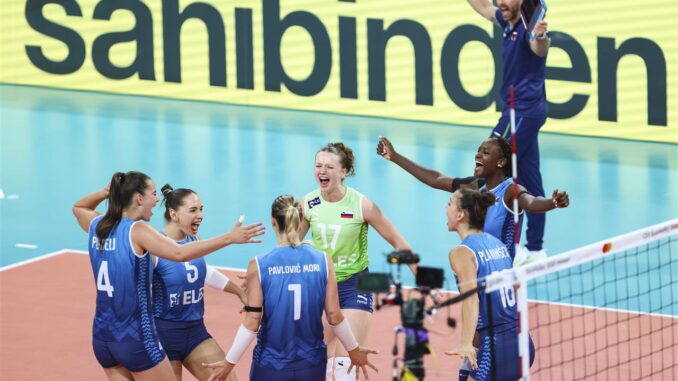

Half of Saturday’s eight matches went to a deciding set, Slovenia produced the day’s biggest upset with a straight-set win over Germany, and several pre-match favorites discovered that nothing would come easily on Day 2.
DAY 2 RESULTS | 22 August 2026
Day 2 of Women’s EuroVolley 2026 delivered the first real wave of tournament drama. Four of the eight matches went to five sets, one of the strongest pre-match favorites was swept, and several teams that were expected to win needed late recoveries to avoid early trouble.
The biggest result came in Istanbul, where Slovenia beat Germany 3–0 despite trailing for significant stretches of all three sets. In Baku, both Belgium and the Netherlands survived five-set scares. Sweden also needed a tie-break after losing a 2–0 lead against Slovakia, while Greece recovered from a 1–2 deficit to beat Ukraine in another match that could have major consequences for Pool B.
Italy and Czechia were the two teams that most closely followed the expected script, both winning in straight sets with control. Poland also won 3–0, but Hungary pushed the world No. 5 particularly hard in the second set.
For context before the matches, see our Women’s EuroVolley 2026 Day 2 Preview. You can also revisit the Day 1 Results and the full Tournament Preview.
Day 2 Results at a Glance
| Pool | Match | Result | Sets |
|---|---|---|---|
| A | Germany vs Slovenia | 0–3 | 22–25, 21–25, 20–25 |
| A | Hungary vs Poland | 0–3 | 12–25, 24–26, 20–25 |
| B | Ukraine vs Greece | 2–3 | 23–25, 25–23, 25–12, 22–25, 10–15 |
| B | Austria vs Czechia | 0–3 | 16–25, 17–25, 17–25 |
| C | Belgium vs Spain | 3–2 | 25–15, 18–25, 23–25, 25–17, 15–8 |
| C | Romania vs Netherlands | 2–3 | 21–25, 28–26, 15–25, 25–22, 9–15 |
| D | Italy vs Montenegro | 3–0 | 25–13, 25–20, 25–19 |
| D | Slovakia vs Sweden | 2–3 | 22–25, 16–25, 25–14, 25–22, 6–15 |
Slovenia Stun Germany — and Win Every Key Moment
The biggest surprise of the day was not simply that Slovenia beat Germany, but that they did it in straight sets: 25–22, 25–21, 25–20. Germany entered the match ranked No. 12 in the world, seven places above Slovenia, and repeatedly put themselves in positions to win sets. They still could not finish any of them.
The opening set began with Slovenia racing to a 7–1 lead. Germany recovered, levelled at 13–13 and briefly moved in front, only for Slovenia to regain control late. The pattern reversed in the second: Germany led 9–4 and 12–7, but Slovenia caught them at 14–14, stayed level through the closing phase and took the final points when the set tightened.
The third set followed the same logic. Germany built advantages at 12–8 and 15–11, yet Slovenia again erased the gap, reached 16–16 and 17–17, and then took over the finish. The 3–0 score therefore hides an important part of the match: Germany were competitive for long periods, but Slovenia were much better when every set reached its decisive phase.
Fatoumatta Sillah was the outstanding individual performer with 24 points, including 20 winning attacks and four blocks. No other Slovenian reached double figures. It was exactly the kind of result that validates Slovenia’s pre-tournament dark-horse status — and immediately changes the hierarchy of Pool A.
Belgium Survive Spain After Falling 1–2 Behind
Belgium were clear pre-match favorites against Spain, and after taking the first set 25–15 it looked as if the match might follow expectations. Instead, Spain changed the rhythm completely, winning the next two sets 25–18 and 25–23 to move within one set of the upset.
Even at 1–2, however, Belgium still looked capable of finding another level. They did exactly that. The fourth set swung back decisively at 25–17, and the tie-break was even more convincing at 15–8. Across those final two sets Belgium outscored Spain 40–25 and finally imposed the difference that had been expected before first serve.
Britt Herbots finished with 25 points and Pauline Martin added 23, while Julia De Paula matched Herbots with 25 for Spain. Belgium got the win, but Spain also left the opener with a ranking point and evidence that Pool C may be less predictable than it appeared before the tournament.
Netherlands Need Five Sets to Escape Romania
A few hours later, the other major Pool C favorite had similar problems. The Netherlands, ranked No. 8 in the world, were pushed to five sets by Romania before finally winning 25–21, 26–28, 25–15, 22–25, 15–9.
Romania had chances much earlier than the final score might suggest. They led 17–14 and 18–15 in the first set before the Dutch closed strongly. After losing that set, Romania answered by taking the second 28–26. The Netherlands restored order with a dominant 25–15 third set, but Romania again refused to go away and forced the tie-break by winning the fourth 25–22.
Only in the fifth did the favorite finally look secure, opening a 10–4 advantage and closing at 15–9. Elles Dambrink led the Netherlands with 24 points, while Indy Baijens added 20. The result gives the Dutch the win, but together with Belgium’s five-set battle it leaves a clear Day 2 message: the leading teams in Pool C were both tested immediately.
Greece Stop Ukraine’s Comeback in a Five-Set Thriller
Ukraine and Greece entered their second Pool B match after opening-day defeats, which made the result especially important. Greece eventually won 3–2 — 25–23, 23–25, 12–25, 25–22, 15–10 — but the match changed direction several times before the decisive set.
Greece controlled much of the first set. The second was more even, but the Greek side moved ahead 16–12 before Ukraine changed both setter and opposite. Stanislava Parfonova and Viktoriia Danchak came onto the court, the attack became more direct and aggressive, and Ukraine reduced the deficit. Greece still reached 23–20, but a late serving run from Valeriia Nud’ha, pressure on the Greek reception and stronger Ukrainian defence turned the set around for a 25–23 win — Ukraine’s first set victory of EuroVolley 2026.
Parfonova and Danchak stayed in the starting lineup for the third set, and Ukraine carried the momentum into their best volleyball of the tournament, overwhelming Greece 25–12. At that point the match looked transformed. Greece, however, responded after 7–7 in the fourth with five straight points to establish a 12–7 lead. Ukraine returned to their original setting option later in the set but never fully recovered the same attacking rhythm, and Greece forced the tie-break 25–22.
The fifth set stayed level to 5–5 before Greece edged ahead 7–5 and steadily increased the gap. Martha Anthouli finished the match with 28 points. Ukraine actually won the total points 105–100, but Greece won the moments that decided the match.
The result is a major step for Greece in the fight to reach the Round of 16. Ukraine now have one ranking point from two defeats and almost no margin for error. The next match against Austria has become close to must-win; after that come Czechia and Serbia, where Ukraine are likely to enter as underdogs. Their path is still open mathematically, but it has become extremely narrow.
Sweden Nearly Lose a 2–0 Lead — Then Haak Takes Over
Sweden’s second match was supposed to strengthen their dark-horse case. It ultimately did, but only after a major scare. The hosts led Slovakia 2–0 after winning 25–22 and 25–16, then completely lost control of the third set 14–25 and dropped the fourth 22–25.
With the match suddenly at 2–2, Sweden faced the possibility of wasting a position that had looked comfortable less than an hour earlier. Their response was emphatic: 5–1 at the start of the tie-break, then 10–6 and finally 15–6.
Isabelle Haak carried an enormous attacking load and finished with 38 points, including 35 winning spikes. Slovakia’s Karin Sunderlikova answered with 26. The match was played in front of 6,220 spectators in Scandinavium, a new attendance record for Sweden’s women’s national team.
Sweden are now 2–0, which keeps the dark-horse narrative alive, but the match also exposed a vulnerability: they can lose structure and momentum for long stretches. The positive side is that when the match reached its most dangerous moment, Sweden still had the star power to dominate the deciding set.
Poland Win 3–0, but Hungary Make Them Work
Poland’s 3–0 win over Hungary looks routine in the results table, but the middle of the match was anything but. Poland dominated the first set 25–12 and led 13–5 in the second, at which point a quick finish looked likely.
Hungary then changed the tone of the match, improving their block and defence and eventually moving in front 23–22. Poland escaped the set 26–24, but the warning was clear. Hungary carried the confidence into the third and stayed level until 20–20 before Poland closed with five straight points.
Anett Németh was the match’s top scorer with 22 points for Hungary. Magdalena Stysiak led Poland with 15, while Maja Koput added 12 points and five blocks. Poland got the expected result, but their lapse in the second set showed why Pool A may punish any favorite that loses concentration.
Italy and Czechia Deliver the Day’s Most Controlled Wins
While much of Day 2 was defined by comebacks and five-set tension, Italy and Czechia largely avoided it. Italy beat Montenegro 25–13, 25–20, 25–19 for a second consecutive straight-set victory in Gothenburg. Ekaterina Antropova led the scoring with 13 points and produced six aces, while Paola Egonu added 11.
Italy also used the match to rotate their options, but the level remained stable. After two matches they are 2–0 without dropping a set, exactly the kind of start expected from the world No. 1 team.
Czechia were similarly convincing at home, beating Austria 25–16, 25–17, 25–17. Michaela Mlejnková led the Czech scoring with 13 points, while Magdalena Jehlářová contributed nine points and four blocks. The hosts are now 2–0 in Pool B and have taken maximum points from their opening two matches.
Austria, by contrast, remain without a set win after straight-set defeats to Serbia and Czechia. That makes their next match against Ukraine highly important for both teams at the lower end of the Pool B race.
What Day 2 Changed
Slovenia are no longer just a theoretical dark horse. A straight-set win over Germany gives their pre-tournament momentum a major result at EuroVolley itself.
Pool C looks more open than expected. Belgium and the Netherlands both won, but both needed five sets against lower-ranked opponents.
Sweden have two wins — and a warning sign. Their home run continues, but losing a 2–0 lead against Slovakia showed that the team can be destabilised.
Czechia are building real home momentum. Two wins from two and maximum points put the hosts in a strong early position in Pool B.
Ukraine’s qualification path is now extremely narrow. One point from two matches means Austria is close to must-win, with Czechia and Serbia still ahead.
Italy are doing exactly what favorites should do. Two matches, two 3–0 wins, and no unnecessary drama so far.
Day 2 by the Numbers
| Statistic | Day 2 |
|---|---|
| Matches played | 8 |
| Five-set matches | 4 |
| Straight-set wins | 4 |
| Biggest upset | Slovenia 3–0 Germany |
| Top scorer | Isabelle Haak — 38 points |
| Highest attendance | 6,220 — Slovakia vs Sweden |
| Teams still perfect after playing twice | Italy, Sweden, Czechia |
Final Takeaway
Day 1 introduced the tournament; Day 2 made it unpredictable. Slovenia produced the clearest upset so far, four matches went to tie-breaks, and three teams that were expected to win — Belgium, the Netherlands and Sweden — needed all five sets to do it.
The early standings are beginning to take shape, but the more important development is that several pre-tournament assumptions have already been challenged. Slovenia look more dangerous than their ranking suggested. Pool C’s favorites are vulnerable. Sweden continue to win but are not untouchable. And in Pool B, every lost point is becoming expensive very quickly.
Italy and Czechia were the clearest exceptions. Both handled their assignments without drama and left Day 2 with exactly the kind of position they wanted. For everyone else, the European Championship has already started asking harder questions.
Editorial Note
This article combines official CEV match data with VolleyCommunity’s match-flow observations from Day 2. Interpretive comments about momentum, tactical changes and attacking rhythm are editorial analysis rather than official CEV assessments.



Be the first to comment