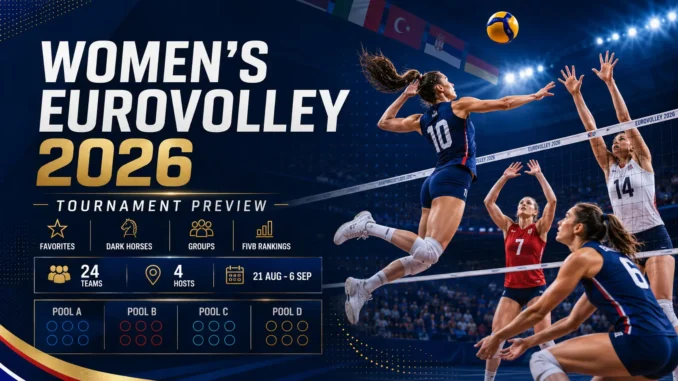

Italy arrive as reigning Olympic and world champions, Türkiye come in as VNL 2026 winners, and a deep European field makes the 34th Women’s EuroVolley one of the most open continental tournaments in years.
PRE-TOURNAMENT SNAPSHOT | Rankings, form and roster information checked through 19 August 2026
Women’s EuroVolley 2026 begins on 21 August with 24 national teams spread across four host countries and four six-team pools. By 6 September, the field will have been reduced through the Round of 16, quarterfinals and semifinals to the two teams fighting for European gold in Istanbul.
The headline is easy to identify: Italy are still the team everyone has to catch. The Azzurre are No. 1 in the FIVB World Ranking, the reigning Olympic and world champions, and they reached another international podium with bronze at the 2026 Volleyball Nations League. But they are not entering an empty race. Türkiye arrive as the new VNL champions, Poland remain a top-five team with a strong recent medal record, Serbia carry one of the deepest championship pedigrees of the last decade, and the Netherlands have climbed back into the world top eight.
Behind them is a second layer that could make the tournament especially interesting. Sweden enter their home pool after a perfect European League campaign, Czechia combine a rising ranking with home-court advantage in Brno, and Slovenia have continued to move upward internationally. Those teams may not begin the event among the obvious title favorites, but they have the profile to disrupt the bracket.
For a full explanation of the group phase, points system, tiebreakers and knockout crossover, see our Women’s EuroVolley 2026 Format & Rules guide.
Women’s EuroVolley 2026 at a Glance
| Category | Details |
|---|---|
| Dates | 21 August – 6 September 2026 |
| Teams | 24 |
| Hosts | Türkiye, Czechia, Azerbaijan, Sweden |
| Pools | 4 groups of 6 teams |
| Teams advancing | Top 4 from each pool |
| Knockout field | 16 teams |
| Total matches | 76 |
| Final weekend | Istanbul, Türkiye |
| Pre-tournament FIVB No. 1 | Italy |
| Defending European champions | Türkiye |
| 2026 VNL champions | Türkiye |
The Power Picture Before First Serve
The current FIVB ranking gives us a useful first snapshot of the field, but it should not be treated as a complete prediction. Rankings reward recent international results; championship pedigree tells us who has repeatedly handled knockout pressure; and current form can move faster than either.
Among the 24 EuroVolley participants, five teams begin inside the world top 10: Italy (#1), Türkiye (#3), Poland (#5), the Netherlands (#8) and Serbia (#10). Germany (#12), Czechia (#14), France (#15), Belgium (#16), Ukraine (#18) and Slovenia (#19) create a large second tier that is strong enough to punish any poor group-stage performance.
The Main Favorites
Italy — Still the Team to Beat
Italy have the strongest overall case. They are No. 1 in the world, Olympic champions from Paris 2024 and world champions from 2025. Their 2026 VNL campaign did not end with another title, but a bronze medal after a 10–2 preliminary phase still confirmed that their floor remains extremely high.
Julio Velasco’s final EuroVolley group again contains elite options across every line. Alessia Orro and Carlotta Cambi are the setters; Paola Egonu is listed among the opposites; Anna Danesi and Sarah Fahr anchor the middle; Myriam Sylla remains an experienced receiving option. The most intriguing roster detail is Ekaterina Antropova being listed among the outside hitters, giving Italy a possible route to use Antropova and Egonu in the same lineup. Loveth Omoruyi misses the tournament after an injury suffered during the final preparation period.
Italy also won their final preparation tournament in Koszalin, beating France, Ukraine and Poland. They do not need to be flawless to be favorites; their combination of depth, recent titles and multiple high-level attacking solutions gives them more ways to win than any other team in the field.
Türkiye — The Hottest Challenger
Türkiye enter EuroVolley with the freshest major trophy. They won the 2026 VNL in Macao, defeating Brazil in the final, and Melissa Vargas was named tournament MVP. That title was Türkiye’s second VNL crown after 2023 and adds to a run that already includes the EuroVolley 2023 title and a historic silver medal at the 2025 World Championship.
The ranking now places Türkiye at No. 3 in the world. More importantly, their last three seasons show that this is no longer a team trying to break into the elite. Türkiye have become an established championship team capable of winning a short knockout tournament. They also play Pool A in Istanbul, giving them home support before the tournament returns to the same city for the medal stage.
Poland — A Top-Five Team With Something Still to Prove
Poland begin at No. 5 in the FIVB ranking and have one of the most consistent recent VNL records in Europe: three consecutive bronze medals in 2023, 2024 and 2025. They also reached the quarterfinals at Paris 2024 and the 2025 World Championship.
There is, however, a reason to place them just behind Italy and Türkiye. Poland finished eighth in the 2026 VNL preliminary phase and did not reach the Finals. Their final EuroVolley roster was announced on 19 August and includes Magdalena Stysiak, Martyna Czyrniańska and Katarzyna Wenerska among the central names. The ceiling is clearly medal level, but Pool A gives Poland little room for a slow start.
Established Contenders
Serbia — The Ranking Undersells the Pedigree
Serbia are only No. 10 in the current ranking, but no serious preview can treat them as an ordinary tenth-ranked team. Across our 2016–2026 window they won the 2018 and 2022 World Championships, the 2017 and 2019 European Championships, Olympic silver in 2016 and bronze in 2020, and then added EuroVolley silver in both 2021 and 2023.
Their 2026 VNL was modest — 11th in the preliminary phase — but Serbia travelled to Brno with a 15-player group that included Tijana Bošković, Maja Ognjenović, Aleksandra Uzelac, Hena Kurtagić and Mina Popović. That mix of proven champions and younger high-level talent makes Serbia one of the hardest teams to price. If their best lineup finds rhythm, they can outperform the ranking by several places.
Netherlands — Back in the Top Eight
The Netherlands arrive at No. 8 in the world after a solid 2026 VNL, where they finished seventh in the preliminary phase and qualified for the VNL Finals for the first time. Their recent championship history also carries weight: Olympic fourth place in 2016, World Championship fourth place in 2018, EuroVolley silver in 2017 and bronze in 2023.
Pool C offers a realistic opportunity to build momentum. Belgium are dangerous, but the Dutch begin as the highest-ranked team in the group and should view first place as a realistic target. A strong pool finish matters because Pool C crosses with Pool A in the Round of 16, where the difference between first and third can dramatically change the difficulty of the first knockout match.
Dark Horses: Who Could Break Into the Medal Race?
Sweden — Home Court, Haak and a Perfect Summer
Sweden are the clearest dark-horse candidate. They are only No. 21 in the FIVB ranking, but the ranking does not fully capture their 2026 momentum. Sweden won the CEV European League with ten consecutive victories and defeated Slovenia in two five-set finals. That followed their European Golden League title in 2024.
They also play Pool D at home in Gothenburg. Italy are the obvious favorite in the group, but France, Slovakia, Croatia and debutants Montenegro create a path where Sweden can realistically fight for second place. With Isabelle Haak as the central attacking reference and a home crowd behind them, Sweden have the ingredients of a team capable of turning a good group phase into a dangerous knockout run.
Czechia — A Rising Team With a Home Path
Czechia are No. 14 in the world and finished 10th in the 2026 VNL preliminary phase. Those numbers alone make them competitive with most of the field outside the top favorites. The extra factor is geography: they play Pool B in Brno, and Brno also hosts four Round of 16 matches and two quarterfinals.
A top-two finish in Pool B could therefore create a very valuable home-court runway. Serbia remain the biggest name in the group, but Czechia enter with a higher current ranking and more stable recent results than several of their direct rivals.
Slovenia — Momentum Meets a Brutal Pool
Slovenia are No. 19 and reached the final of the 2026 European League after a strong campaign, losing only to Sweden in the two-match title series. Their first World Championship appearance in 2025 also accelerated their rise in the FIVB ranking.
The problem is Pool A. Türkiye, Poland and Germany all begin above Slovenia in the world ranking, so the margin for error is small. That is also what makes Slovenia interesting: if they can steal a result from one of the top three, they can change both the pool order and the A–C side of the knockout bracket.
Two More Teams to Watch: France and Belgium
France and Belgium sit at No. 15 and No. 16 respectively, but their recent profiles are very different. France reached the quarterfinals of the 2025 World Championship yet finished only 17th in the 2026 VNL. Belgium finished 13th in the VNL and enter Pool C as the second-highest ranked team behind the Netherlands. Neither starts as a medal favorite, but both have enough quality to punish a favorite that lands in the wrong Round of 16 matchup.
Group-by-Group Preview
Pool A — Türkiye, Poland, Germany, Slovenia, Hungary, Latvia
Pool A is the strongest group at the top. Türkiye (#3) and Poland (#5) are both genuine medal candidates, Germany (#12) are a top-12 team, and Slovenia (#19) arrive with upward momentum. Hungary (#26) are capable of making the qualification battle uncomfortable, while Latvia (#65) return to EuroVolley for the first time since 1997.
The four qualifying places look relatively clear on paper, but the order is anything but settled. First place is especially valuable because Pool A crosses with Pool C, and avoiding the Netherlands or Belgium early could matter.
Pool B — Serbia, Czechia, Ukraine, Greece, Bulgaria, Austria
Pool B may be the most balanced group from first to fifth. Serbia (#10), Czechia (#14) and Ukraine (#18) form a compact leading trio in the ranking, while Greece (#29) and Bulgaria (#31) are close enough to challenge for qualification. Austria (#43) return to the European Championship for the first time since 1971.
Serbia have the deepest historical pedigree, Czechia have home-court advantage and the best 2026 VNL finish among the group, and Ukraine enter after their first VNL season. Bulgaria’s seventh place at EuroVolley 2023 is a reminder that a lower current ranking does not make them harmless.
Pool C — Netherlands, Belgium, Romania, Spain, Portugal, Azerbaijan
Pool C has the clearest ranking hierarchy. The Netherlands (#8) and Belgium (#16) begin well ahead of Romania (#28) and Spain (#30), while Portugal (#48) and hosts Azerbaijan (#49) are close together at the lower end.
The Dutch should be favored to win the pool, but second place could be important enough to turn Belgium’s matches against Romania and Spain into some of the group’s key fixtures. Azerbaijan also have a notable historical reference point: they finished fourth at EuroVolley 2017.
Pool D — Italy, France, Sweden, Slovakia, Croatia, Montenegro
Italy (#1) are the clear favorite, but the fight behind them should be one of the tournament’s best subplots. France (#15) have a high recent World Championship ceiling, Sweden (#21) arrive in outstanding European League form, and Slovakia (#35) and Croatia (#40) both have recent EuroVolley knockout experience.
Montenegro (#47) are the only first-time participants in the 2026 field. For them, simply reaching the Round of 16 would be an historic achievement. For Sweden, meanwhile, second place is a realistic ambition — and perhaps the starting point for something larger.
FIVB Ranking of All 24 EuroVolley 2026 Teams
The table below uses the FIVB women’s world ranking snapshot available on 19 August 2026, before the first EuroVolley matches.
| Among Euro teams | Team | FIVB rank | Points | Pool |
|---|---|---|---|---|
| 1 | Italy | 1 | 461.17 | D |
| 2 | Türkiye | 3 | 388.35 | A |
| 3 | Poland | 5 | 338.37 | A |
| 4 | Netherlands | 8 | 292.64 | C |
| 5 | Serbia | 10 | 276.38 | B |
| 6 | Germany | 12 | 253.62 | A |
| 7 | Czechia | 14 | 220.41 | B |
| 8 | France | 15 | 207.28 | D |
| 9 | Belgium | 16 | 195.58 | C |
| 10 | Ukraine | 18 | 188.10 | B |
| 11 | Slovenia | 19 | 182.01 | A |
| 12 | Sweden | 21 | 180.54 | D |
| 13 | Hungary | 26 | 149.28 | A |
| 14 | Romania | 28 | 142.40 | C |
| 15 | Greece | 29 | 138.71 | B |
| 16 | Spain | 30 | 137.04 | C |
| 17 | Bulgaria | 31 | 136.02 | B |
| 18 | Slovakia | 35 | 128.23 | D |
| 19 | Croatia | 40 | 110.34 | D |
| 20 | Austria | 43 | 92.37 | B |
| 21 | Montenegro | 47 | 84.53 | D |
| 22 | Portugal | 48 | 84.16 | C |
| 23 | Azerbaijan | 49 | 77.36 | C |
| 24 | Latvia | 65 | 58.89 | A |
Recent Tournament Pedigree: Why the Ranking Is Not the Whole Story
A ranking snapshot is most useful when paired with what teams have actually done in major tournaments. The table below highlights the most relevant championship results from the 2016–2026 window.
| Team | Major results / recent pedigree |
|---|---|
| Italy | Olympic gold 2024; World gold 2025, silver 2018, bronze 2022; EuroVolley gold 2021; VNL gold 2022/2024/2025, bronze 2026 |
| Türkiye | EuroVolley gold 2023; World silver 2025; Olympic 4th 2024; VNL gold 2023 and 2026 |
| Poland | VNL bronze 2023/2024/2025; Olympic QF 2024; World QF 2022 and 2025; EuroVolley 4th 2019 |
| Serbia | World gold 2018 and 2022; EuroVolley gold 2017 and 2019; Olympic silver 2016, bronze 2020; Euro silver 2021/2023 |
| Netherlands | Olympic 4th 2016; World 4th 2018; EuroVolley silver 2017, bronze 2023 |
| Germany | EuroVolley 6th 2019; World 11th 2018 |
| Czechia | EuroVolley 8th 2023; World 18th 2022; 10th in VNL 2026 |
| France | World QF 2025; EuroVolley 6th 2023 |
| Belgium | World 9th 2022; EuroVolley 9th 2019 |
| Ukraine | EuroVolley 9th 2023; World 17th 2025; VNL debut 2026 |
| Slovenia | World Championship debut 2025 (Round of 16); European League runner-up 2026 |
| Sweden | EuroVolley 8th 2021; European Golden League champions 2024; European League champions 2026 |
| Bulgaria | EuroVolley 7th 2023; World 11th 2018 |
| Azerbaijan | EuroVolley 4th 2017; World 15th 2018 |
Five Storylines to Watch
1. Can Italy hold every major crown at once? Italy already own the Olympic and world titles. A EuroVolley victory would complete an extraordinary cycle and restore the European crown they last won in 2021.
2. Can Türkiye defend Europe after winning the VNL? Türkiye are the defending European champions and the 2026 VNL winners. Repeating as EuroVolley champions would confirm that the 2023 breakthrough has become sustained dominance.
3. Which version of Serbia will appear? No team has a bigger gap between current ranking and championship pedigree. Serbia’s group stage should tell us quickly whether their experienced core is ready for another deep run.
4. Is Sweden ready for a breakthrough on home soil? Ten straight European League wins make Sweden the tournament’s most obvious dark horse. The first target is a top-two finish in Pool D; after that, the bracket can open.
5. How much will pool position matter? With A crossing C and B crossing D, finishing first or second is not just cosmetic. A single group-stage upset can move a contender into a much harder Round of 16 and reshape an entire half of the bracket.
Final Outlook
Italy enter Women’s EuroVolley 2026 as the most complete favorite. Their ranking, recent championship record, depth and final preparation all support that position. Türkiye are the strongest direct challenger and perhaps the team carrying the best immediate momentum after winning the VNL.
Poland belong in the medal conversation but arrive with more questions after missing the 2026 VNL Finals. Serbia and the Netherlands form the next tier: Serbia because their championship pedigree remains exceptional, the Netherlands because their ranking and 2026 form have moved back in the right direction.
The most interesting upset candidates are Sweden, Czechia and Slovenia. Sweden have the best dark-horse profile because form, star power and home court all point in the same direction. Czechia’s home route in Brno can become a major advantage, while Slovenia’s growth makes them a dangerous team trapped in a difficult group.
The safest prediction is not that the tournament will be predictable, but that group position will matter more than usual. With 16 of 24 teams advancing, the first week is less about simple survival for the favorites and more about earning the right knockout path. That is where EuroVolley 2026 may begin to separate the teams capable of reaching the Round of 16 from the teams capable of reaching Istanbul.
Frequently Asked Questions
Who are the favorites to win Women’s EuroVolley 2026?
Italy and Türkiye begin as the two strongest favorites. Poland are also a major medal contender, while Serbia and the Netherlands have realistic paths to the podium.
Who is the biggest dark horse?
Sweden stand out because they enter on a ten-match winning run in the 2026 European League, play the group phase at home in Gothenburg and are led by elite opposite Isabelle Haak.
Which is the strongest group?
Pool A is the strongest at the top, with Türkiye, Poland and Germany all ranked inside the world top 12. Pool B is arguably the most balanced from first to fifth.
How many teams advance from each pool?
The top four teams from each six-team pool advance to the Round of 16.
Why can a lower-ranked team still be dangerous?
The FIVB ranking measures current results, but knockout volleyball also rewards experience, matchup quality and short-term form. Serbia are the clearest example: No. 10 in the ranking, but two-time world champions within the last decade.
Editorial Note
This article is intentionally written as a pre-tournament snapshot. FIVB ranking positions and points reflect the list available on 19 August 2026, while roster and injury references reflect official federation announcements available before opening day. The article is not intended as a live tournament tracker.



Be the first to comment