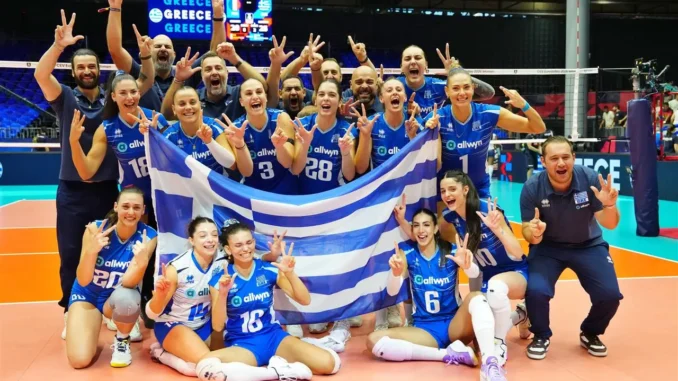

Greece produced the first major upset of the Women’s EuroVolley 2026 knockout stage with a commanding straight-set victory over France, before Serbia recovered from a surprising opening-set defeat to Croatia and booked their own place in the quarterfinals.
ROUND OF 16 RESULTS | 30 August 2026 | Brno
The knockout stage of Women’s EuroVolley 2026 began with two matches that initially appeared capable of turning the bracket upside down.
Greece did exactly that.
After France had finished second in Pool D with four wins from five matches and had established themselves as one of the most consistent teams outside the main title favorites, Greece eliminated them 3-0 without allowing the match to develop into a prolonged battle.
A few hours later, Croatia threatened an even bigger surprise by taking the opening set against unbeaten Pool B winners Serbia. This time, however, the favorite found an answer. Serbia raised their attacking level, took control at the net and became increasingly dominant as the match progressed, winning the next three sets 25-19, 25-17 and 25-12.
The two winners will now meet in the quarterfinals, creating a rematch of their Pool B encounter earlier in the tournament.
Women’s EuroVolley 2026 Round of 16 Results – 30 August
| Match | Result | Set scores |
| France vs Greece | 0-3 | 16-25, 18-25, 20-25 |
| Serbia vs Croatia | 3-1 | 19-25, 25-19, 25-17, 25-12 |
France 0-3 Greece – Greece Turn an Upset Opportunity Into Complete Control
France entered the Round of 16 with one of the strongest group-stage records among the teams that had not won their pools.
They had swept Slovakia, Croatia and Montenegro, became the only Pool D team to take a set from Italy and then defeated hosts Sweden 3-1 in the direct battle for second place.
Greece had followed a much less predictable route. They lost their opening match against Czechia before changing the direction of their tournament with a five-set victory over Ukraine, then collected the results needed to finish third in Pool B.
That made Greece dangerous.
What happened in Brno went considerably further.
This was not an upset built on one dramatic fifth set, a late collapse by the favorite or a handful of points at the end of three close sets. Greece established control early and never really surrendered it.
Greece Set the Tone Immediately
France stayed within touching distance early in the opening set, but Greece were already ahead 8-6 at the first major scoring checkpoint.
By 16-11, the separation had become significant.
The Greek advantage then expanded to 21-13 before the set ended 25-16.
The manner of the opening set mattered almost as much as the score. Greece were producing points through several routes, while France struggled to establish the attacking rhythm that had made them so reliable during the pool stage.
Greece also created immediate pressure through their block and serve, recording three aces and four blocks in the first set alone.
France were suddenly facing elimination volleyball from behind.
France Stay Closer, but Greece Win the Key Passage
The second set initially offered France more hope.
Greece led only 8-7 at the first checkpoint, and France remained close enough at 14-16 to make the set feel open.
Then came one of the decisive passages of the match.
Greece turned a two-point advantage into a 21-15 lead, taking control of the middle-to-late section of the set before closing it 25-18.
Instead of responding after the difficult opener, France were now two sets down and had yet to force Greece into a truly uncomfortable finish.
That was becoming the defining feature of the match.
Whenever France appeared close enough to change the emotional direction of the contest, Greece produced the next important run.
France Make One Final Push – Greece Answer Again
The third set became France’s best opportunity to extend the match.
Greece once again created the first meaningful separation, moving ahead 8-4 and then 16-12. At 21-16, another straight-set finish appeared close.
France finally pushed back.
They reduced the deficit to 21-19, bringing themselves within two points and creating the first moment in which Greece faced genuine late-set pressure.
It lasted only briefly.
Greece won four of the final five points and completed the upset 25-20.
The final scoreline – 25-16, 25-18, 25-20 – tells an important story. France became progressively more competitive, but never enough to take control of a set. Greece were ahead at every 8-, 16- and 21-point checkpoint across all three sets.
They did not steal a close knockout match. They controlled it.
Why Greece Won: Attack, Block and Break-Point Pressure
The attacking numbers explain a large part of the result.
Greece converted 45 of 83 attacks for 54%, while France finished with 40 winning attacks from 98 attempts – 41%.
France actually attempted 15 more attacks but scored five fewer points from them.
The difference was also substantial at the net.
| Statistic | Greece | France |
| Winning attacks | 45 | 40 |
| Attack success | 54% | 41% |
| Blocks | 7 | 2 |
| Aces | 6 | 3 |
| Break points | 33 | 17 |
The break-point difference may be the most revealing number of all.
Greece scored 33 points while serving compared with only 17 for France. That repeatedly allowed them to turn small advantages into meaningful leads rather than simply exchanging side-outs.
France were therefore playing from behind for long stretches of the match.
Martha Anthouli Leads a Balanced Greek Attack
Martha Anthouli delivered the outstanding individual performance of the first Round of 16 match.
She finished with 20 points, including:
- 17 winning attacks
- 2 blocks
- 1 ace
- 17 kills from 26 attacks – 65%
Producing 20 points in a three-set knockout match was impressive enough. Doing it while converting almost two-thirds of her attacks made Anthouli particularly difficult for the French block-defense to contain.
But Greece’s victory was not built around one player alone.
Markella Papageorgiou scored nine points and converted eight of her ten attacks. Elpida Tikmanidou also finished with nine points, including two blocks and an ace, while Effrosyni Bakodimou added another nine.
That distribution prevented France from simply concentrating on Anthouli.
Four Greek players reached at least nine points in a match that lasted only three sets.
France Never Find Their Group-Stage Attacking Rhythm
Cyrielle Depie led France with 12 points, including 11 winning attacks, while Lilou Ratahiry added nine.
But the overall French attack never reached the level needed to match Greece.
Ratahiry finished with nine kills from 23 attempts, while Amelie Rotar had an especially difficult evening, converting only 4 of 18 attacks.
For a French team that had spent most of the group stage looking stable and controlled, the inability to establish multiple efficient attacking options became increasingly costly.
France leave the tournament after a 4-1 pool stage in which their only defeat had come against Italy.
Greece, who began EuroVolley with a defeat against Czechia, are heading to the quarterfinals.
It is the clearest reminder yet that group-stage momentum guarantees nothing once knockout volleyball begins.
Serbia 3-1 Croatia – Another Upset Starts to Form
After Greece had already knocked France out in straight sets, the opening stages of Serbia vs Croatia suggested that the first knockout day might become even more chaotic.
Serbia had entered the match as one of the clearest favorites anywhere in the Round of 16.
They had won Pool B with a perfect 5-0 record, collected all 15 available standings points and dropped only one set across five matches.
Croatia had taken almost the opposite route.
They lost their opening two matches, needed a reverse sweep against Slovakia to change their tournament and eventually qualified fourth from Pool D with a 2-3 record.
On paper, Serbia had earned exactly the kind of Round of 16 matchup that finishing first was supposed to provide.
For one set, none of that mattered.
Croatia Turn the Opening Set Around
Serbia led 8-6 early, but Croatia refused to allow the favorite to settle.
By the next major checkpoint, Croatia had moved ahead 16-13. They then extended the lead to 21-16 and closed the opening set 25-19.
More importantly, Croatia had earned the advantage rather than simply waiting for Serbia to collapse.
Croatia produced 15 winning attacks from 35 attempts – 43% in the opening set.
Serbia managed only 9 from 31 – 29%.
After Greece’s earlier victory, the possibility of another major upset suddenly looked real.
Serbia Change the Match in the Second Set
Croatia were still ahead 8-7 early in the second set.
Then Serbia began to look like Serbia again.
The teams remained close into the middle of the set, with Serbia only narrowly ahead at 16-15. From there, the match changed rapidly.
Serbia moved to 21-16 and eventually won the set 25-19.
The difference at the net was dramatic.
Serbia recorded six blocks in the second set alone, compared with one for Croatia.
Their attack also transformed.
After hitting only 29% in the opener, Serbia converted 14 of 27 attacks – 52% in the second set. Croatia went in the opposite direction, falling from 43% to 23%.
Croatia still managed three aces in the set, so their serve continued to create pressure.
But Serbia had begun controlling what happened after the serve.
At 1-1, the emotional direction of the match had completely changed.
Serbia Keep Increasing the Pressure
The third set showed that the second had not been a temporary response.
Serbia moved ahead 8-5, 16-11 and 21-14 before closing the set 25-17.
Croatia’s attack actually recovered to around 41%, but another problem became increasingly damaging: errors.
Serbia collected 12 points from Croatian errors in the third set, while Croatia also committed seven service errors in the set.
The aggressive serving that had helped create instability early in the match was becoming too expensive.
Serbia no longer needed to survive pressure. They were dictating it.
The Fourth Set Becomes One-Sided
Any remaining possibility of a Croatian comeback disappeared quickly in the fourth.
Serbia led 8-4, 16-7 and 21-9 before closing the set 25-12.
The 13-point margin was the widest of the match.
Serbia again produced five blocks in the set and attacked at 50%, while Croatia managed only nine winning attacks from 35 attempts.
The progression across the four sets explains the match particularly well.
| Set | Serbia attack | Croatia attack |
| 1 | 29% | 43% |
| 2 | 52% | 23% |
| 3 | 44% | 41% |
| 4 | 50% | 26% |
Croatia were clearly the better attacking team in the opening set.
Serbia then attacked above 40% in every remaining set and reached at least 50% twice.
After losing the first set 19-25, Serbia won the next three by a combined 75-48.
What began as another possible knockout shock ended with one of the tournament favorites looking increasingly comfortable.
Serbia’s Block Takes Over
The largest full-match statistical difference came at the net:
Serbia 15-4 Croatia in blocks.
Hena Kurtagic was central to that dominance.
She scored 12 points, including:
- 5 winning attacks
- 6 blocks
- 1 ace
Kurtagic alone therefore recorded more winning blocks than the entire Croatian team.
Mina Popovic added four blocks and Aleksandra Uzelac three.
The Serbian block was not merely adding occasional points. It changed the conditions in which Croatia had to attack and helped turn an effective opening-set offense into something much less stable over the rest of the match.
Boskovic and Uzelac Share the Scoring Lead
Serbia also showed why their offense cannot be reduced to Tijana Boskovic alone.
Boskovic and Aleksandra Uzelac both finished with 18 points.
Boskovic recorded 17 winning attacks and one block, converting 17 of 33 attacks – 52%.
Uzelac supplied 15 winning attacks and three blocks.
Kurtagic added 12 points and Vanja Ivanovic reached 10, giving Serbia four players in double figures.
For Croatia, Mika Grbavica and Samanta Fabris finished with 15 points each.
But across the full match Serbia held the advantage in attacking efficiency and an overwhelming advantage in blocking.
Croatia also paid a significant price for their aggressive service strategy. They produced six aces compared with Serbia’s three, but committed 15 service errors, while Serbia had six.
The risk helped Croatia disrupt Serbia early. Over four sets, the cost became too high.
Two Matches, Two Very Different Upset Stories
The opening day of the Round of 16 produced an interesting contrast.
Greece seized control against France and never gave it back.
Croatia also put a favorite under immediate pressure, but Serbia found the response that France never managed to produce.
France became more competitive as their match progressed, yet Greece continued winning every decisive passage.
Serbia, by contrast, fundamentally changed their match after the first set. Their attack improved, their block took over and Croatia’s margin for error disappeared.
That distinction is why the first match ended in a major upset and the second ended with the favorite winning by an increasingly comfortable margin.
Greece vs Serbia Is Now Confirmed for the Quarterfinals
The two winners from Brno now move into the same quarterfinal.
That gives Greece an immediate reunion with Serbia.
The teams already met during the Pool B stage, when Serbia swept Greece as part of their perfect 5-0 group campaign.
But Greece arrive at the rematch in a very different position.
Their tournament began with defeat against Czechia. Since then, they have survived a five-set battle with Ukraine, qualified from a difficult Pool B and now eliminated one of the most consistent teams from the group stage in straight sets.
Serbia will still enter the quarterfinal as the favorite.
The first day of knockout volleyball has already provided a warning about what that label is worth.
Round of 16 – What Comes Next
The remaining six Round of 16 matches will be played across Brno and Istanbul.
On 31 August, Italy face Bulgaria and hosts Czechia meet Sweden in Brno, while the Netherlands play Slovenia and unbeaten Pool A winners Poland face Portugal in Istanbul.
The Round of 16 concludes on 1 September with Belgium vs Germany and Turkiye vs Azerbaijan.
Eight teams entered this stage expecting to move closer to the medals.
After the first day, Greece have already shown how quickly those expectations can change.
Final Take
The first two Round of 16 matches provided both versions of knockout volleyball.
France discovered the brutal version. Five group-stage matches had established them as one of the tournament’s most reliable teams, but one poor evening was enough to erase that work. Greece attacked more efficiently, dominated the block and repeatedly prevented France from turning small moments of momentum into a full comeback.
Serbia experienced the warning without suffering the same consequence.
Croatia exposed them in the opening set, attacked at 43% and briefly made another major upset look possible. Serbia’s response was the response of a title contender: better attacking, 15 blocks and increasingly decisive control as the match progressed.
The first quarterfinal pairing is therefore set: Greece vs Serbia.
One team arrives after producing the biggest upset of the knockout stage so far.
The other has just shown how quickly it can recover when an upset begins to form.
Editorial Note
This article covers the Women’s EuroVolley 2026 Round of 16 matches played in Brno on 30 August 2026.
Results, set scores, player point totals and match statistics are based on the official CEV match pages and statistical reports available after completion of France vs Greece and Serbia vs Croatia.
In CEV statistics, “winning attacks” refers to successful attacks (kills), not total attack attempts.
Assessments of momentum, turning points and the significance of individual statistical differences are VolleyCommunity editorial analysis.


Be the first to comment