

Sixteen teams remain. Italy and Serbia enter the knockout stage with near-perfect records, Poland and Belgium arrive unbeaten, and one group-stage result has reshaped the bracket: Türkiye can no longer meet Italy before the final, while Poland now share Italy’s half of the draw.
ROUND OF 16 PREVIEW | 30 August–1 September 2026 | All match times below are local to the host city
The group stage answered many of the questions that surrounded Women’s EuroVolley 2026 before first serve. Italy and Serbia looked every bit like title contenders, Poland won Pool A without a defeat, Belgium overturned the expected order in Pool C, and several of the tournament’s dark horses survived into the knockout stage.
Now the format changes completely. There are no standings points to recover and no next match to repair a bad evening. Eight Round of 16 ties will reduce the field from 16 teams to eight, with four matches in Brno and four in Istanbul.
The bracket also adds a new layer to the tournament. Poland’s final-day victory over Türkiye gave them first place in Pool A and the easier Round of 16 matchup against Portugal. But it also placed Poland in the same semifinal half as Italy. Türkiye, despite losing the pool, moved into the opposite half: if both Türkiye and Italy keep winning, they can now meet only in the gold-medal match.
For the full picture of how all 16 teams reached this stage, see our Women’s EuroVolley 2026 Group Stage Review. You can also revisit the Tournament Preview and our Format & Rules guide for the knockout crossover and competition format.
Round of 16 Schedule
| Date | Local time | Host city | Match | Group-stage records |
|---|---|---|---|---|
| 30 Aug | 16:00 | Brno | France (D2) vs Greece (B3) | 4–1 vs 3–2 |
| 30 Aug | 19:00 | Brno | Serbia (B1) vs Croatia (D4) | 5–0 vs 2–3 |
| 31 Aug | 16:00 | Brno | Italy (D1) vs Bulgaria (B4) | 5–0 vs 2–3 |
| 31 Aug | 19:00 | Brno | Czechia (B2) vs Sweden (D3) | 4–1 vs 3–2 |
| 31 Aug | 16:00 | Istanbul | Netherlands (C2) vs Slovenia (A3) | 4–1 vs 3–2 |
| 31 Aug | 19:00 | Istanbul | Poland (A1) vs Portugal (C4) | 5–0 vs 2–3 |
| 1 Sep | 16:00 | Istanbul | Belgium (C1) vs Germany (A4) | 5–0 vs 2–3 |
| 1 Sep | 19:00 | Istanbul | Türkiye (A2) vs Azerbaijan (C3) | 4–1 vs 3–2 |
What Makes This Round of 16 Stand Out
The eight ties do not all carry the same level of uncertainty. Italy, Serbia and Poland earned fourth-place opponents by winning their pools and should enter as clear favorites. Türkiye also have a significant advantage against Azerbaijan, especially with the knockout stage in Istanbul.
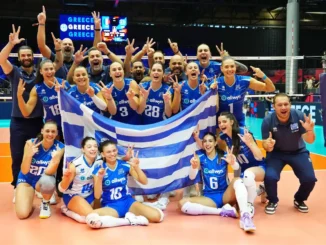
The middle of the bracket is much more interesting. Czechia vs Sweden brings together two teams we identified as dark horses before the tournament. Netherlands vs Slovenia gives Slovenia another opportunity to challenge a higher-ranked opponent after their opening sweep of Germany. France vs Greece pits one of the group stage’s most consistent teams against a Greek side that recovered impressively from an opening defeat.
Belgium vs Germany may be the most revealing test of how seriously we should treat the group stage. Belgium went 5–0 and beat the Netherlands to win Pool C; Germany finished only fourth in Pool A, but their ceiling remains higher than their final position suggests. If Belgium win convincingly, their unbeaten run starts to look like much more than a favorable week in Baku.
France vs Greece — Can Greece Disrupt France’s Momentum?
France enter the knockout stage with one of the cleanest profiles outside the four unbeaten pool winners. They started with three consecutive straight-set victories over Slovakia, Croatia and Montenegro, then became the only team in Pool D to take a set from Italy before beating hosts Sweden 3–1 to secure second place.
That final win over Sweden matters. France did not simply collect points against the lower half of the pool; they proved in a direct positional battle that their early form could hold up against a stronger opponent.
Greece reached this stage through a very different route. They lost their opener to Czechia, then changed the trajectory of their tournament with a five-set win over Ukraine, followed it by beating Bulgaria and Austria, and ultimately finished third in Pool B. Their 10–10 set record reflects the fact that almost nothing came easily.
France should be favored because they have shown greater stability, more controlled victories and a stronger group-stage finish. But Greece have already demonstrated an ability to survive matches that change direction, and that makes them a dangerous opponent if France allow the tie to become emotional or extended.
Serbia vs Croatia — The Biggest Favorite in Brno
Serbia produced one of the two best group-stage records in the tournament: five wins, the maximum 15 points and a 15–1 set record. Czechia were the only team to take a set from them. Austria, Bulgaria, Greece and Ukraine were all swept.
More importantly, Serbia did not look dependent on one narrow path to victory. Tijana Bošković remains the obvious offensive reference point, but Aleksandra Uzelac and the wider rotation repeatedly gave Serbia enough depth to control matches even when the lineup changed.
Croatia’s route was far more dramatic. They lost their first two matches, then produced a reverse sweep against Slovakia, pushed Sweden to five sets and finally beat Montenegro 3–2 to take the fourth qualifying place in Pool D.
That resilience deserves respect, but Serbia represent a completely different level of challenge. Croatia have repeatedly needed long matches and comebacks just to stay alive; Serbia spent most of the pool stage preventing opponents from creating that kind of chaos. On everything shown so far, Serbia should control this tie.
Italy vs Bulgaria — The Tournament Benchmark Meets a Young Challenger
Italy enter the Round of 16 exactly where the pre-tournament picture suggested they would be: as the team everyone else is still trying to measure themselves against. They finished Pool D 5–0 with 15 points and a 15–1 set record, dropping only the second set against France.
The depth that made Italy our pre-tournament favorite has also been visible throughout the competition. Paola Egonu, Ekaterina Antropova, Sarah Fahr and the wider rotation have all had important stretches, allowing Italy to win without needing the same player to carry every match.
Bulgaria have already shown the potential of their young roster. Their opening 3–0 victory over Ukraine was one of the early surprises of the tournament, and they later survived a five-set battle with Austria to secure the final qualifying place in Pool B.
But the inconsistency of a young team also appeared quickly: Bulgaria lost to Greece, Serbia and Czechia. Italy are much less likely than those teams to give them extended openings. Bulgaria can make individual sets uncomfortable if their young attackers find rhythm, but a full-match upset would be one of the biggest surprises of the championship.
Czechia vs Sweden — The Dark-Horse Clash
If one Round of 16 match best represents the tournament’s second tier, it may be this one. Before EuroVolley, we identified both Czechia and Sweden as potential dark horses. Both justified the label, and now one of them is guaranteed a quarterfinal place.
Czechia went 4–1 in Pool B and lost only to Serbia. They handled the matches they were expected to win, beat Ukraine 3–1 when qualification pressure increased, and closed the group stage with a straight-set victory over Bulgaria. They also keep the major advantage of playing in Brno, in front of the same home support that helped build their group-stage momentum.
Sweden’s pool stage was more volatile. They opened with two wins, including a five-set escape against Slovakia, then lost 0–3 to Italy. A five-set win over Croatia secured their position before France beat them 3–1 in the direct fight for second place.
Sweden still possess the most obvious individual weapon in the matchup in Isabelle Haak, and that alone makes the tie difficult to predict. Czechia have been the more stable team; Sweden may have the higher single-player ceiling. This looks like one of the Round of 16 matches most capable of reaching four or five sets.
Netherlands vs Slovenia — Another Dark-Horse Test for Slovenia
The Netherlands finished second in Pool C after a group stage that was successful but rarely straightforward. Romania pushed them to five sets in the opener, Portugal made parts of the Dutch 3–0 win more competitive than expected, and Belgium ultimately beat the Netherlands 3–2 to take first place. Their 3–0 win over Spain and 3–1 victory over Azerbaijan showed a higher ceiling, but consistency remains the question.
Slovenia are exactly the kind of opponent capable of testing that weakness. Their 3–0 win over Germany was one of the biggest results of the first week, and they then took a set from Türkiye. Poland swept them, but even there Slovenia came within two points of the second set before eventually finishing third in Pool A.
The Netherlands remain favorites because of their greater depth and higher overall level. But Slovenia have already shown they are comfortable entering matches in which the opponent is supposed to be better. If the Dutch produce the same uneven stretches they showed earlier in Baku, this tie can become uncomfortable very quickly.
Poland vs Portugal — A Reward for Winning Pool A
Poland earned one of the clearest rewards available in the crossover system. Their 3–2 victory over Türkiye on the final day gave them first place in Pool A and a Round of 16 meeting with fourth-placed Portugal rather than Azerbaijan or the Netherlands.
Poland’s 5–0 record was not built entirely on comfortable matches. Latvia repeatedly forced them to recover from lost advantages, Slovenia pushed the second set to 28–26, and Türkiye dominated significant stretches of the pool decider. Yet Poland found a way to win all five matches, and their ability to survive uncomfortable passages may be especially valuable now that every match is elimination volleyball.
Portugal deserve credit for reaching this stage at all. After starting 0–3, they beat Spain and then Romania in five sets to qualify for the EuroVolley Round of 16 for the first time. They also showed against the Netherlands that they can stay in sets with stronger teams for long periods.
Still, the difference in depth and physical quality should be substantial. Portugal’s achievement was reaching the knockout stage; Poland’s ambition is a medal. Anything other than a Polish victory would be a major upset.
Belgium vs Germany — Can Belgium Turn a Perfect Pool Stage into a Knockout Run?
Belgium are one of the clearest examples of how much the group stage changed the tournament hierarchy. They arrived as the likely No. 2 team in Pool C and left Baku 5–0, with a five-set victory over the Netherlands securing first place.
Their path was not perfect from the start. Spain pushed Belgium to five sets in the opener, but the response was strong: Portugal, Romania and Azerbaijan were all beaten in straight sets before the decisive win over the Dutch.
Germany travelled a very different road. Slovenia swept them on their opening day, Latvia then took a remarkable 25–13 set from them, and losses to Türkiye and Poland left Germany fourth in Pool A. Their two wins came against Latvia and Hungary.
On group-stage evidence, Belgium deserve to be favorites. The caution is that Germany remain a more dangerous fourth seed than their record might suggest. Belgium will need the controlled version of themselves seen in the middle of Pool C, not the team that required a rescue against Spain.
Türkiye vs Azerbaijan — The Hosts Begin a New Route Through the Bracket
Türkiye’s only group-stage defeat came in the match that decided first place. Poland beat them 3–2 in front of almost 16,000 spectators, leaving the defending European champions second in Pool A despite four earlier victories.
That defeat clearly made the Round of 16 less comfortable. Instead of Portugal, Türkiye now face Azerbaijan, a team that won its first three matches in Baku and finished third in Pool C. The hosts of Pool C beat Portugal and Spain, then survived Romania in five sets before stronger tests against Belgium and the Netherlands finally exposed the gap to the top of the group.
In Istanbul, Türkiye should still be clear favorites. Azerbaijan’s best chance is to make the match uncomfortable early and force the home team into the same kind of uneven stretches seen against Poland. But over a full knockout match, Türkiye have more attacking power, more depth and the advantage of playing in front of their own crowd.
The more interesting consequence of the Poland defeat comes after this round. Türkiye now sit in the quarterfinal branch with the winner of Netherlands vs Slovenia and, beyond that, the Serbia/France side of the bracket. Italy are in the opposite semifinal half. If Türkiye and Italy both keep winning, their first possible meeting is now the final.
Round of 16 Matches to Watch
| Angle | Match | Why it matters |
|---|---|---|
| Most balanced | Czechia vs Sweden | Two pre-tournament dark horses; Czech home advantage vs Haak-led Sweden. |
| Upset watch | Netherlands vs Slovenia | The Dutch are favorites, but Slovenia have already swept Germany and troubled Türkiye. |
| Form test | Belgium vs Germany | Unbeaten Pool C winner meets a dangerous fourth seed from the strongest top-heavy pool. |
| Momentum test | France vs Greece | France were highly consistent; Greece have already survived several pressure matches. |
| Heavy favorite | Serbia vs Croatia | Serbia lost only one set in five pool matches. |
| Heavy favorite | Italy vs Bulgaria | The tournament benchmark faces a talented but inconsistent young team. |
| Pool-winner reward | Poland vs Portugal | Poland’s first-place finish produced the clearest mismatch on the Istanbul side. |
| Host spotlight | Türkiye vs Azerbaijan | Türkiye begin knockout volleyball at home after losing the Pool A decider. |
The Bracket Beyond the Round of 16
The Round of 16 is not reseeded. The bracket is fixed, which means every result now has consequences beyond the next match.
| Quarterfinal path | Projected pairing if favorites advance |
|---|---|
| QF1 | Poland vs Belgium |
| QF2 | Türkiye vs Netherlands |
| QF3 | Serbia vs France |
| QF4 | Italy vs Czechia |
Those are projections, not confirmed quarterfinals, but they show the structure clearly. QF1 and QF4 feed into the same semifinal; QF2 and QF3 feed into the other.
That creates one of the most interesting consequences of the Pool A finale. Poland’s victory over Türkiye gave the Poles a more favorable Round of 16 matchup, but it also placed them on Italy’s side of the bracket. If Poland and Italy both win their Round of 16 and quarterfinal matches, they would meet in the semifinal.
Türkiye face the opposite trade-off. Finishing second made their immediate route harder — Azerbaijan first, then potentially the Netherlands — but it moved them away from Italy. If Türkiye and Italy both keep winning, the defending European champions and the pre-tournament favorites cannot meet before the final in Istanbul.
Final Outlook
The group stage created four unbeaten winners, but the Round of 16 is where those records stop protecting anyone. Serbia and Italy enter with the strongest statistical profiles. Poland and Belgium arrive undefeated but already know what five-set pressure feels like. Türkiye have lost once, yet remain one of the teams most capable of winning the tournament.
The most obvious favorites — Serbia, Italy and Poland — should advance if they reproduce their group-stage level. Türkiye should also have too much for Azerbaijan, although the emotional context in Istanbul makes their response to the Poland defeat worth watching.
The other half of the card offers much less certainty. Czechia–Sweden may be the closest matchup, Netherlands–Slovenia carries genuine upset potential, and Belgium–Germany will show whether Belgium’s perfect Pool C run can translate immediately into knockout volleyball. France should have the edge over Greece, but Greece have already shown they are comfortable in matches that refuse to follow the expected script.
From here, one bad set can become one bad match, and one bad match ends the tournament. The time for building position is over. Women’s EuroVolley 2026 is now knockout volleyball.
Editorial Note
This article is a pre-match snapshot of the Women’s EuroVolley 2026 Round of 16. Group-stage records and set records reflect the completed pool phase through 28 August 2026. Match dates and local start times are based on the official CEV schedule available before the knockout stage begins.
Assessments of favorites, upset potential, momentum, bracket difficulty and projected quarterfinals are VolleyCommunity editorial analysis. Projected quarterfinal pairings are shown only to explain the fixed bracket and depend on the listed teams winning their Round of 16 matches.



Be the first to comment