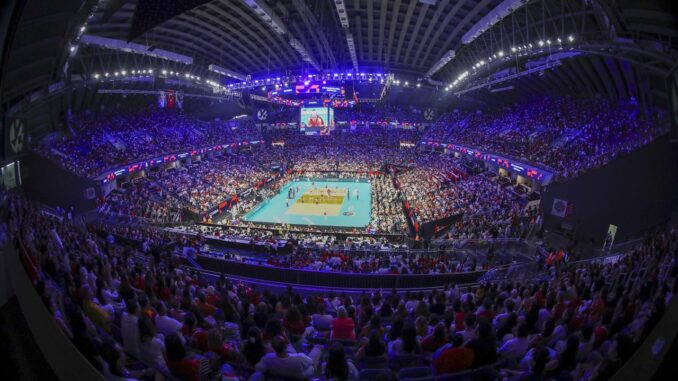

The 60-match pool phase is complete: Italy and Serbia finished with 15–1 set records, Poland and Belgium changed the expected group hierarchy, the dark horses delivered, and Ukraine became the highest-ranked team eliminated before the Round of 16.
GROUP STAGE REVIEW | 21–28 August 2026
Before Women’s EuroVolley 2026 began, the broad power picture looked reasonably clear. Italy were the team everyone had to catch. Türkiye arrived as defending European champions and fresh VNL winners. Poland belonged in the medal conversation but still had something to prove. Serbia’s ranking appeared lower than their championship pedigree suggested, while the Netherlands looked like the natural favorite in Pool C.
Behind them, we identified Sweden, Czechia and Slovenia as the most interesting dark-horse candidates, with France and Belgium as two more teams capable of disrupting the bracket. Eight days and 60 pool matches later, some of those expectations look even stronger — while others have been rewritten.
Italy and Serbia were every bit as convincing as expected. Poland went one step further and won Pool A in Istanbul. Belgium overturned the expected order in Pool C by beating the higher-ranked Netherlands. Slovenia justified their dark-horse label with an opening sweep of Germany, Czechia used home court to finish second, and France emerged from Pool D looking much stronger than their recent VNL campaign suggested.
But the group stage also produced casualties. Ukraine, ranked No. 18 before the tournament, finished fifth in Pool B. Romania collected more standings points than Portugal but still missed the knockout stage because Portugal won more matches. And the Netherlands, although still very much alive as a contender, did not secure the first-place finish that looked realistic before the tournament.
For the expectations we set before first serve, revisit our Women’s EuroVolley 2026 Tournament Preview. For the points system, tiebreakers and knockout crossover, see our Women’s EuroVolley 2026 Format & Rules guide.
Group Stage at a Glance
| Category | Group-stage result |
|---|---|
| Matches played | 60 |
| Teams | 24 |
| Teams advancing | 16 |
| Teams eliminated | 8 |
| Unbeaten pool winners | Poland, Serbia, Belgium, Italy |
| Maximum 15 points | Serbia, Italy |
| Best set records | Serbia 15–1; Italy 15–1 |
| Highest-ranked eliminated team | Ukraine — pre-tournament FIVB No. 18 |
| Lowest-ranked qualifier | Azerbaijan — pre-tournament FIVB No. 49 |

Pool A — Poland Take First Place, Slovenia Validate the Dark-Horse Label
| Pos. | Team | W–L | Sets | Points |
|---|---|---|---|---|
| 1 | Poland | 5–0 | 15–3 | 14 |
| 2 | Türkiye | 4–1 | 14–5 | 13 |
| 3 | Slovenia | 3–2 | 10–8 | 8 |
| 4 | Germany | 2–3 | 7–10 | 6 |
| 5 | Latvia | 1–4 | 7–14 | 3 |
| 6 | Hungary | 0–5 | 2–15 | 1 |
Pool A looked like the strongest group at the top before the tournament, and that assessment survived the week. Türkiye and Poland were both genuine medal candidates, Germany entered at No. 12 in the world, and Slovenia arrived with enough momentum to make the order unpredictable.
The biggest change was at the very top. Poland completed a 5–0 pool campaign by beating Türkiye 3–2 in Istanbul on the final day. The hosts dominated the first and fourth sets, but Poland took the second and third and then controlled the tie-break 15–10. CEV noted that it was Poland’s first EuroVolley victory over Türkiye since the 2003 gold-medal match.
Poland’s perfect win–loss record should not be confused with five easy matches. Latvia repeatedly caused problems in a 3–1 defeat, Slovenia pushed the second set to 28–26, and Türkiye clearly had the level to win the pool decider. What Poland did consistently was find solutions when sets became uncomfortable.
Türkiye still leave Pool A looking like a title contender. Four wins, 13 points and a 14–5 set record are hardly signs of crisis. But losing first place matters because the A–C crossover now sends them toward Azerbaijan rather than fourth-placed Portugal.
Slovenia may be the most satisfying confirmation of our pre-tournament dark-horse call. We asked whether they could steal a result from one of the three higher-ranked teams in the group. They did much more than steal one: their 3–0 victory over Germany became one of the defining early upsets, and they also took a set from Türkiye before finishing third.
Germany recovered enough to qualify, but fourth place is clearly below their pre-tournament position in the hierarchy. Latvia also deserve more credit than a 1–4 record suggests: they took sets from Germany and Poland, pushed Slovenia to five, and finally beat Hungary in a tie-break.
Pool B — Serbia Dominate, Czechia Deliver at Home and Ukraine Fall Short
| Pos. | Team | W–L | Sets | Points |
|---|---|---|---|---|
| 1 | Serbia | 5–0 | 15–1 | 15 |
| 2 | Czechia | 4–1 | 13–5 | 12 |
| 3 | Greece | 3–2 | 10–10 | 8 |
| 4 | Bulgaria | 2–3 | 7–11 | 5 |
| 5 | Ukraine | 1–4 | 6–12 | 4 |
| 6 | Austria | 0–5 | 3–15 | 1 |
Our tournament preview called Pool B the most balanced group from first to fifth. That proved accurate — but not in the way Ukraine would have wanted.
Serbia settled the argument at the top almost immediately. Their No. 10 world ranking always looked modest next to a roster built around Tijana Bošković, Maja Ognjenović, Aleksandra Uzelac and a core with enormous championship experience. Five matches later, Serbia are 5–0 with the maximum 15 points and a 15–1 set record.
The only set Serbia lost in the entire pool came against Czechia. Every other opponent was swept. That is exactly what we meant before the tournament when we wrote that Serbia’s ranking understated their pedigree: the question was which version of Serbia would arrive in Brno, and the group stage delivered the dangerous one.
Czechia also justified the optimism around them. The hosts beat Greece, Austria, Ukraine and Bulgaria, losing only to Serbia. Their second-place finish gives them another match in Brno in the Round of 16 — precisely the home-court runway we identified as potentially valuable before first serve.
Greece produced one of the best recoveries of the group phase. They lost the opener to Czechia, then beat Ukraine in five sets, Bulgaria in four and Austria in four before Serbia stopped the run. Three wins were enough for third place and a deserved knockout ticket.
Bulgaria took the final qualifying position, and their opening-day 3–0 victory over Ukraine ultimately became one of the most important results in the pool. They also produced a reverse sweep against Austria after falling 0–2 behind.
For Ukraine, the group stage is the biggest disappointment relative to the pre-tournament hierarchy. They entered at No. 18 — above Greece and Bulgaria — but lost to both, then fell to Czechia and Serbia. Their only victory came against Austria. One win, four defeats and fifth place make Ukraine the highest-ranked team eliminated in the group stage.
Pool C — Belgium Break the Expected Hierarchy
| Pos. | Team | W–L | Sets | Points |
|---|---|---|---|---|
| 1 | Belgium | 5–0 | 15–4 | 13 |
| 2 | Netherlands | 4–1 | 14–6 | 12 |
| 3 | Azerbaijan | 3–2 | 10–9 | 8 |
| 4 | Portugal | 2–3 | 7–12 | 5 |
| 5 | Romania | 1–4 | 9–12 | 6 |
| 6 | Spain | 0–5 | 3–15 | 1 |
No group changed more from the pre-tournament picture than Pool C. We called it the pool with the clearest ranking hierarchy: the Netherlands entered at No. 8 in the world, Belgium at No. 16, while Azerbaijan and Portugal were down at No. 49 and No. 48 respectively.
The final table looks very different. Belgium won all five matches. Their tournament started nervously with a 3–2 escape against Spain, but the level steadily improved. They swept Portugal, Romania and Azerbaijan before beating the Netherlands 3–2 in the match that decided first place.
The Netherlands did not collapse — four victories and 12 points are still a strong return — but the warning signs appeared early. Romania pushed them to five sets in the opener, Portugal made parts of their 3–0 defeat uncomfortable, and Belgium eventually did enough to take the head-to-head and the pool.
Azerbaijan may be the biggest positive surprise relative to ranking. The hosts entered at No. 49, the second-lowest-ranked team in the tournament, yet opened with three consecutive wins against Portugal, Spain and Romania. Losses to Belgium and the Netherlands then showed the gap to Pool C’s strongest teams, but third place remains a major success.
Portugal produced an even more unexpected qualification story in terms of the table. After starting 0–3, they beat Spain and then defeated Romania 3–2 in the direct battle for the final knockout ticket.
The final standings also provide the clearest practical example of the tournament’s tiebreak rules. Romania finished with six standings points, one more than Portugal’s five, but Portugal ranked fourth because they had two victories to Romania’s one. Number of wins comes before standings points in the CEV ranking criteria — a detail explained in our Format & Rules guide.
Romania therefore leave the tournament with a strange record: they pushed the Netherlands, Azerbaijan and Portugal to five sets, collected more points than the team that qualified above them, yet won only once.
Pool D — Italy Confirm Their Status, France Rise and Sweden Stay Dangerous
| Pos. | Team | W–L | Sets | Points |
|---|---|---|---|---|
| 1 | Italy | 5–0 | 15–1 | 15 |
| 2 | France | 4–1 | 13–4 | 12 |
| 3 | Sweden | 3–2 | 10–10 | 7 |
| 4 | Croatia | 2–3 | 8–13 | 5 |
| 5 | Slovakia | 1–4 | 7–12 | 5 |
| 6 | Montenegro | 0–5 | 2–15 | 1 |
If any pool most closely followed the basic pre-tournament hierarchy, it was Pool D. Italy were our strongest overall favorite before first serve, and nothing in Gothenburg changed that assessment.
Italy won all five matches, collected the maximum 15 points and dropped only one set — against France. Their group-stage dominance was not built around one fixed lineup or one scorer. Paola Egonu, Ekaterina Antropova, Sarah Fahr and the wider rotation all contributed, and the depth we identified as Italy’s biggest advantage was visible throughout the week.
The more revealing question was what would happen behind them. France provided the clearest answer. Their 2026 VNL result had created uncertainty, but three consecutive straight-set victories over Slovakia, Croatia and Montenegro immediately put them in control. Italy stopped that perfect run 3–1, yet France responded by beating Sweden 3–1 in the direct fight for second place.
That makes France one of the strongest positive stories from the first phase. Sweden did not quite reach the second place we suggested was possible, but the dark-horse logic still holds. Three victories, home momentum and Isabelle Haak’s scoring make them a dangerous third seed rather than an ordinary one.
Croatia reached the Round of 16 through resilience more than consistency. Their reverse sweep against Slovakia rescued the campaign, and a later five-set win over Montenegro provided the second victory they needed. Slovakia actually finished with the same five standings points, but Croatia ranked fourth because they had two wins to Slovakia’s one.
Four Unbeaten Pool Winners — but Two Stand Above the Rest
| Team | W–L | Points | Sets | Pool finish |
|---|---|---|---|---|
| Serbia | 5–0 | 15 | 15–1 | 1st Pool B |
| Italy | 5–0 | 15 | 15–1 | 1st Pool D |
| Poland | 5–0 | 14 | 15–3 | 1st Pool A |
| Belgium | 5–0 | 13 | 15–4 | 1st Pool C |
All four pools were won by unbeaten teams, but the routes were different. Italy and Serbia are the statistical leaders: five wins, the maximum 15 points and only one lost set each. Poland were equally perfect in wins and losses but needed a five-set victory over Türkiye, leaving them one point short of the maximum. Belgium’s route was the most dramatic, with five-set victories against Spain and the Netherlands reducing their total to 13 points.
The distinction matters for evaluating the group stage, but the larger message is even clearer: every pool winner survived five matches without a defeat.
How the Pre-Tournament Preview Held Up
Several of the central calls from our original preview now look particularly strong. Italy were labelled the team to beat, and they responded with a 5–0, 15–1 group stage. We argued that Serbia’s ranking understated their championship pedigree; their identical 15–1 set record is perhaps the clearest confirmation anywhere in the tournament.
Our three primary dark horses — Sweden, Czechia and Slovenia — all reached the Round of 16. Czechia finished second, while Slovenia and Sweden finished third. Slovenia also delivered exactly the kind of result we said could change Pool A by sweeping Germany.
We also singled out France and Belgium as two additional teams capable of punishing stronger opponents. France finished second behind Italy; Belgium went further and won Pool C undefeated. And the warning that pool position would matter has already become reality, because the final order has created very different Round of 16 paths.
Where the Group Stage Rewrote the Preview
The biggest change came in Pool C. The Netherlands were the natural first-place favorite based on ranking, but Belgium beat them head-to-head and took the group. Poland also moved above the initial hierarchy by defeating Türkiye in Istanbul to win Pool A.
Azerbaijan dramatically outperformed their No. 49 ranking to finish third, while Portugal recovered from three opening defeats to qualify fourth. In Pool B, the competitive depth we expected became costly for Ukraine: Greece and Bulgaria did not merely challenge for qualification, they both finished above the world No. 18 team and eliminated them.
The rankings gave us a useful starting point. The group stage reminded us why they were never supposed to be the final answer.
Round of 16 Matchups
The pool phase is over, and the final positions now feed directly into the knockout crossover. The Round of 16 is split between Brno and Istanbul. All times below are local to the host city.
| Date | Local time | Host city | Round of 16 matchup | Crossover |
|---|---|---|---|---|
| 30 Aug | 16:00 | Brno | France vs Greece | D2 vs B3 |
| 30 Aug | 19:00 | Brno | Serbia vs Croatia | B1 vs D4 |
| 31 Aug | 16:00 | Brno | Italy vs Bulgaria | D1 vs B4 |
| 31 Aug | 19:00 | Brno | Czechia vs Sweden | B2 vs D3 |
| 31 Aug | 16:00 | Istanbul | Netherlands vs Slovenia | C2 vs A3 |
| 31 Aug | 19:00 | Istanbul | Poland vs Portugal | A1 vs C4 |
| 1 Sep | 16:00 | Istanbul | Belgium vs Germany | C1 vs A4 |
| 1 Sep | 19:00 | Istanbul | Türkiye vs Azerbaijan | A2 vs C3 |
The schedule immediately shows why winning a pool mattered. Poland receive fourth-placed Portugal, while Italy and Serbia also begin the knockout phase against fourth-place finishers. Belgium’s unexpected first place in Pool C gives them Germany rather than Slovenia, while the Netherlands now face one of the group stage’s most convincing dark horses.
There are also two especially intriguing second-versus-third matchups. Czechia vs Sweden brings together two teams we identified as dark-horse candidates before the tournament, while Netherlands vs Slovenia gives Slovenia another opportunity to test whether their breakthrough group-stage performances can translate into knockout volleyball.
France vs Greece may be another useful measure of how much the group stage changed perceptions. France were one of the most consistent teams outside the obvious favorites, while Greece recovered from an opening defeat to win three of their next four. Türkiye vs Azerbaijan, meanwhile, puts the defending European champions against one of the tournament’s biggest ranking overachievers.
Final Takeaway
Before Women’s EuroVolley 2026 began, the field looked deep enough that rankings alone were unlikely to tell the whole story. The group stage confirmed that.
Italy still look like the tournament benchmark. Serbia have re-established themselves as a team whose championship pedigree matters more than their No. 10 ranking. Poland proved they belong in the highest tier by taking first place from Türkiye, while Belgium transformed themselves from a dangerous second-tier team into an unbeaten pool winner.
The dark horses largely delivered too. Czechia have home court and a second-place finish. Slovenia changed Pool A with their victory over Germany. Sweden remain dangerous despite finishing third. France may have exceeded all three in terms of consistency, losing only to Italy before beating Sweden for second place.
At the other end, Ukraine became the clearest example of how quickly a difficult group can punish missed opportunities. Romania showed that competitive matches do not automatically produce qualification. Spain, Hungary, Austria and Montenegro never found enough consistency to change their position.
The pool phase has reduced 24 teams to 16. More importantly, it has changed the questions. Before the tournament we asked whether Italy were still the team to beat, whether Serbia could rediscover their championship level, whether the dark horses were real and how much group position would matter. Most of those questions now have answers. The Round of 16 will tell us which of those answers survive knockout volleyball.
Editorial Note
This review compares the final Women’s EuroVolley 2026 group-stage results with VolleyCommunity’s pre-tournament analysis published before the opening matches. Pre-tournament FIVB rankings refer to the snapshot used in our Tournament Preview, with rankings, form and roster information checked through 19 August 2026. Final standings, win–loss records and set records reflect the completed pool phase through 28 August 2026.
Interpretive comments about expectations, overperformance, underperformance, momentum and team hierarchy are VolleyCommunity editorial analysis rather than official CEV assessments.

Be the first to comment