
How the 24-team European Championship works: four six-team pools, match points, tiebreakers, Round of 16 crossovers and the fixed road to the final in Milan.
FORMAT & RULES GUIDE | Updated 29 August 2026
Men’s EuroVolley 2026 will bring together 24 national teams across Italy, Bulgaria, Finland and Romania from 9 to 26 September. The championship opens with four pools of six teams, and every nation plays five group-stage matches before the field is reduced to 16 for the knockout rounds.
The basic qualification rule is simple: the top four teams from each pool advance to the Round of 16, while the bottom two are eliminated. From that point onward, every match is single elimination, with the two semifinal losers meeting once more for the bronze medal.
The details matter, however. Pool standings are ranked first by matches won rather than standings points, and the knockout bracket is not reseeded. Pools A and C cross in Turin, while Pools B and D cross in Sofia, so a team’s final pool position determines both its Round of 16 opponent and its potential quarterfinal route.
This guide explains the full Men’s EuroVolley 2026 format, including the groups, ranking-point system, tiebreakers, official knockout crossover, host venues and qualification stakes. For a comparison with the women’s championship, see our Women’s EuroVolley 2026 Format & Rules guide.
Men’s EuroVolley 2026 at a Glance
| Category | 2026 format |
|---|---|
| Dates | 9-26 September 2026 |
| Host countries | Italy, Bulgaria, Finland, Romania |
| Teams | 24 |
| Pools | 4 pools of 6 teams |
| Pool matches per team | 5 |
| Teams advancing from each pool | Top 4 |
| Teams in Round of 16 | 16 |
| Knockout format | Single elimination |
| Total matches | 76 |
| Maximum matches for one team | 9 |
| Round of 16 / quarterfinal hubs | Turin and Sofia |
| Semifinals and medal matches | Milan, Italy |
| LA28 stake | European champion earns an Olympic quota place |
How the Men’s EuroVolley 2026 Format Works
The tournament has two main phases: a 60-match pool phase followed by a 16-match knockout phase. There is no second group stage and no overall 1-to-16 reseeding after the pools.
Each team plays every other team in its pool once. After five matches per team, the first four positions qualify for the Round of 16. Final pool position then places each qualifier directly into a predetermined knockout slot.
That makes group position more important than simply finishing inside the top four. A pool winner receives a fourth-place team from the crossover pool in the Round of 16, while a fourth-place qualifier must face the opposite pool winner.
Group Stage – Four Pools of Six Teams
| Pool | Host | Teams |
|---|---|---|
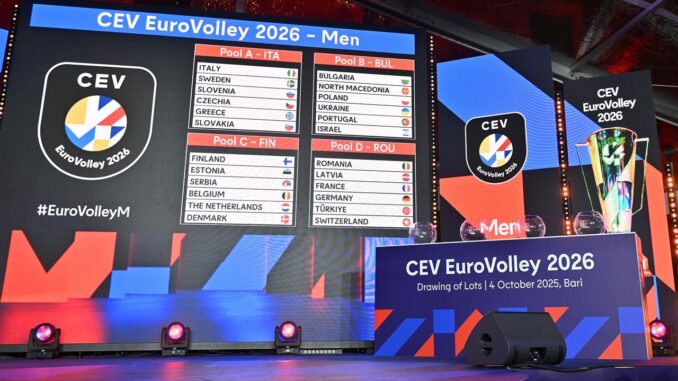
| A | Italy | Italy, Sweden, Slovenia, Czechia, Greece, Slovakia |
| B | Sofia, Bulgaria | Bulgaria, North Macedonia, Poland, Ukraine, Portugal, Israel |
| C | Tampere, Finland | Finland, Estonia, Serbia, Belgium, Netherlands, Denmark |
| D | Cluj-Napoca, Romania | Romania, Latvia, France, Germany, Türkiye, Switzerland |
The four pools were confirmed by the official CEV draw. Every pool contains 15 matches, giving the group stage 60 matches in total.
Pool A has a slightly different travel pattern from the other groups. Italy’s opening match against Sweden is scheduled in Naples on 10 September, while the rest of Pool A is played in Modena. Pools B, C and D are based entirely in Sofia, Tampere and Cluj-Napoca respectively during the group stage.
How Teams Qualify for the Round of 16
The top four teams in each pool advance. Teams finishing fifth and sixth are eliminated, reducing the field from 24 to 16.
| Pool finish | Outcome |
|---|---|
| 1st | Round of 16 – faces 4th from crossover pool |
| 2nd | Round of 16 – faces 3rd from crossover pool |
| 3rd | Round of 16 – faces 2nd from crossover pool |
| 4th | Round of 16 – faces 1st from crossover pool |
| 5th | Eliminated |
| 6th | Eliminated |
With four of six teams progressing, one isolated defeat does not usually end a campaign. But because the bracket is fixed, every position can materially change the difficulty of the next round.
EuroVolley 2026 Match Points System
CEV uses the standard volleyball match-points system during round-robin play.
| Match result | Winner | Loser |
|---|---|---|
| 3-0 or 3-1 | 3 points | 0 points |
| 3-2 | 2 points | 1 point |
A five-set defeat therefore still earns one ranking point. A team losing 0-3 or 1-3 receives none.
The important distinction is that these ranking points are not the first criterion in the table. CEV first compares the number of matches won.
How Pool Standings and Tiebreakers Work
Under the current CEV Volleyball Competitions Regulations, teams in a round-robin pool are separated in the following order:
| Priority | Ranking criterion |
|---|---|
| 1 | Matches won |
| 2 | Ranking points |
| 3 | Set quotient |
| 4 | Set-points quotient |
| 5 | Head-to-head result(s) |
1. Matches Won
The team with more victories ranks higher. A team with four wins therefore finishes above a team with three wins even if unusual five-set results give the three-win team a similar or higher-looking points total.
2. Ranking Points
If two or more teams have the same number of victories, CEV compares the ranking points earned from match results: three for a 3-0 or 3-1 win, two for a 3-2 win and one for a 2-3 loss.
3. Set Quotient
If the tie remains, total sets won are divided by total sets lost. The higher quotient ranks first.
4. Set-Points Quotient
If teams remain tied, total rally points scored are divided by total rally points conceded across the competition. Again, the higher quotient ranks first.
5. Head-to-Head
If the previous criteria still do not separate the tied teams, CEV uses the result or results of the matches played between those teams.
The Knockout Bracket – No Reseeding
The Round of 16 does not create a new overall ranking of the 16 qualifiers. Instead, the pools are paired in advance: A crosses with C, and B crosses with D.
This also divides the first two knockout rounds geographically. The A/C section is played in Turin, Italy, while the B/D section is played in Sofia, Bulgaria. The surviving teams from the two sides of the bracket meet only in the semifinals in Milan.
Round of 16 Crossovers
| Match | Round of 16 pairing | Host |
|---|---|---|
| EF1 | A1 vs C4 | Turin |
| EF2 | C1 vs A4 | Turin |
| EF3 | A2 vs C3 | Turin |
| EF4 | C2 vs A3 | Turin |
| EF5 | B1 vs D4 | Sofia |
| EF6 | D1 vs B4 | Sofia |
| EF7 | B2 vs D3 | Sofia |
| EF8 | D2 vs B3 | Sofia |
The practical rule is straightforward: first plays fourth and second plays third from the paired pool. A Pool B qualifier, for example, can only face a Pool D team in the Round of 16. That is especially relevant for Poland, Ukraine and Bulgaria because Pool D contains France, Germany and Türkiye.
Quarterfinal Path
Round of 16 winners are not reseeded. Their quarterfinal matchups are already fixed in the official bracket.
| Quarterfinal | Pairing | Host |
|---|---|---|
| QF1 | Winner EF1 vs Winner EF4 | Turin |
| QF2 | Winner EF2 vs Winner EF3 | Turin |
| QF3 | Winner EF5 vs Winner EF8 | Sofia |
| QF4 | Winner EF6 vs Winner EF7 | Sofia |
The A/C qualifiers therefore remain on the Italian side through the quarterfinals, while the B/D qualifiers stay on the Bulgarian side. This fixed route allows potential quarterfinal paths to be calculated as soon as the pool standings are known.
Semifinals and Medal Matches
| Stage | Pairing / format | Venue |
|---|---|---|
| SF1 | Winner QF1 vs Winner QF4 | Milan |
| SF2 | Winner QF2 vs Winner QF3 | Milan |
| Bronze medal match | Semifinal losers | Milan |
| Gold medal match | Semifinal winners | Milan |
The bracket’s two geographical halves finally cross in the semifinals. Both semifinals are scheduled for 25 September in Milan, followed by the bronze and gold medal matches on 26 September.
A team that reaches the semifinal weekend plays nine matches in total: five pool matches, a Round of 16 match, a quarterfinal, a semifinal and then either the bronze or gold medal match.
Men’s EuroVolley 2026 Tournament Timeline
| Stage | Dates |
|---|---|
| Pool phase | 9-18 September 2026 |
| Round of 16 | 19-21 September 2026 |
| Quarterfinals | 22-23 September 2026 |
| Travel / rest day | 24 September 2026 |
| Semifinals | 25 September 2026 |
| Bronze and gold medal matches | 26 September 2026 |
The four pools do not all begin or finish on the same day. CEV also reserves the right to schedule knockout matches according to international broadcast programming after the pool phase, so exact match order can be adjusted while the bracket structure remains fixed.
Host Cities and Venues
| Host city | Venue | Tournament role |
|---|---|---|
| Naples | Piazza del Plebiscito | Pool A opening match |
| Modena | PalaPanini | Remaining Pool A matches |
| Turin | PalaVela | 4 Round of 16 + 2 quarterfinals |
| Milan | Unipol Forum | Semifinals + bronze + final |
| Sofia | Arena 8888 | Pool B + 4 Round of 16 + 2 quarterfinals |
| Tampere | Nokia Arena | Pool C |
| Cluj-Napoca | Polyvalent Hall BT Arena | Pool D |
The current venue plan and match distribution are listed on the official CEV host-venues page. Italy stages 25 matches overall, Sofia stages 21, and Tampere and Cluj-Napoca host 15 each.
How the 24 Teams Qualified
The final field consists of 12 automatic qualifiers and 12 teams that earned their places through the EuroVolley qualifiers.
Automatic Qualification
| Route | Teams |
|---|---|
| Co-hosts | Italy, Bulgaria, Finland, Romania |
| EuroVolley 2023 final standing | Poland, Slovenia, France, Netherlands, Serbia, Ukraine, Germany, Portugal |
CEV confirmed that the four co-hosts qualified automatically alongside the eight best eligible teams from the 2023 final standing. Poland enter 2026 as the defending European champions. See the CEV host announcement for the automatic qualification framework.
EuroVolley Qualifiers
| Qualification route | Teams |
|---|---|
| Seven pool winners | Denmark, Belgium, Czechia, Estonia, Switzerland, Greece, Slovakia |
| Five best runners-up | Latvia, Türkiye, Israel, Sweden, North Macedonia |
The final qualifying places were confirmed after the seven groups were completed. North Macedonia took the last best-runner-up place ahead of Austria on the relevant quotient criteria. CEV published the final qualification update after the decisive matches.
Why EuroVolley 2026 Matters for LA28 and the 2027 World Cup
This edition carries qualification consequences beyond the European title. Under the confirmed LA28 system, the top-ranked team at each 2026 continental championship earns one Olympic quota place. For Europe, that makes the Men’s EuroVolley 2026 champion the continent’s first direct qualifier for the Los Angeles 2028 men’s volleyball tournament.
The final standings also feed into qualification for the 2027 FIVB Volleyball World Cup. The three highest-placed eligible teams from each continental championship qualify for the World Cup, and every match contributes to the FIVB World Ranking.
These pathways were confirmed by the FIVB LA28 qualification system and the FIVB continental-championship qualification update.
How EuroVolley Differs from the VNL
| Feature | Men’s EuroVolley 2026 | VNL |
|---|---|---|
| Competition type | European continental championship | Annual global competition |
| Teams | 24 | 18 |
| Initial phase | 4 separate pools | One combined standings table |
| Matches before knockout | 5 per team | 12 per team |
| Knockout participants | 16 | 8 |
| Qualification to knockout | Top 4 from each pool | Final standings / Finals host rules |
| Bracket entry | Fixed by pool position | Seeded Finals bracket |
EuroVolley reaches elimination volleyball much faster. Five pool matches determine both qualification and bracket position. For the annual global competition, see our VNL Format & Rules guide.
Frequently Asked Questions
How many teams compete in Men’s EuroVolley 2026?
Twenty-four national teams compete in the final tournament.
How many pools are there?
There are four pools – A, B, C and D – with six teams in each.
How many pool matches does each team play?
Five. Every team faces each of the other five teams in its pool once.
How many teams qualify from each pool?
The top four teams advance to the Round of 16. Fifth and sixth place are eliminated.
What is the first ranking criterion?
Matches won. Ranking points are considered only when teams are tied on victories.
How are match points awarded?
A 3-0 or 3-1 win is worth three points. A 3-2 win is worth two, while the five-set loser receives one. A 0-3 or 1-3 defeat is worth zero.
Which pools cross in the Round of 16?
Pools A and C cross in Turin. Pools B and D cross in Sofia.
Is the knockout bracket reseeded?
No. Round of 16, quarterfinal and semifinal paths are predetermined by the official bracket.
Where are the semifinals and final played?
At the Unipol Forum in Milan, Italy.
How many matches are played in the tournament?
Seventy-six: 60 in the pool phase and 16 in the knockout phase.
What is the maximum number of matches one team can play?
Nine. Every semifinalist completes the tournament with either the bronze medal match or the gold medal match.
Does the champion qualify for LA28?
Yes. The top-ranked team at the 2026 European Championship earns Europe’s direct quota place for the Los Angeles 2028 Olympic Games.
Why is EuroVolley 2026 three years after EuroVolley 2023?
The international volleyball calendar was reorganised for the 2025-2028 cycle. Continental championships moved to 2026 and now form part of the qualification pathway toward LA28 and the 2027 World Cup.
Final Takeaway
Men’s EuroVolley 2026 starts with a forgiving-looking qualification line – four teams advance from every six-team pool – but the format makes finishing position highly significant. First place brings a fourth-place opponent, second meets third, and those positions feed directly into a fixed bracket with no later reseeding.
For Pools A and C, the knockout road runs through Turin. For Pools B and D, it runs through Sofia. Only after the quarterfinals do the two sides converge in Milan for the semifinals and medal matches.
That structure makes the pool phase more than a race to avoid fifth place. Every win, every five-set point and every tiebreak criterion can shape the route to the title – and in 2026, the title itself also carries a direct Olympic reward for LA28.
Editorial Note
This guide reflects the Men’s EuroVolley 2026 competition structure, pools, host venues and official match calendar available through 29 August 2026. Ranking and tiebreak procedures follow the current CEV Volleyball Competitions Regulations. Olympic and 2027 World Cup qualification information follows the FIVB systems and updates published for the 2026 continental championships.
CEV reserves the right to schedule knockout matches according to international broadcast programming after the pool phase. Exact match times or order may therefore change without altering the crossover pairings or bracket structure described above.

1 Trackback / Pingback